Feeds:
Posts
Comments

When I moved out for the first time after college and in with a new roommate, he had a premium cable package including HBO (dude was a huge Sopranos fan). I was worried that I’d be asked to pay for half of something I didn’t really want, but soon after I found that HBO had enough quality original programming and movies to warrant the cost of half a subscription. But for the few weeks after I moved in, I didn’t yet have a cable box in my bedroom until the cable guy could come to install the additional box. So when my roommate was home and watching his beloved New Jersey Devils hockey games, which I had no interest in, I was relegated to watching Scrubs DVDs for hours at a time. This was the closest I’d come to “cord cutting,” i.e. canceling one’s cable subscription.

Held Hostage by The Cable Company
As I recently wrote in a blog post called “Time Warner Cable Sucks—But You Already Knew That (And So Do They),” I believe Time Warner Cable, well, sucks. Their service is spotty, with rarely a month going by without some sort of interruption, usually a frozen cable box and an ambiguous “Please Wait…” message when I’m trying to use their on-demand services. Each time I call the response is “try restarting your cable box,” which usually fixes the issue. But when it happens at an important time (important relative to TV, not to, you know, life), such as during one of your favorite shows’ season finales, it’s fairly inconvenient to miss the last fifteen minutes of the episode while you’re waiting for the box to turn back on. (After years and years of calling, only recently did a rep tell me that if I turn my cable box off at night, it gives the box a chance to receive updates from the mother ship, which would reduce the freezing incidents.)

During the eighteen months in which I worked in market research, specializing in customer loyalty, I learned the term “hostage,” which refers to someone who is only loyal to a brand because they don’t have many other options, but are dissatisfied with the brand as a whole. Since my days as a Cablevision subscriber on Long Island and in New Jersey, through my current period as a Time Warner Cable customer, I’ve absolutely felt like a hostage of The Cable Company, whichever one it is.

I’m also regularly teased by the onslaught of Verizon FIOS commercials, which make their service sound like the best cable and internet provider in the world—and for which I’m not geographically eligible. The satellite companies also seem to offer a better package than The Cable Company, but I’m not willing to lay out the non-refundable equipment fees for a service I’m not certain I will want to keep for at least two or three years.

So for years I’ve complained often about The Cable Company, but never actually canceled my cable. But this week I came extremely close.

So You’ve Decided to Cut Cable
I’d been discussing my cable woes with two coworkers who are bonafide cord cutters. They both watch all their favorite TV content without a cable subscription.

Remember these?

Remember these?

For the four major broadcast networks—that’s ABC, CBS, FOX and NBC—I could get those “over the air,” though I might need to purchase a separate piece of equipment, a tuner, for around $50. Ironically, despite all the technological advances of TV, I’d be reverting all the way back to some version of “rabbit ears” and praying for decent reception.

For my favorite cable shows, I could look online for recent episodes; I could try dubious online streaming sites; or I could purchase or rent the episodes from iTunes, Amazon Prime Video or Google Play for about $2 an episode.  If I was less concerned with the timeliness (and selection) of the TV I watch, I could subscribe to Netflix or Hulu Plus for about $8 a month.

But I’d effectively lose most of the Yankees’ games, besides the ones that air on local broadcast TV once a week or so, or a nationally televised Saturday games on Fox. I wouldn’t be able to access any of their games using the MLB package online, as I would be considered an in-market subscriber. (Strangely, I could watch Yankees through the very same service if I moved out of the New York market.)

As for HBO, well, I pretty much lose any (legal) access to their program. Again, I could buy individual digital episodes (or DVDs) of HBO shows, but that’s a costly venture. Amazon Prime Video offers season passes, but at $45 for 12 episodes of a given series, it doesn’t seem to add up. That means that like millions of other Game of Thrones fans, I might be tempted to watch the series through other, slightly less legal methods.

What Can I Do to Put You in a Cable Box Today?
Still uncertain about what I should do, but with my cord-cutting coworkers’ voices still ringing in my head, I called Time Warner Cable this past Monday night. I explained to a rep from the cancellations department that I was seriously considering canceling my cable subscription (which was true), and asked whether there was anything they could do to lower my bill significantly. If they couldn’t, I would start making preparations to cancel by the weekend.

After a few minutes on hold, my rep informed me that she could lower my bill by $25 a month based on a “promotional offer,” and I would still be able to keep all the channels I was already getting. Leading up to the call, I had been thinking about what sort of offer they would need to make to keep my business, and this was pretty close.

I thought it over for a minute, and decided to take the deal.

I’m probably still paying a little more per month for cable than I would pay if I pieced together all my same preferred TV content online as a cord cutter. But the convenience of having my content already sent to my TV screen through my cable box—assuming the cable box is not frozen—is baked into that high monthly bill. To me it’s not worth the leg work just to save $10 or $20 a month by the time I factor in the costs of online content subscription services like Netflix or buying episodes à la carte from iTunes.

But more than the specific programming set aside time for, it’s always nice to be able to flop onto the couch and mindlessly watch a rerun of Duck Dynasty or Seinfeld without having to actively select exactly what I’m in the mood for. For example, I don’t own a DVD of 8 Mile, but I get disproportionately excited when I catch the last fifteen minutes—the rap battle!—on MTV. (“This guy’s real name is CLARENCE!”)

Through this exploration of my TV content options, I can hardly call myself a “hostage” to The Cable Company anymore, since I’ve actively made the choice to keep purchasing their services month after month, year after year. They know this and I know this. For now, or at least until my “promotional offer” expires and my bill goes back up, I guess we’ll call it a stalemate.

From the time I moved to the post-college paradise that is Hoboken, New Jersey, in 2006, until the day I moved out of the oft-flooded mile-square city in 2008, I’d never heard of Buddy Valastro.

I also didn’t know much about his bakery, Carlo’s Bake Shop, though I’d walked past it hundreds of times on Hoboken’s main drag, Washington Street. With its picturesque storefront window and classic gold on maroon signage, Carlo’s always felt very upscale from the outside; it was the kind of place that someone like me, who routinely ate mac and cheese with cut-up hot dogs for dinner, should walk right past without a second glance.

But what I also didn’t know was this: that behind that fancy storefront window I’d been so intimated by, Buddy Valastro was busy building an empire.

Having his cake…
It was my fiancée who introduced me to Valastro’s cable reality show, Cake Boss, in 2009. The show is about a family-owned bakery in Hoboken starring the son of the bakery’s late owner, Bartolo “Buddy” Valastro Sr.

Buddy Jr.’s supporting cast is made up of the other people who work in the bakery, many of them related to him by blood or marriage. They play innocuous pranks on each other, bicker like family often does, and produce elaborate works of edible art in each episode.

Even since the TLC show debuted, I would guess the bakery still sells more pastries like cannoli, cupcakes, and lobster tails than it does its $25,000 masterpieces. Yet it’s the higher profile clients and cakes that the show centers around; they represent a new challenge to Buddy and his bakers in each episode.

CB_roulette

Always bet on red…velvet! Am I right??? (Photo credit: http://www.mediaglare.wordpress.com)

Cake Boss, which begun its sixth season this past Memorial Day, is a lot like the storefront window at Carlo’s in that it’s been a showcase for the talents of Buddy and his staff. They’ve made everything from a wedding cake that was fitted to house two live doves, to a roulette table and wheel cake for a local men’s social club. (For Cake Boss‘s “Top 5 Most Impressive Cakes,” click here.)

Upon each cake’s delivery on the show, often by Buddy himself, the client thanks the Cake Boss effusively for using his artistic medium, cake, to transform their vision into a gorgeous and delicious homage to the person, place or thing they’re celebrating. And Buddy, always modest and deferential, seems to understand that the client isn’t really a customer, but a patron of the arts who allows him to make a lucrative living doing what he loves to do.

…and Eating It, Too
For many of us, it would have been enough to propel our family’s mom-and-pop bake shop into a multi-million dollar business with its own accompanying reality show. But Buddy, so it appears, is far more ambitious than his goofy, avuncular, PG-rated disposition might suggest.

The Next Great Baker, his competition reality show, just wrapped up its third season in February 2013. From 2011 to 2012 he hosted two seasons of yet another TLC show called Kitchen Boss, a cooking show where Buddy traded in eggs, sugar and flower for tomato sauce, pasta and meatballs, and shared his family’s Italian food recipes.

Meanwhile, after opening up another facility at the Lackawanna Center in Jersey City to keep up with the high volume of national orders–more voluminous thanks to Cake Boss‘s popularity–he has since expanded, opening a second Carlo’s Bake Shop in Ridgewood, New Jersey. He’s also got a small shop in Times Square. I get the sense he won’t stop there.

Sure, A&E’s Duck Dynasty may have stolen some of the cable reality headlines recently. The hit show has emerged as a ratings machine, beating everything in the Wednesday 10 pm time slot including broadcast network programming.

Like Willie Robertson, the CEO of Duck Commander born into a family whose patriarch started a modest duck call business, Valastro has benefited by being at the right place–and in the right family–at the right time, as the oldest son of a baker with his own bake shop. And yes, if you asked Valastro he might tell you how blessed he feels to be where he is today. But it hasn’t been all roses for Valastro, who lost his father in 1994 and whose mother, as documented on Cake Boss, was recently diagnosed with ALS.

Yet the Cake Boss machine rolls on, all Buddy’s hard work seemingly less about avarice than about honoring the family tradition he was destined to carry on.

Taking His Talents to Upstate New York
Despite everything on his cake plate, Buddy is apparently still up for a new challenge.

Joining Restaurant Impossible‘s Robert Irvine and Hotel Impossibles Anthony Melchiorri, Buddy Valastro is looking to become the next star in reality TV’s small business renovation sub-genre. After all, if you needed advice on running your family-owned bakery, wouldn’t Valastro be the first guy you’d want to talk to?

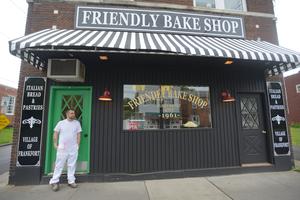
In the premiere episode of his latest TLC show, Bakery Boss, last Monday night, Valastro visited Friendly Bake Shop upstate in Frankfort, New York. (About 200 miles away from Carlo’s, Friendly is safely outside Valastro’s customer base. For now.)

Friendly Bake Shop after the Buddy treatment.

Friendly Bake Shop after the Buddy treatment. (Photo credit: herkimertelegram.com)

With three old, tired men at the helm of Friendly and their three grown children working devotedly (but fecklessly) for them, it seemed that the former were lacking energy to keep the bakery going, while the latter were lacking the know-how. Buddy’s visit was their last chance to turn things around.

As you might expect with any episode in this genre–as we’ve seen so many made-for-reality-TV miracles performed by Irvine and Melchiorri before–Buddy shapes up Friendly Bake Shop in just a few days. He demands a full cleaning of the shop and its equipment, revises the menu with some of his own best-sellers and shows the staff how to make them, and renovates the storefront to look more like Carlo’s than a crappy dive bar in the middle of nowhere.

Early reports say the shop is now flourishing since the episode aired, though Yelp has just one review from someone in California.

Success Story or Sell-Out?
Former New York Yankee great Yogi Berra once reportedly said about a popular restaurant, “Nobody goes there anymore. It’s too crowded.”

Many of us can relate to the idea of liking things before it was cool. Our favorite indie band gets mainstream radio airplay, and suddenly we can’t get tickets to their concerts. Our favorite TV show, which so aptly captured the zeitgeist of people our age, suddenly got popular among the masses and became prosaic beyond recognition.

So should we stop rooting for guys like Buddy, who was once a great upstart story but has since saturated the market with pre-made cakes sold in grocery stores, a line of baking equipment, and enough TV shows to start his own cable network? There’s no right answer to that, of course, but for me it’s always felt strange rooting for the underdog only until they’re not the underdog anymore.

En route to our Memorial Day weekend away at the beach, my fiancée and I stopped off at Carlo’s to get some treats before getting onto the New Jersey Turnpike.

Arriving on Friday morning, we hoped they would still have plenty of their signature coffee cake–my fiancee’s mom’s favorite–with the crumbs the size of small boulders. Our only concern, with a tight schedule and a long drive ahead, was the length of the line.

As it turns out we were right to be concerned. We had apparently showed up just a few minutes behind a bus full of tourists who had made a special trip to wait on line at the famous bakery from TV. They were queued up along the sidewalk, blocking the path of Hoboken residents whose formerly cute little local Italian bakery was now a nuisance to walk past.

We chose not to wait. In that moment we would have loved to have pulled up and seen no line so we could get in and out. I’m sure Buddy would disagree.

I’ll still be rooting from Buddy from afar, like a high school friend I don’t speak to but keep up with all the goings on in their life via Facebook. In the meantime there’s no shortage of up-and-coming reality stars to latch onto, perhaps even the next Buddy Valastro.

This past Monday night I was watching Sundance Channel‘s new show Rectify, about a guy who spent 19 years on death row in a Georgia prison before recent DNA evidence overturns the verdict and he’s released back into society.

The show has been pretty good so far, but for the last 15 minutes of the last episode I found it a little hard to follow.

It’s not that the plot was hard to follow. It was for those last 15 minutes of the show, instead of a picture, I only saw a black screen with a simple message from Time Warner Cable in white font: “Please wait…”

I still had full audio, but it’s a little distracting when you’re told to “Please wait…” for your $70/month cable provider (not including internet) to show a picture to appear on your TV screen. The ellipsis–those three little passive aggressive dots–are particularly obnoxious; they’re Time Warner Cable’s way of letting me know that it’s an open-ended “please wait.” They’re not telling me to wait five seconds or five minutes or five years. They’re simply telling me to wait. Please.

I’ve called Time Warner Cable’s customer support enough times to know that they were going to tell me to reboot my cable box, which is about a 15-minute process and would have meant missing the end of Rectify anyway. So I tried another approach: Twitter. I tweeted this:

They responded shortly after, asking me if I had rebooted my cable box yet. I responded:

https://twitter.com/TWC_Help/status/334140407371943936

I direct messaged TWC my account info, just to see the whole thing play out, and the representative known only as “SS” explained succinctly: “I do apologize. At this time we are experiencing an outage in the area.”

I turned off my cable box and went to bed.

This post is not necessarily meant to pick on Time Warner Cable, which recently lost in the quarterfinals of Consumerist’s Worst Company in America 2013 tournament to fellow cable provider Comcast. In truth, my customer service experiences with their phone and physical customer service center representatives haven’t been entirely unpleasant. But if a big company like TWC is going to go through the trouble to hire someone to troll Twitter for negative comments about their product only to have them apologize for circumstances beyond their control, they’re doing something wrong.

Zach Braff has been in the news a lot over the last month.

Braff, the main character on NBC comedy Scrubs and of the surprise 2004 hit film Garden State which he wrote, directed and starred in (and of which I have a poster in my apartment), wanted to make another film as a long-awaited follow-up to Garden State. But to do that he needed money, apparently, and so he took to Kickstarter.

garden_state_xlg

It’s been mentioned in nearly every article about Zach Braff’s Kickstarter project that the would-be makers of a Veronica Mars film tried this first, and were wildly successful. Kickstarter, which allows people to go online and ask for help funding their business projects, got the Veronica Mars people to their goal of $2 million…plus another $3.7 million on top of that.

Using a similar formula, Zach Braff took to Kickstarter to appeal to his fan base–myself included–to help finance his next project, a film called Wish I Was Here. Braff explained  on the site that he needed $2 million from fans to get the movie made in the way he wanted to make it, rather than going through the traditional channels, i.e. financiers, who would then dictate the way he made the film, i.e. final cut.

I was a little skeptical that a TV and movie star didn’t have enough cash of his own or enough juice in Hollywood (or enough rich friends he could trust) to get a movie made without appealing to fans to pay for it ahead of time. Still, as long-time fan of Braff’s, I seriously considered donating $10, 20, or even $50 to the campaign to see the thing get made. After all, it was likely that the movie he ended up making would be the kind I would want to see. More than that, Braff was giving away a variety of items, from Braff-autographed merch to advanced online screenings of Wish I Was Here to tickets for the movie’s premieres in major cities.

But in the end, I decided not to contribute because of the following three tenets which I believe to be true:

  • It is not the responsibility of the audience–whether that audience is made up of loyal fans or someone who’s never seen an artist’s work–to fund an artist’s creative projects before those projects have been completed.
  • Once the project is completed it is then the audience’s choice, not their responsibility, to support the project (i.e. purchase a movie ticket) once they know enough about the finished product to make an educated decision (e.g. viewing the trailer or reading reviews).
  • Should an artist ask someone–either the average person or a wealthy financier–to invest in their work in progress before it is created, that investor should have the opportunity to make a profit from their investment.

On that last point, Braff addresses it in his Kickstarter in the FAQs:

Current SEC laws prevent Kickstarter from offering equity or financial returns. As Kickstarter explains in Kickstarter Basics: “Project creators keep 100% ownership of their work.  Kickstarter cannot be used to offer financial returns or equity, or solicit loans.  Some projects that are funded on Kickstarter may go on to make money, but backers are supporting projects to help them come to life, not financially profit.”

Fine, I guess. Though I didn’t contribute to the campaign, I was glad it got its $2 million, and vowed–pending the reviews, which I expect to be largely positive–to see the film when it is completed. (I also look forward to some day when I can invest in a film like I would a stock, and potentially see a financial return on my investment.)

But then this past week a story came out about the project: Zach Braff is getting money from financiers after all.

Was Zach Braff misleading his backers? Did he not really need that $2 million at all, and was just trying to keep from having to pull it from his own pockets? Is Zach Braff a dick?

Well, not really. In his original Kickstarter he noted that “With a combination of my own personal funds, backing from my fans and the sale of some of the film’s foreign rights, I will be able to make the film I intended to make which I am hoping is a film you want to see.”

This is classic fine print and was readily available to any would-be Kickstarter backer who cared to read it. From what I gather on the internet, the world’s most reliable source of information, everything here is above board. Braff later “hit back,” as the tabloids say, at the negative story with his own response on Kickstarter. It essentially said that this was the plan all along, that nothing has changed from the original Kickstarter campaign, and that haters gon’ hate no matter what and not to get caught up in the negativity.

The sketchy dealings of the movie business aside–of which I know about solely from watching HBO’s Entourage–Braff’s trying something different in virtually uncharted waters. He’s doing what he believes he needs to do to make the best film possible, and we can hardly fault him for that.

But if we (myself included) decide that we don’t like what Braff is trying to do with his film, there’s no shortage of movie sequels and prequels and threequels and remakes and reboots of films that Hollywood wants you to see instead. Speaking of which, Fast & Furious 7 starts filming this summer.

If you’re a beer drinker, you know that weddings aren’t always the best place to find a quality adult beverage that suits your palate. And if you’re lucky enough to find an alternative to Bud Light, Coors Light, or Miller Lite, it’s likely to be some “exotic” brew like Heineken, which isn’t going to knock your socks off.

So when my fiancée and I began looking at venues for our own wedding we assumed that we, like so many betrothed couples before us, would be stuck serving whatever beers the venue wanted to serve, with little wiggle room for a wannabe beer snob like me to add in a few wildcard selections. But as it turns out, the venue we chose is allowing us to buy and serve any alcohol we want, which means we can customize our own beer list. Hoo-ray beer!

That said, I don’t know as much about beer as I’d like to–or should, given how much of it I’ve drunk over the years. So, I enlisted the help of beer connoisseur Henry Joseph. If you’re an avid reader of this blog (i.e. Mom), you may recognize Henry’s name from previous posts–one about New York City’s Pony Bar and another about the best holiday seasonal beers. Here’s Henry’s take on wedding beer, in his own words:

I LOVE going to weddings. Scratch that. I LOVE dressing up and drinking all day. Weddings are usually good for that, but they are RARELY good for offering you a tasty beer to drink all day. This always bothers me, and I usually stay away from beer altogether, opting instead to start with whisk(e)y and moving on to vodka sodas with maybe a Coors Light in between. Heaven forbid someone offer up an Allagash White at a wedding…

Wheat
Now if someone wanted to put some thought (and money, of course) into it, there are plenty of beers out there that would be PERFECT for a wedding. That Allagash White I mentioned is definitely one, as is any number of other wheat beers. Say, for example, Franziskaner Hefeweizen or the recent GABF Gold Medal winning Dreamweaver Wheat from Troegs.

Saisons
Saisons are another great option. They tend to be mild and approachable in flavor leaning toward the sweet side and offering pleasant fruit/spice notes. Ommegang’s Hennepin is widely available and tastes pretty good to boot.

(Now I’m not gonna do what you think I’m gonna do and recommend Saison DuPont, the Platonic Ideal of the style because it is damn near impossible to find a bottle that isn’t skunked–draft is amazing and should always be drunk. This is the dirty little secret of the beer geek community. Everyone just walks around pretending like it doesn’t happen and saying it’s the best saison there is when the truth is that two seconds in the light has an irrevocable negative effect on its flavor. Rant. Over.)

Saisons are a little harder to find but Ithaca makes a great one in the spring time called Ground Break. It’s available right now and you should go drink it.

Lagers
Of course, you can also go the lager route and offer up a nice crisp, clean alternative to your Bud-Miller-Coors. Go continental with some old German light lagers like Augustiner Edelstoff or heck, even just a simple Spaten Lager and you can have a refreshing beer to drink in large mass and your guests will hardly notice the absence of macro swill. Or you can stay closer to home and go with Victory’s Lager–it’s only one of my favorite beers ever from one of my favorite breweries ever.

In the end, though, it’s your wedding and you can serve whatever the hell you want. I’ve known some people in this industry who’ve poured some pretty cool stuff at their weddings. Some have even poured beer that they made themselves! I’ve never done this so take the following advice with a whatever, but your caterer will probably have beer distributors that they typically work with and they should be able to provide you with a product list. Or if you’re in good with your friendly neighborhood bar/beer store, they may be willing to order a keg for you. There’s no need to make people drink more shitty beer. You’re inviting your friends and family to share this special moment with you, make sure they have something special to drink, too.

As always, big thanks to Henry for schooling us all. What’s your ideal beverage at a wedding? Do you have a preferred “wedding beer”? Please share in the Comments section!

The Registry

“It’s like playing laser tag,” said the smiling Crate & Barrel associate, explaining to my fiancée and me how to use the barcode scanner before sending us off into the wilderness that was two floors packed with home goods.

The laser tag comment, I gathered, was for my benefit—an attempt to engage the historically less-interested half of a male-female couple when it comes to registering for wedding gifts. Patronizing as it might have been, I couldn’t help appreciate the effort to involve me. It reminded me of the way older siblings let their younger siblings “play” video games with them by handing them an unplugged controller and letting them go nuts. The younger sibling gets to participate in the game, or so he thinks, despite the fact that he doesn’t actually have control over anything in front of him. (Sorry, Danny, but I absolutely pulled this stunt with you when we were kids. You were not, in fact, the Tecmo Bowl touchdown maker you thought you were.)

Our first stop was the refreshments table, set up for the exclusive registry event we were attending; “exclusive” meant we were allowed inside the store from 9 to 11 am on a Sunday morning, before the store opened to the general public. But much to our chagrin, we learned that the mimosas we’d been told we’d get were actually non-alcoholic cocktails of sparkling grape juice with OJ. We grabbed coffees instead and headed downstairs, past the couches and kitchen tables that our one-bedroom apartment wouldn’t be able to accommodate.

With only two hours on the clock, we decided to tackle place settings first. C&B’s display included about twenty pre-arranged dishware sets—that’s dinner plate, salad plate, bowl, and coffee cup for the nuptial neophytes out there. An associate found us perusing and encouraged us to “play around” with pieces from different sets and explained that we didn’t necessarily have to be so “matchy-matchy” with our selections. She even set us up with our own area at a kitchen table with a placemat.

We found a nice gravel-colored dinner plate with brown trim around the outside that we liked. Next was the salad plate. For that set, as with most sets, the salad plate was just a smaller version of the dinner plate in the exact same color and design. We didn’t want to be too matchy-matchy, so we looked for something else to offset the gravel. We found three different black salad plates from three different sets across a gradient of shininess—from very shiny to no shine (or matte). We chose the middle one. Next, we realized we couldn’t use the bowl from our original set because it was too shallow. What if I needed to bring my bowl of cereal from the kitchen to the living room? Was I confident that this shallow bowl would keep my cereal and milk within the confines of the bowl’s edges? I was not. Luckily, we found a bowl from another set, in turquoise, that we both agreed was functional and aesthetically pleasing relative to the dinner and salad plates.

After we got the dishware down, we move onto the flatware. (I know what you’re thinking: But you didn’t choose your coffee cups! YOU MUST COMPLETE THE SET. Relax. We decided that we liked the idea of serving coffee or tea using funky, mismatched coffee cups. Turns out, we were already avoiding matchy-matchiness in our home and didn’t even realize it.) Selecting our flatware was simply a matter of picking regular-looking forks, spoons and knives. (Incidentally, I wonder if there are couples who spend hours deliberating over their first set of flatware. Honey, I want people to remember our butter knives.)

Before we left that section of the store, it was time to scan all the items, LASER TAG STYLE. And let me tell you, that lady was right: it was exactly like playing laser tag. (Note: It was nothing like playing laser tag.) I was in charge of scanning each item. But after adding eight dinner plates to our registry, I noticed that our salad plates were double the price of the dinner plates…surely, no one would buy us such expensive salad plates! So it was back to the drawing board, but thankfully we were able to replace the black salad plates with white ones without throwing off the delicate balance of the place setting. Consider that bullet dodged. I scanned the bowls, the flatware, some glassware we’d chosen—including four port/sherry glasses, for all the port/sherry we anticipate serving to our hypothetical dinner party guests—and the original placemat the associate had set us up with (by then we were too drained to keep shopping for a different one).

After a quick stop in the cookware section—which included a free sample of bacon sausage cooked in a wonderful Le Cruset skillet!—we were just about out of time and decided to wrap things up by hooking our laser gun, I mean scanner, up to a computer that saved our list and created an account for us. Our registry was officially “live.”

My fiancee’s mother later explained that we should have registered for at least twelve of everything, not eight—our hypothetical dinner party guest list had grown by four hypothetical people—so clearly, there is more work to be done. But if nothing else, it was a start.

At dinner this past weekend, my future father-in-law, a lifelong Yankee fan since the days when Mickey Mantle roamed centerfield, confessed just two days before the start of the 2013 baseball season that he was considering becoming a fan of the Washington Nationals.

Switching one’s fan allegiance, especially when it comes to baseball teams, is usually a big no-no according to the rules of fandom. But hear him out. He was born and raised in New York City but has been a resident of the suburbs of Washington D.C. for over 30 years. The Nationals only arrived in Washington in 2005. Before that, they were playing in Canada as the Montreal Expos and the closest major league baseball team to D.C. was the Baltimore Orioles an hour away. In becoming a Nats fan, he promised, he would still support the Yankees as his favorite American League team but he’d have more access to the excitement (and the televised games in his local market) to the Nats, of the National League.

Prior to the 2010 season, you would have been hard-pressed to find someone who would care one way or another whether a baseball fan chose to support the hapless Nationals. To put it eloquently, the team stunk. In 2009, they won just 59 games (a .364 winning percentage) and finished dead last in their division, 34 games back of first place. Meanwhile the Yankees had won 95 games and made the playoffs. Again. Becoming a Nationals fan in 2005 to 2009 when you were already a Yankees fan would be like if you drove a mint condition ’57 Chevy and decided to also buy a ’94 Ford Taurus.

But things are different in Washington these days. In 2012 the Nats won their division and reached the playoffs for the first time since moving to D.C. More than that, the two young players everyone hoped would become stars–starting pitcher Stephen Strasburg and outfielder Bryce Harper–had become stars. Though the Nationals didn’t get past the first round of the playoffs in 2012, the future was bright–like, blindingly bright. (Even as the Nationals opened their season today, Strasburg retired 19 batters in a row at one point and Harper hit two home runs. Like I said: bright.)

So back to my FFIL. My advice, since he asked for it, was this: GO ALL IN ON THE NATS! (I didn’t actually yell it–we were in a restaurant.) My 13-year-old self would have punched myself in the face if he heard me say that. But as I wrote at the end of the Yankees anti-climactic 2102 playoff run that saw Derek Jeter suffer a season-ending ankle injury (an injury, by the way, that held him out of the 2013 opening day lineup), I’m no longer sure what I’m rooting for as a Yankee fan.

Rooting for a sports team is meant to be fun. Some fan bases, like the Chicago Cubs’ or the Cleveland Browns’, have historically relished their status as the hard luck losers year after year. But as a Yankee fan, I can tell you that it has been fun because the modern team (1994-present) has always been competitive (and yes, they outspent all the other teams by several millions of dollars to do so). However as I look at the unrecognizable roster with which they opened the 2013  (which, to be fair, has been decimated by injuries), I can’t see any way that it will be more fun to watch the Yankees play baseball in 2013 than it would be to watch the younger, hungrier, and more talented Nationals do it.

Is my FFIL pretty much just jumping on the Nats bandwagon like so many other people will do this year as the Times calls them a “lock” for the World Series? Absolutely. But at least he’s got a geographical claim to the team. I have no such claim, but I’ll be keeping an eye on the Nats from afar here in New York (and keep track of a few of my fantasy team guys that play for Washington) as the Yankees get another year older.

Of course, my blessing to go on and root for the hometown Nationals came with a stern warning: he can go on supporting both the Yankees and Nationals in their respective leagues, American and National, as long as he wants to. But should the two teams meet in the World Series in this or in future years, he’ll have to pick a side once and for all.

When I received the generous gift of an iPad Mini for my birthday last month, I thought a lot about how owning the state-of-the-art tablet would enhance my day-to-day life. I was excited to set up the device, personalize it, and start using it for all it’s various, well, uses. But at the thought of taking it out of its sleek packaging and then out of my apartment and into the world, I was struck with a sense of panic.

I had no iPad Mini case to protect this gorgeous piece of machinery from the various perils of New York City!

So off I went to Amazon.com. I knew Amazon would have a variety of cases at every price point. And more than that, it would have reviews, thousands and thousands of wonderfully helpful reviews! (If you’re one of six avid readers of this blog, you know that I love to review things. And when I’m not reviewing things, I’m reading reviews of things.)

I budgeted about 15 minutes on a Sunday afternoon for the task of finding the perfect iPad Mini case that would be protective, decent-looking, and not too bulky. I didn’t need anything fancy or expensive, so I started off my search with a price point of $30 and under and I only viewed products with an average customer rating of at least a four stars (out of five). I had no idea what I was in for. I did my best below to paraphrase the deal-breaking features of each case I found, primarily based on each product’s negative (one- and two-star) reviews:

Bear Motion ($16) doesn’t protect the iPad Mini’s edges; Moko Slim Fit ($18) is shoddy; Belkin Quilted ($26) and i-Blason Leather ($20) are bulky; Snugg Leather ($25) is actually polyurethane leather (which is not “real” leather, as advertised); Photive Smart Cover ($18) has an ugly “Photive” logo on the cover; Acase Folio ($13) is hard to prop up to watch video; Finite Degrees ($10) and Poetic Slimline ($11) are flimsy; SupCase Leather ($14) has a chemical-y odor to it; Belkin Striped ($31) doesn’t close properly because its magnets are weak; Speck iGuy ($23) just looks ridiculous (that’s not actually in the review…just see below).

Right?

Right?

Jeez! Feeling like I’d read one too many Goldilocks-style reviews–each one was too this or too that, without finding my “juuuuust right” case–I invoked my 15 months of market researcher work experience and chose a new strategy for evaluating the reviews. Rather than only reading the 1’s and 2’s, which were overly negative (or the 4’s and 5’s, which were overly positive), I read the three-star reviews, which tended to list pros and cons rather than only the deal-sealers, i.e. what they loved, or deal-breakers, i.e. what they hated. (I imagined each three-star review was being read to me by an even-keeled imaginary friend who never really gets too negative about anything, but who also never really gets super excited about anything. Is that weird?)

After two separate research sessions, I finally found a winner from a company called Devicewear ($27). Of its 260 reviews, 242 were five stars, with just two one- or two-star reviews. If it had a drawback, per the reviews, it was that it was not going to protect the iPad Mini from a serious drop (but then, how many cases would?). Other than that, it fit my price point and seemed OK looking. (If it turns out to be uglier than in its pictures, I’ll just cover it with Garbage Pail Kids stickers or something.) Once I receive it and use it for a week or two, I’ll report back on Amazon with a review of my own.

Because everyone loves blog posts with an appendix at the end, here are a few other notes from my review-seeking process:

  • Thinking now about having to sift through so many reviews to find one common theme for each product (e.g. “shoddy” or “doesn’t protect the edges”), perhaps Amazon would consider showing suggested keywords or phrases that appear most often in each product’s reviews. Mr. Bezos: Call me.
  • I realize I could have expanded my search to cases well over my $30 cut-off, but I’m simply not willing to pay that much for a case. My assumption, correct or not, was that spending another $10 or $20 on a case wouldn’t offer more protection or practical functionality, only more bells and whistles or a sleeker look, which I didn’t care about.
  • The case that Apple makes got surprisingly poor reviews and was almost $40, so I ruled it out.
  • I bought a great Amazon Kindle case for just over $30 from M-Edge. I even reread the reviews of that case to see if I was making too much of the iPad Mini cover reviews. It was rated as well as I remembered it with the only drawback being bulkiness, which I didn’t mind after breaking my first Kindle’s screen a week after receiving it. However M-Edge’s selection of iPad Mini cases was expensive and not particularly well-reviewed, so I moved on.
  • I clicked on some of the reviewers profiles to make sure they’d reviewed other things. I know sometimes companies are sneaky and place “false positive” reviews on their product page. This didn’t seem to be the case on any of the reviewers I investigated.
  • I also factored the number of reviews into my evaluation process. From a statistical standpoint, I realize that someone might rather a product with a slightly lower score across  1,000 reviews than a much higher score across, say 25 reviews. But I found that most products I viewed had a robust enough sample size of reviews (at least 200) to make it a non-issue. The Snugg Leather (the “fake leather” one) had a four-star average rating, like the others, across over 3,100 reviews–far more than any of the other products I looked at. I considered letting the higher number of reviews be my tiebreaker, but that’s like choosing to eat at a restaurant simply because it’s full of diners (or not choosing a restaurant because it’s empty). Sales volume is not necessarily the best indicator of quality. If you don’t believe me, watch any highly-rated reality TV show.

Back in April last year, I wrote a blog post detailing the first ever episode of Hotel Impossible. It’s become one of my most popular posts, so I thought it would be appropriate to write a follow up as Anthony Melchiorri, hotel fixer extraordinaire and star of the show, visits six of the hotels from the first season to see how they’re doing since he left them on last night’s episode.

Like I wrote in my last post, my favorite part of watching shows like Hotel Impossible and Restaurant Impossible is looking up the properties after the fact to see what the reviews say. (Full disclosure: If the owners hesitate, even slightly, to listen to Anthony, I start rooting against them hardcore like a Deal or No Deal contestant who went against the mathematical odds for a chance at the million-dollar suitcase instead of cashing in for $250K.)

Here’s what I hoped to find out from this follow-up edition of Hotel Impossible: Was it, in fact, possible to revamp these properties? Did Anthony’s tough love and business strategies pay off? Did the owners ultimately heed his advice, or did they just yes him to death until he was gone, then go back to their old ways?

Here’s a brief recap of each follow-up, as well as a few tweets Anthony (@AnthonyHotels) sent out in real time last night:

Ocean Manor Resort Hotel (Fort Lauderdale, FL), 10 months later
The hotel seems to be doing better now that the owner is less involved and the GM is running the show, but it’s still receiving negative reviews on TripAdvisor. A January 28 review called it “The worst hotel ever!” Not a ringing endorsement for the job Anthony did, but I appreciate the show tellin’ it like it is by actually mentioning the negative reviews in its recap. My favorite line from the follow-up came from the owner, who said that since Anthony left, they’ve renovated “over 37 rooms.” So…38?

Dude Rancher Lodge (Billings, MT), 5 months later
There was nothing too remarkable about this hotel’s recovery. During the initial visit, Anthony won over the curmudgeonly sales manager, but she retired and they hired a younger manager from the area to replace her. This seemed to be working out just swimmingly until THERE WAS A SHOOT-OUT BETWEEN POLICE AND A CRAZED GUNMAN AT THE HOTEL. (The police eventually shot him dead, in case you were wondering.) Still, the recent reviews are mostly positive…

Purple Orchid Inn, Resort & Spa (Livermore, CA), 8 months later
A couple-owned hotel and spa, this appeared to be one of Anthony’s easier missions. The property is gorgeous; the spa just needed a little updating. Also, Anthony persuaded the couple to put on some events to promote their own wine and that of other local vineyards. According to the owners, who have since had a son, they’ve now gotten 150,000 visits to their website and they’re doing 300 spa appointments per month (previously they were doing about two appointments per week), which is what Anthony said a spa in the area should be handling in order to maximize its profits. See their reviews here.

Purple Orchid Resort & Spa in Livermore, CA

Purple Orchid Resort & Spa in Livermore, CA

Dream Inn (Daytona Beach, FL), 5 months later
This place was being run by an older couple (the mother was recently diagnosed with cancer) before her son took over the day-to-day operations. It was a pretty classic case of a hotel that was being run by people who, despite the hotel being their only source of income, didn’t know (or care) how to help themselves. The rooms need to be CLEANED? The hotel staff should wear UNIFORMS? We NEVER woulda thought of that! (Also, the property was overrun with dolphin statutes, like a lot of dolphin statues, which was just weird.) Since Anthony’s visit, the owners replaced their housekeeping staff with a professional cleaning service, and guests no longer have to clean their own dishes (in the original episode, leaving a dirty dish would have cost a guest a $25 charge at check-out). Per the owners, revenue is up 25%, occupancy up 10%. With the hotel’s phenomenal view of the ocean, Anthony thinks it can do even better than that. Still, the recent reviews are very strong.

La Jolla Cove Suites (La Jolla, San Diego, CA), 7 months later
Like Purple Orchid, Anthony’s primary role in fixing this place was to consult on the marketing front. And like Dream Inn, the view was not the problem. The owner wasn’t utilizing the roof space, they launched a marketing event to get locals up there to expose them to the view. The owners were also in the process of renovating the rooms but ran out of money. Since Anthony’s visit, the owners didn’t disappoint. They replicated the sample room Anthony’s designer created 22 times, all rooms have new mattresses, and Anthony’s famous “face plant” method–falling face-first onto the mattress–is now used the staff to test the mattress softness. Meanwhile Anthony struck gold with his suggestion to use the roof top as the hotel’s main selling point: since he left, La Jolla Cove Suites has hosted 29 weddings and 35 corporate events on roof deck. Per the owner, the hotel was named the second-best wedding venue in the county, and she says people mention Hotel Impossible when they call to inquire about rooms and events. Occupancy is up 22% occupancy, and there’s been a $400,000 increase in revenue (I believe that number was year over year) in the last five months. Anthony earned his paycheck on that one. Here are the reviews.

New Yorker Boutique Hotel (Miami, FL), 10 months later
As with the Dream Inn, this too was couple-owned and the co-owner wife had been recently diagnosed with MS. Meanwhile the financial struggles piled up, with the owners’ whole family living in a small apartment in the back of the hotel, now $1 million in debt. They seemed generally clueless about how to run a hotel, in one instance admitting that they let emails sit in their inbox for several days, even for a corporate client inquiring about rates for 150 nights a year (Anthony, incredulous, closed the guy over the phone in about two minutes for $85 a night). But after Anthony’s visit, which included a few lessons in marketing in sales, the couple says they’ve paid off 50% of their debt, and the co-owner is better able to manage her health and see doctors more often. Meanwhile, they report the hotel’s occupancy is at 80-95%. The reviews, on the other hand, are a mixed bag (don’t stay in room 223, apparently).

Much like Robert Irvine’s drill sergeant style on RI, Melchiorri’s New York Italian brashness was not always well-received by his would-be clients. (As the viewer, I didn’t mind the brashness, perhaps because it wasn’t my failures as a businessman he was exposing on a TV show whose title posits these hotels may be “impossible” to fix, or simply because I’m a New York Italian.) There was often resistance in the form of crying, yelling, or just, well, interesting comments from hotel owners like, “paper never crashes” in response to Anthony’s insistence that they invest in a computer system to track reservations rather than just writing them down and filing them away.

Of course I’m sure many moments were played up or down for the cameras, but Anthony seems to be having a positive effect on these hotels, if nothing else than for some increased visibility as “that hotel from the TV.” Perhaps Melchiorri’s reputation will start to proceed him as the show becomes more and more popular and he’ll have fewer clashes with these failing hotel owners, who might actually just shut up and listen. But then, where would the fun be in that?

Hotel Impossible can be seen on Mondays at 10 pm on Travel Channel.

RELATED: Hotel Impossible’s First Mission: Gurney’s Inn on Long Island

RELATED: Hotel Renovation Proves ‘Impossible’ for Anthony Melchiorri

I’m running like my life depends on it. I’m not running fast, like I’m running away from something, but controlled, like I’m running toward something that’s far away.

My pace slows as I run up and then…OVER the Queensboro Bridge, leaving Queens, where I was born, and entering Manhattan, where I now reside. I allow myself a quick and barely audible YESSS!–three boroughs down, two to go–and then it’s back to work. At the foot of the bridge I’m greeted by throngs of spectators who make me feel like they showed up just to cheer me on. I turn onto 1st Avenue and head uptown towards the Bronx. “Bobby! You can do it!!!” someone yells from the crowd, a family member, maybe a friend, or perhaps just someone who’s reading the brightly colored duct tape that spells my name on my shirt. I smile and wave in the direction of the voice. But there’s no time to scan the crowd to find the speaker–I still have another ten miles to go. I think to myself, I’m really doing this.

I played that scene in my head dozens of times in the summer of 2012, like a high school mixtape in the days before iPods. It was part of my mental training to go along with the grueling physical training I endured as I prepped for the 2012 New York City Marathon. Only that marathon never took place.

The Decision

As Hurricane Sandy swept through the New York area in late October, leaving much of Staten Island, the Rockaways, and New Jersey devastated, the marathon was eventually canceled. I say eventually because New York City Mayor Mike Bloomberg’s first reaction was that the show must go on. The public disagreed, loudly and angrily, embodied in the comments section of a Nov. 1 New York Times article, “Officials Defend Decision Not to Cancel Marathon.” The comments included:

“I think it’s wrong. There are still fatalities in the wreckage. There are still senior citizens sitting in dark, cold, flooded homes. Two young boys, ripped from their mother’s arms, have just been found in Staten Island.”

“Take the money that would be spent on the marathon and put it in a fund to help the affected. Running is such an individual sport. It’s a time to put the needs of the group ahead of those of the individual.”

“I am ashamed and disgusted that the mayor is allowing this marathon. So many homeless people, without water, food, or electricity. We need volunteers and the police should be helping those hurt by Sandy, not cheering runners.”

And, few and far between, a handful of supporters for the decision, including:

“The marathon is the most positive and uplifting event in NYC and the one where everyone joins together to support and cheer each other on. This is EXACTLY what we need right now! Good work Bloombito!”

Just two days before the marathon was scheduled to take place, Bloomberg released another statement, that “a shadow would be cast over the event,” and that it would be canceled after all. Contrary to the oft-quoted maxim, sometimes you can fight City Hall.

Meanwhile in Virginia, my fiancée’s family sprung into action just moments after the announcement, looking for a Plan B for us. They contacted us shortly after the news of the cancellation to tell us that, if we were interested, a marathon down in Richmond, Virginia, was accepting late entries from New York City Marathoners who still wanted to run. After a few minutes of deliberation, we looked at each other as if to say, “Let’s do it,” and pulled out our credit cards. As poker players say, we were pot committed–we’d already invested so much in the hand that even if it’s a bad decision to keep playing, it would be a worse decision to fold now.

Richmond

Six days after I was slated to run 26.2 miles around the five boroughs of New York, and twelve days after Hurricane Sandy had come and gone, I was lined up in the streets of Richmond, Virginia–“RVA” to the locals–to finish what I started.

I can’t say enough about the Anthem Richmond Marathon, which more than lived up to its billing as “America’s Friendliest Marathon.”

DSC_0890_edited-1

I told ya, it’s America’s Friendliest Marathon!

As the crowd of runners started to moved forward over the start line and onto the course, I took a quick inventory of my body’s trouble areas–my sometimes stiff right IT band felt good; my creaky left ankle and Achilles was pain-free. But I didn’t account for one body part, my eyes, and the fact that I might start crying.

I’m not much of a crier, and at first I wasn’t sure what had prompted that visceral response. I wanted to believe some of those tears were about for the circumstances–namely Hurricane Sandy and its victims–which rerouted my marathon plans from New York to Virginia. But they also felt like tears of joy, for having finally reached my goal of running (or at least starting) a marathon. Wiping my tears surreptitiously, as if I was wiping a bead of sweat in 40-degree weather, I glanced over to my fiancée, who met my glance. We’re really doing it.

I was so lost in my own thoughts that when we reached Mile 2, I turned to her and said, “We’ve gone two miles already?” She nodded. I looked at the time: we’d been running for 21 minutes. I’d been coasting, which made my first two miles feel like just a few minutes. I gather this is how the world’s top runners feel all the time, though for them, it actually does only take a few minutes per mile.

How do all these people know my name???

How do all these people know my name???

The first six miles were almost easy; even by the halfway point, my only concern was taking a bathroom break, which I took just after the Mile 13 marker at a porto-potty with a short line. Relieved–in all senses of the word–I felt renewed and my energy carried me to Mile 16 where I thought, dangerously, This isn’t bad at all. I feel great!

At Mile 18, I knew I was entering uncharted territory; the farthest I’d run in my training was 18.65 miles, and that had hurt. I knew anything after 18 was going to be a challenge. By Mile 20, what I’ve heard serious runners refer to as “The Wall,” I was in pain. And while I didn’t feel like I’d crashed into a tangible Wall, my knees were pounding. Mile 21 felt worse, but by then I was willing to injure myself permanently rather than stop just a few miles short of the finish line. (I also thought it might be fun when I’m 70 to say, “Yeah, that’s my bad knee…injured it running my first marathon back in ’12. You know what they say, the first marathon is the hardest!”)

The last mile was almost all downhill–which counter-intuitively sounds like a good thing, but is actually brutal on already-sore knees. As I ambled across the finish line, I was near tears again. The staff ushered me away from the finish line and towards the post-race festivities. I tried to plead my case to stay. “I’m just waiting for my fiancée!”, who was just a few minutes behind me. I felt like Rocky at the end of his first fight with Apollo Creed (3:16 mark), wanting no part of any interview questions, only concerned with finding Adrian in the crowd through puffy, bloodied eyes. (Yes, I realize how that sounds, but I swear, that’s how it felt.)

Weeeeee...are the chaaaaampions...my frieeeeends...

Weeeeee…are the chaaaaampions…my frieeeeends…

The Resolution

After that, we didn’t hear much from New York Road Runners, the organization that puts on the marathon, except to say, “We’re still figuring things out.” I misanthropically took this to mean, “We’re still figuring out how to keep your entry fees.”

NYRR finally announced its resolution on its website on December 20:

2012 Marathoners may choose one of the following options:

  • Option #1 – Refund. While NYRR has always had a no-refund policy for the Marathon, given these extraordinary circumstances, we are offering runners who were entered in the 2012 Marathon, and were unable to run due to the cancellation, the opportunity to obtain a full refund of their 2012 Marathon entry fee (excluding the $11 processing fee);  OR
  • Option #2 – Guaranteed entry to the ING New York City Marathon for 2013, 2014, or 2015. Entrants in the 2012 Marathon who choose this option will be granted guaranteed entry to the Marathon for the year they choose. Runners will be required to pay all processing and entry fees at the time of application (in the given year), with fees maintained at the same rate as those paid in 2012; OR
  • Option #3 – Guaranteed entry to the NYC Half 2013. Entrants in the 2012 Marathon who choose this option will be granted guaranteed entry to the NYC Half 2013, to be run on March 17, 2013. Runners will be required to pay all processing and entry fees at the time of application. Availability will be limited.

Upon first reading, I was happy with this resolution. They did the right thing for people who wanted simply to get their money back and move on. I was also happy that, if I wanted to, I could re-train and run it at some point in the next three years. I even tweeted this:

But as I read through my options a second time, I realized that I’d have to pay another entry fee if I wanted to run the race in 2013, 2014 or 2015, with my original payment going towards “guaranteed entry.” My spot was, in essence, being held hostage unless I was willing to pay twice (that’s $237 x 2) for one marathon.

I had originally qualified for the marathon by completing a series of nine races through NYRR in 2011 (at about $20 apiece, plus the $35 annual NYRR membership). The “9+1” program is actually really nice, especially if you live relatively close to Central Park (where most of the races take place on Saturday and Sunday mornings) but it’s a time and money commitment I’m just not willing to do again. I could also try to qualify by entering NYRR’s lottery program, but as its name suggests, it’s a longshot.

I realized then that, in all likelihood, I’ll never run the New York City Marathon. And that kind of bummed me out. It would have been an amazing feeling to come off the Queensboro Bridge, cheered by thousands of people, just as I’d fantasized about. But there are other marathons out there, and I could even see myself running Richmond again someday.

As I re-learn every day, things don’t typically work out the way you plan them but, if you’re willing to adapt, your Plan B might not be so bad. And after all, life is a marathon, not a sprint. (Oh come on, don’t roll your eyes at me. I had to!)