Feeds:
Posts
Comments

Last week I started to write a blog post called “The Death of Fantasy Baseball,” about how the fantasy baseball league I’ve played in for the last seven years had finally dissolved. It was going to be a Classic Bobby nostalgia story about how something I loved while I was in my twenties was suddenly less appealing to me in my thirties. (My recent piece about being called “sir” at a Hoboken St. Patrick’s Day party falls into this category.)

But before I could hit “Publish” in my WordPress dashboard to make the piece go live, thus effectively ending my spotty fantasy baseball career, the league started to gain some momentum. Rather than the twelve teams collectively throwing in the towel and skipping fantasy baseball this year, it seemed that we were preemptively missing our league before the season would have even started. (If my fellow managers from the league disagree, feel free to mention that in the Comments–but I certainly felt this way.) On a group email chain we reignited the conversation and agreed upon a date and time for our online draft–a Friday night at 8:30, which should tell you how much our lives have changed from our twenties to our thirties.

The biggest reason the league almost fell apart was that most of us didn’t feel we had enough time to prepare or maintain our teams. Our league is one of the more demanding fantasy leagues, using advance “Moneyball“-friendly statistics categories (e.g. on-base percentage rather than batting average) that most casual fantasy baseball players wouldn’t pay attention to–and the kind that are harder to find on basic “best and worst” rankers on ESPN.com or Yahoo!. It’s also a daily league, meaning lineups can be adjusted each day, rather than a “set it and forget it” weekly lineup that some leagues employ to save everyone the anguish of feverishly checking each day’s match-ups.

I’d been dreading doing the research leading up to the draft–ranking each player by position (e.g. first base or left field) based on our league’s stats and thinking about a strategy for who I would select first, who I would wait to select later in the draft. In this way I felt like an athlete who retires despite most experts saying he could probably play for two or three more years. It’s not that he doesn’t still love his sport, but the preparation, the conditioning, the practicing, the media attention leading up to game day was no longer worth the high he would experience from actually playing in the game itself. (I realize the irony of comparing my fantasy baseball preparation to what an actual athlete goes through to get ready for a season, but I’m sticking with this comparison. Hey, it’s my blog.)

In fact, preparing for and running the league had been so challenging for me that a few years ago, I approached my friend and fellow fantasy manager, Brian, about running a team together. Rather than throwing away our separate $100 entry fees* on two under-managed teams that would finish last and second-to-last in our league, we figured we could co-manage and only lose $50 apiece.

*This is a hypothetical $100, of course. There, that should satisfy the fictitious attorney The 250 Square Foot View keeps on retainer.

The co-managing approached actually worked, leading us to a second-place finish that season. (I think both our wives were happy to see that after six months of “Honey, gimme two minutes…it’s my week to check our fantasy team,” some money was coming back in our direction.)

Now that we’ve drafted our team, I think we’re in pretty good shape–though I say that literally every year, despite winning the league just once, in my first season, when I didn’t know what I was doing–and I’m feeling confident about the upcoming season.

It’ll also be my favorite real (i.e. not fantasy) baseball player Derek Jeter’s last season, and, perhaps, my last year playing fantasy baseball. Who knows, maybe we’ll both go out on top.

Sir

About a month ago, I attended  Hoboken St. Patrick’s Day. I wrote about HSPD before on this blog a couple of years ago. As I put it then, “From the ages of 24 to 26, Hoboken St. Patrick’s Day was my Christmas Morning.” I lived in Hoboken from 2006 to 2008 with my roommate, Mike, and each year we threw a HSPD party at our crappy apartment.

Even after moving out of New Jersey in 2008, I continued to attend HSPD nearly every year. Mike still lived in Hoboken with his wife, Linda, and would still invite me in either to his place or to a party he knew of. It was an excuse for me to cross-state lines and get together with him again. I jumped at the chance to reminisce about our own parties back in the day.

Yet as the years went by I began to eclipse various milestones that took me further from my days in Hoboken: I hit age 30; my girlfriend moved into my Manhattan apartment with me; we got engaged and later married; and my drinking tolerance waned (and I acquired a taste for better beers). As a result, I found it increasingly difficult to muster up the necessary alacrity for yet another HSPD celebration.

Still, this year—just a month after my 32nd birthday—I found myself in Mike’s younger brother Matt’s Hoboken apartment for the second year in a row, huddled into the corner of the room with Mike, his wife Linda, and my wife, Kim.

Just a week before, we were celebrating my belated birthday with two other couples, including Mike and Linda. Kim tried to sell it as a “boozy brunch,” evoking the unlimited mimosa-fueled meals we might have had in our twenties, but in reality the brunch had been decidedly tame—the way we all seemed to prefer it. We had a delicious meal, a great conversation, and no one was sloppy drunk by the end of it.

In the week between the “boozy brunch” and HSPD, Kim said she was worried that she’d feel old at Matt’s party, even though at 28 she was just two years older than Matt and most of his friends who would be at the party. If anyone at the party was going to feel old, I assured her, it would be me.

As the four of us caught up on “adult” topics like house hunting and promotions at work—with Matt interrupting occasionally to make sure we were having a good time—Kim suggested we try to get on the beer pong table for the next game, which Matt arranged for us.

Our game lasted about ten minutes before we lost, albeit respectably, with just a few of our cups remaining on the other side of the table. As we shook hands with our opponents and walked away, I heard a female voice say, “Sir…sir…”

I slowly turned towards the voice, praying that she was talking to someone’s dad standing behind me. But I knew better.

It took about a second for Mike and Kim to process what had just occurred, before they both started laughing. Recognizing that a harsh reaction would only make the situation worse, I smiled and accepted my role as the elder statesman of the party and approached the girl who had called me “sir,” one of our beer pong opponents.

“Did you just call me sir?”

“Yeah. I’m an English teacher. I wanted to say I like your shirt.”

I was wearing an old t-shirt I’d purchased from one of those novelty t-shirt websites back when I was living in Hoboken. Back then I couldn’t afford to “dress to impress,” so my strategy was to “dress to amuse” with an extensive repertoire of funny t-shirts. This particular one bore a bust of Shakespeare with the caption “Prose before Hos” underneath. At 32 I found that HSPD was the only place I could still appropriately wear the shirt—besides, it was green.

Her being an English teacher, I suppose, explained why she liked my Shakespeare shirt. But she’d done nothing to assuage my hurt feelings about being called “sir” at a party full of people in their twenties. The even harsher reality was that she didn’t even realize that calling me “sir” might have been insulting—to her, I was so obviously older than anyone there that it was the only appropriate way to get my attention. I would have much preferred a ruder but more age-neutral “Hey!”

When Mike and Kim finally stopped laughing, we unanimously decided that my youth was officially over. I haven’t yet made a decision on whether I’ll ever come back to HSPD, but if I do I think I’ll avoid the beer pong table.

I really enjoyed the first episode of the new season of Comedians in Cars Getting CoffeeJerry Seinfeld’s web series. The featured guest was Louis C.K., a comedian I admire for both his comedic chops and his business savvy.

As is standard on the show, Jerry and his guest talked shop. Aside from the stark contrast in style between the two—Jerry is known for his clean-as-a-whistle humor while Louis C.K. is anything but—the two comedians have a lot in common. They both have or had their own eponymous TV series, they both started out and continue to do stand-up, and they both seem self-aware enough to know how big a part luck (in addition to their immense talent) has played in their success.

During the 20-minute episode, Louis tells a couple of funny anecdotes, including one about grounding his boat the first time he takes it out, and being ship-wrecked for an entire day with his young daughters. He tells another story about going to the movies stoned and sneaking in candy. In that one, he mentions that for this mission he hired an Uber car to drive him to the theater. (Uber is a new-ish car service app.)

I don’t know the first thing about shooting a TV show, but I happened to notice that the camera was not on Louis when the word “Uber” was said (if you watch the episode, it’s at the 15:04 mark). And while Uber made sense in the context of the story, something about its mention seemed fishy–meaning I suspected it was a paid product placement by Uber edited into Louis’s story after the fact. (It was also possible that I was simply piecing together the words “Seinfeld” and “Uber” after recently reading an article about how Jerry’s wife overpaid for an Uber ride for their kids during one of Uber’s price surges. That or the news of Uber’s kitten delivery promotion back in October took up permanent residence in my brain.)

Whatever the impetus, I was suspicious about the Uber mention and was left wondering if anyone else had seen the episode and felt the same way, so I took to Twitter and wrote this:

Like most of my tweets, it didn’t receive much of a response.  At that point I let it go for fear of sounding a little too obsessive about something so meaningless—but not before I told a few people about my product placement theory, including my co-worker.

Fast forward to this week, when that same co-worker told me that she’d watched recently the episode of CICGC after the Louis C.K. one and that there was a much more overt mention of Uber. The car Jerry was driving with his guest, comedian-actor Patton Oswalt, broke down. (In each episode, Jerry drives a super-rare antique car. That episode featured a DeLorean.) Ostensibly stranded on the side of the road, Oswalt used his Uber app to hail a car (with a close-up of him using the app on his phone), and the show “restarted,” now featuring an Uber car instead of the DeLorean that had broken down. The Uber car that came to pick them up was a Honda, which makes sense considering the show’s sponsor is Acura (and Honda owns Acura).

Now it was clear that Uber had been a product placement all along, and that Louis C.K.’s Uber mention was simply laying the groundwork for the Oswalt episode.

I have nothing against product placement, per say, but it’s a little tough to stomach considering the show is already book-ended by two Acura commercials written by Jerry Seinfeld himself.

Seinfeld was notorious for using brand names in so many of its episodes, though it was never clear whether they were paid because they seemed so organic to the story. Off the top of my head I can think of quite a few (incidentally all snack-related): Junior Mints, Snapple, Twix, O’Henry, Yoohoo, Snickers. Not to mention the not-so-ringing endorsement for the U.S. Postal Service and its finest employee, Newman.

In a new world where everyone’s trying to get native advertising just right on sites like Buzzfeed, Uber didn’t quite hit the mark for me because it seemed too forced and didn’t quite match the laid back, informal environment the show tries to cultivate.

Although come to think of it, I just wrote a 600-word blog post mentioning Uber multiple times–and some of you probably hadn’t heard of it before. So maybe it wasn’t as far off the mark as I thought.

I know what you’re thinking: What’s the deal with this blog post? Does Jerry Seinfeld really need more appreciation?

Without listing his résumé, I think we can all agree that Jerry (who I’ll refer to by first name as not to confuse him with his somewhat popular TV show, Seinfeld) is about as successful as a human being can be within his chosen profession.

That being said, anything else he does for the rest of his life, in comedy anyway, will inevitably be less successful than Seinfeld.

Since his show went off the air in 1998*, Jerry’s body of work might be considered unremarkable. He participated in a 2002 documentary, Comedian (about being a comedian), in which he retired his old stand-up material and started his comedy career from scratch (apart from his obvious name recognition). He wrote, produced and starred in the animated Bee Movie (grossed $257 worldwide) and NBC reality series-slash-game show The Marriage Ref (canceled after 19 episodes over two seasons). He appeared throughout the seventh season of Seinfeld co-creator Larry David’s Curb Your Enthusiasm for a faux Seinfeld reunion. He’s toured his stand-up act. And now he’s got a web series, Comedians in Cars Getting Coffee, a talk show about, well, you can figure it out.

*While most hit shows stay on air past their prime these days, Seinfeld was still putting up huge ratings numbers in its ninth and final season. As Jerry told Louis C.K. on CICGC, “My show was about four single people living this certain type of lifestyle. We didn’t want to do Kramer’s fiftieth birthday party.”

“Man, I gotta get on that internet,” Jerry once quipped on Seinfeld. Now 59 years old, he certainly seems to have gotten a hang of the web. In addition to CICGC, he recently participated in a Reddit AMA (ask me anything), where he discussed with his fans everything from cars to failed Seinfeld scripts (Jerry buys a handgun?) to the revelation that the secret behind Seinfeld‘s success was that Jerry was actually the straight man to Kramer, George and Elaine.

It’s not that I appreciate Jerry Seinfeld because he can still achieve success four decades after he started his career. I appreciate him because he’s still trying new things. The media, especially the internet, can be a cruel place, even for its most treasured celebrities. Jerry Seinfeld, or any other performer of his status, has very little to gain from putting himself out there again and again.

Maybe it’s an addiction, and he simply can’t help himself. It’s the idea, which Jerry himself has talked about, that he simply can’t stop looking at the world from a comedian’s perspective. So many little things in life will always be funny to him, and he’ll always be looking for ways to articulate and disseminate those funny moments in a stand-up routine or a script or simply a filmed conversation with a fellow comedian.

In his Reddit AMA Jerry he hinted at a new “big, huge, gigantic” project he’s working on with Larry David, which has fans like myself intrigued. Will it be as successful as Seinfeld? Probably not. But that’s not really the point, is it? The point is that, in Kramer’s words, Jerry’s out there, and he seems to be loving every minute of it.

WARNING: This post contains some minor spoilers about the current season of Fox’s New Girl. If you’re like Frank Costanza (“I like to go in fresh!”), we suggest you tune out from this blog post.

Will they or won’t they?

That’s the question TV viewers have been trained to ask themselves from the moment a they start watching a new show in which there’s a not-so-subtle attraction between two of its main characters.

Spoiler alert: They almost always will.

And so, the better question becomes: When those characters inevitably get together, does that moment then become the driving force behind the show moving forward (making it ever better), or does it signal a peak from which there is no other direction but down? Or, to put it another way, do two main characters getting together ruin your favorite TV show?

I had a chance to debate this point with some co-workers recently regarding Fox’s third-year sitcom New Girl. We all love the show, but I expressed concern over the show’s direction, now that two of the show’s four main characters have become an item. (Incidentally, do people still say “an item”? Nevermind.) My co-workers, on the other hand, thought the new coupledom would have no negative effect on the show’s funniness.

One of them actually informed me that the WTOWT? concept is often referred to in TV criticism circles as “The Moonlighting Effect,” a reference to the 80s sitcom starring Bruce Willis and Cybill Shepherd. It has been said that once Willis’ and Shepherd’s characters got together romantically, the show suffered a marked decrease in quality—and ultimately, in ratings.

*One of those co-workers later mocked me about how Fox’s Prison Break, a drama about, well, a prison break, should be included here along with the sitcoms in that the prison breakers had an on-again, off-again thing with freedom. Once they finally got together with freedom, the magic began to fade.

What hampered my office debate, thus making it unwinnable, was exactly that distinction: quality versus ratings. For example, I’m personally not a big fan of CBS’s The Big Bang Theory—I can see why people like it but I don’t find it LOL funny*—but it would be easy enough for anyone to “scoreboard” me by pointing to the show’s consistently world-leading Nielsen ratings.

*The median age of BBT’s viewers is 50, according to Nielsen so maybe, at 31, I’m not supposed to like it?

On the flipside, TV nerds (myself included) can easily point out the endless parade of quality programs that barely had a chance due to low ratings early in their runs.* My go-to example is Freaks & Geeks, a gem that barely eked out one season on NBC before cancellation.

*Netflix’s streaming catalog is a veritable graveyard of one- or two-season shows that were taken too soon.

Moonlighting may indeed be the bellwether for the trend of co-stars getting together (and the plummeting ratings that follow), but since I was only seven years old when that show ended, it doesn’t resonate with me. The quintessential couple of my generation (bordering on Generations X and Y) is Ross and Rachel.

The WTOWT? model worked wonderfully on Friends for years because it felt organic*. The show wasn’t just about Ross and Rachel and their relationship; it was about six twenty-something friends living in New York City in the 90s. Two of those friends, with a history going all the way back to high school, seemed to keep missing each other’s windows of being single. In the pilot, Ross was still reeling from the eventual end of his current marriage as Rachel left her fiancé at the altar (the pilot episode’s “grab a spoon” moment sets up and foreshadows their future relationship); Rachel was dating a jerk when Ross was newly divorced; Rachel becomes single again and realizes she’s “under” (i.e. not “over”) Ross, who comes back from a work trip with a girlfriend; finally, Ross finds out how Rachel feels about him, and realizes he feels the same way. In the show’s second season, fourteen episodes in, they got together. (Or as Phoebe puts it, “He’s her lobster.”) From there the on-again, off-again thing begins (“We were on a break!” et cetera) and continues for much of the show’s ten seasons.

*Equally organic–and fascinating–is how the writers decided to get Monica and Chandler together, as described in this great Vulture article

Meanwhile an hour later on NBC in the 90s, Seinfeld flipped the WTOWT? thing on its ear. Where Friends’ strength came in its ability to be a sitcom that was occasionally dramatic, Seinfeld was anything but. The series debuts with Jerry and Elaine as exes, and only really touches on their former relationship in a handful of episodes. Instead, the idea that two exes could remain such good friends* plays as a nine-season running joke.

*I wonder how many grown men dating in the 90’s tried to explain away a too-close relationship with their ex-girlfriend to their current girlfriend by saying, “You have nothing to worry about. We’re like Jerry and Elaine!”

Seinfeld even goes so far as to reference the Jerry-Elaine relationship on the show within a show, “Jerry,” when they’re pitching it to NBC for the second time in the series:

NBC Executive: And Elaine – I wouldn’t mind seeing something happening between you two.
Jerry: Definitely.
George: I tell you, I really don’t think so-called relationship humor is what this show is all about.
NBC Executive: Or we could not do the show altogether, how about that?
George: Or we could get them together. Woo!

I’m not as worried about New Girl as I might otherwise be, considering their brand of weird/random/gross/dumb humor is unlike any comedy I’ve seen on TV in a while. Beyond that, seeing these particular two main characters together is almost better than seeing them apart, because it’s exposed new and funny aspects of their respective personalities when they are part of a couple. I don’t know that I’d want to watch them figure out how to be an item (there it is again!) for six more seasons, but so far in this season, I think it has worked out nicely.

Blogger Tip: If you don’t already watch New Girl but want to check it out, seasons 1 and 2 are available on Netflix, though you’ll have to wait a while to see all the episodes from season 3 (click on this link to find out why).

Playing Catch-Up

When I was a kid my mom would sometimes take my brother and me to visit her friend from high school, Lana. Lana and her husband Richard had a great apartment in Queens filled with assorted kitsch I can still picture twenty years later.

Lana and Richard have always enjoyed traveling, especially by train. (I’m serious. The day after our wedding, Richard commended my wife and me for how convenient our wedding venue was to a train station.)

Apart from countless train-related talismans, the apartment also featured Lana’s collection of Coke cans from around the world. And I can still vividly recall a photo of the two of them floating in a boat on the Ganges River in India.

Yet the most memorable aspect of their charmingly cluttered apartment was a library of VHS tapes, what seemed like a hundred or so, lined up in small wooden bookshelf beneath their TV. Lana recorded every episode of her favorite soap opera, General Hospital, on her VCR. But because the show aired during the day and she didn’t have always have time to catch up on the latest episode, Lana fell behind on her GH. Years behind.

Back then, before the Internet or DVRs, staring at a bookshelf full of unwatched tapes might have seemed daunting (the show’s been on since 1963 and as of 2013 has shot over 13,000 episodes). But Lana simply kept plugging away, happily reporting the year she was up to when we asked how far along she’d gotten.

It turns out, Lana was ahead of her time–in today’s media landscape, “time-shifted viewing” is all the rage. Why watch your favorite show on the network’s schedule when you can simply craft your own prime time lineup?

Meanwhile here in 2013, my wife and I have recently embarked on the modern day, VHS-less version of catching up on a show. Rather than working our way through a stack of black tapes with white sticky labels, we had the first thirty or so episodes of our new favorite show queued up on Netflix’s instant streaming service. And of course this takes up a lot less space in our apartment than it might have using Lana’s system.

(I’d tell you what show we’re hooked on, but we’re absolutely terrified of spoilers at this point. The other night we were in the middle of a commercial break while watching a different show on the same network that airs The Show That Shall Not Be Named and a promo for its next episode sneak-attacked us. After looking at each other for a split second with legitimate panic in our eyes, we did the LALALALALALA thing until we were sure it was over. It was a close one.)

Spoilers aside, we’re really into our new show. Thanks to Netflix, we binge-watched the entire first season and several episodes into the second over Thanksgiving weekend. But now we have a problem: we’re almost finished with the second season, and the third isn’t available on Netflix yet because it’s still in the middle of the season on TV.

Lucky for us, most TV networks have a system in place for people like us who want to catch up to a current season. Either using Time Warner Cable’s video-on-demand service, or by going to the network’s website, episodes from the current season are available for free.

But there’s a catch. Only the most recent five episodes of the show are available on demand or online.*

*The reason for this is a little complex, but I’ll do my best to explain succinctly.  When Netflix makes a deal with a TV studio for the rights to air a program on its service, it demands that the studio doesn’t make more than five episodes of a series available at a time elsewhere (i.e. on demand or online). By limiting it to the “rolling five” episodes, fewer people have the opportunity to catch up from the beginning after episode 5—once episodes 2-6 are available but not episode 1. Meaning would-be viewers would have to use a service like Netflix to catch up from the first episode of the season once the current season is over. Like I said, it’s a little complex. For more background, this article from Vulture explains the whole thing really clearly and in much greater detail.

Because we’re now nine episodes behind on the current season, season 3, and the network’s website only has episodes 5 through 9 available, we need to figure out a way to watch the first four episodes of the season. And we’d like to be able to do this for free.

Yes, we could suck it up and purchase the episodes for $2.99 on iTunes or $1.99 or Amazon Video. But is it worth $8 or $12 to buy individual episodes of the show when we’re already paying over $100 for a cable subscription and $7.99 for Netflix each month? Assuming we choose to attain these episodes legally, that’s probably what we’ll end up doing–meaning neither Netflix nor the network will profit by pushing us in this third direction.

Obviously it’s easy to complain about these things in the digital age, when not that long enough I would have basically no options for catching up on a show already in its third season besides having a friend who had watched the show from the beginning who could tell me what has happened so far. But knowing that a large chunk of Netflix’s business is reliant on people using their service to catch up on shows, it seems ironic that Netflix itself—by way of its contract with the studio–is preventing us from catching up on ours.

If we had started our catch-up process just a few weeks earlier, this wouldn’t have been an issue—we might have found ourselves completely caught up by the time the first episode of the third season aired (or at least somewhere within the five-episode window). But organically, we took exactly this long to discover our new favorite show, and now the only thing we’re caught up in is a spider web of media entities, a no-man’s land of prime time TV programming.

We have given Netflix our $7.99 in exchange for thirty episodes of our show, which we watched in an embarrassingly short amount of time. But now it’s time for Netflix to step aside and let us join season 3 in progress—before our show is irrevocably spoiled.

Please note: This post has been updated from its original version, “Review: Hotel Impossible, Sandy Part 1.” In this revised version, I have included an update at the end of the post based on the “Sandy, Part 2” episode, focusing on the controversial Thunderbird Motel project.

I’m a big fan of the business makeover shows, including Restaurant Impossible and Hotel Impossible. As someone who doesn’t own my own business, but might like to some day, it’s interesting to see how someone at the top of their profession can quickly get to the bottom of why a business is failing.

But my biggest frustration with these shows, as I’ve written about before on this blog, is the projects they select. More often than not the biggest reason why a hotel or restaurant fails–at least on these shows–is the ownership. They’re typically lazy (kitchens or hotel rooms are filthy, obvious repairs aren’t made, the customer service is half-assed, etc.) or clueless (“We thought it would be fun to buy a restaurant!”). I have yet to see an episode where a hotel or restaurant owner is doing mostly everything right but is still struggling to turn a profit. While that would be decidedly less “impossible” to turn around, I might prefer that every once in a while to helping people who have been unable or unwilling to help themselves.

In the most recent episode of Hotel Impossible, hotel guru Anthony Melchiorri takes his talents down to the Jersey Shore to help reverse some of the damage done by Hurricane Sandy last October. A worthy cause, or so it seemed.

The episode takes place about a week before July 4, the following summer after Sandy. As he arrives, Anthony seems genuinely shocked at the condition of the hotel he’s there to fix, the Thunderbird Motel in Seaside Heights, NJ (a.k.a. the town where Jersey Shore was filmed), nine months later. The rooms on the ground floor are still being gutted and he’s been told that 20% of the hotel’s inventory is not ready to be sold.

When Anthony questions the family–a couple in their fifties and a grown son and daughter–as to why so little has been done, they talk about how the insurance money was slow to come in. The patriarch tells Anthony about the Thunderbird: “You’re lookin’ at my 401K here” and that the hotel was meant to be the parents’ retirement.

Anthony goes in for a room inspection–a room the son has assured him is ready to be rented immediately–and finds the usual stuff he always finds: dirt, dead bugs, filthy shower heads, and, of course, a week-old pizza box in the fridge (with one slice left!). The son, Ray Jr., goes into the contrite routine we see often of hotel owners on the show, falsely accepting the blame but clearly believing it’s someone else’s fault, in this case housekeeping

Anthony, in classic straight-shooter Melchiorri style, tells Ray Jr. (who believes he runs the hotel), that he is not general manager material. Anthony leaves, and Ray Jr. follows a few minutes behind him, cursing Anthony under his breath. Later, Ray Sr. is recorded behind closed doors saying that he wants to chop Anthony’s head off–so there that is.

Meanwhile, the rest of the family gangs up on Anthony, telling him that they were too hard on Ray Jr. (Direct quote from Ray Jr.’s mom: “He didn’t have to chew my son sixteen new a**holes.”) As he usually does, Anthony gives the family a chance to cool down and explains that he’s there to help, and he can only do that if he’s completely honest. The family seems to get it, sort of, but Ray Jr. still won’t speak to Anthony. Given a chance to walk away from the project and cut his losses, Anthony chooses to stick it out.

Next, Ray Sr. and Anthony take a drive, having apparently patched things up after the whole “chop off his head” thing. Ray Sr. casually points out other real estate in the area he owns, explaining that his assets total about $40 million. Yup.

Anthony doesn’t start screaming at him (as some of us might have) but calmly asks him why, if the hotel was so important to him, he didn’t consider selling off some of his other assets to pay for the repairs. Ray Jr. replies, “I prioritized. I don’t like digging into capital.” Totally see his point. I mean, who does?

Later, Anthony has another closed door conversation with the family, where Ray Jr. asks him to delete the footage of the hotel inspection from the beginning of the episode that shows Ray Jr. in a negative light. Anthony refuses, saying the only way the footage would be deleted is if they cancel the show. Ray Jr. walks out.

Then, still behind closed doors, it is revealed that Ray Jr. was not actually being tapped to be the general manager, and that a new GM the family had already hired would be starting in a few months. This is the last straw for Anthony, who pulls his crew off the set. He declares that he never leaves a job unfinished, but that he can’t deal with the family’s dishonesty. He believes he’s being “played.” If that’s true, it’s hard to see what the family’s game plan was, since Ray Jr. blatantly told Anthony about his substantial assets without any probing. Nevertheless, Anthony is outta there.

The show ends with previews of Part 2 of the Sandy episode, which has Anthony helping other Jersey Shore hoteliers get back on their feet (plus a cameo by NJ Governor Chris Christie!). Disappointingly, the last scene of the preview has Anthony trying to reconcile with the family from the Thunderbird.

Meanwhile the family that owns the Thunderbird Motel is none too happy about how they were portrayed on the show, as scammers. If I came off the way they did, I wouldn’t be, either. Not to mention, $40 million doesn’t go as far as it used to.

***UPDATE!*** 
The end of Sandy, Part 1, teased that Anthony would attempt to reconcile with the Braun family, who own the Thunderbird Motel. Reconciliation proved, well, impossible.

Ray Jr. was barely willing to look at Anthony when he tried to open a dialogue about restarting the project. Meanwhile Ray Sr. expressed, again, that he felt the family was blindsided and that Anthony’s crew had come in and wrecked his hotel. (This statement was confusing, as I don’t believe they actually did any work on the hotel apart from Anthony taking a week-old pizza out of the fridge in one of the rooms.)

Anthony and Ray Sr. shook hands and went their separate ways. However the dialogue continued between Ray Sr. and Anthony’s camera crew, who apparently brought bodyguards. Ray Sr. took offense to HI‘s “muscle,” and said he would bring his own muscle next time.

After they shook hands–which was about as forced as Ray Sr.’s previous handshake with Anthony–Ray Jr. asked whether HI still planned to use the footage from the beginning of the first episode, which he felt made him look foolish. The producer said that they would be using the footage, which was a different story than the one Anthony told him at the end of the first episode. Anthony had told him the footage would be deleted if the show was canceled–but clearly it was not…

I don’t feel great about the way things played out, especially considering that it seemed like Anthony lied (or at least misspoke) about the footage. While the Braun family clearly did not deserve Anthony’s help, they were basically used by the producers to create enough footage for an entire episode and didn’t end up getting a hotel renovation out of it. I don’t know about the waivers they might have signed or the legalities involved, but it seems kinda messed up.

Finally, Anthony goes back to the Thunderbird one last time. As a peace offering, he tells Ray Sr. that his designer had had three rooms and a front desk’s worth custom cabinets made for the Thunderbird already, and that if he wanted them, they were his (on the house). In a cliffhanger that only a reality hotel renovation show can have, HI cuts to commercial before we find out whether Ray Sr. will accept the free cabinets. I can tell you it was a VERY long ninety seconds waiting to find out if Ray Sr. would, in fact, accept the free cabinets. (He did.)

Oh yeah and a bunch of other stuff happened in Part 2, including some hotel renovations. Here are the TripAdvisor pages for all the hotels in the two episodes:

Thunderbird Motel: 4/5 rating on 17 reviews (but none since Hurricane Sandy)
Palm Villa Suites Motel: 3.5/5 rating on 51 reviews
Tradewinds Motor Lodge: 4/5 rating on 14 reviews
Charlroy Motel: 3/5 rating on 49 reviews

Did you watch both episodes? What do you think?

RELATED: Hotel Impossible’s First Mission: Gurney’s Inn on Long Island

RELATED: Hotel Impossible: After Anthony Special – A Review

“I thought I’d never see that girl again. But it turns out, I was too close to the puzzle to see the picture that was forming.” –Ted Mosby, in the pilot episode of How I Met Your Mother

Kids, way back in 2005 I started watching a new TV show called How I Met Your Mother

How I Met Your Mother has occupied a spot in CBS’s Monday night lineup for eight years, an impressive run by primetime TV standards. But in the months before the 2007-08 TV season, the fate of CBS’s two-year-old sitcom hung in the balance.

I was working in TV then and was paying admittedly too much attention to the news surrounding CBS’s 2007 upfront. (An upfront is an industry conference at which a TV network previews its fall lineup to whet the appetites of potential advertisers.) HIMYM was hardly a shoo-in to be renewed for a third season, but it was my favorite show at the time and I was really hoping it would be picked up. (It was.)

The show’s main character, Ted Mosby, was a 20-something living in New York City. He was on a perpetual search for the girl of his dreams, and spent a copious amount of time in the bar downstairs from his apartment with his friends. I connected with it immediately. I felt like it was to my generation, Gen Y, what Friends had been to Gen X.
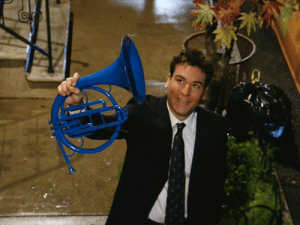
Ted steals a blue French horn for Robin, a quintessential moment for the show.

Ted steals a blue French horn for Robin in HIMYM’s pilot episode. (Photo credit: tumblr.com.)

When I told people that HIMYM was my new favorite show–and that they had to start watching it immediately–I would often mention that the Ted character was just like me. After all, he was single and I was single. He was a hopeless romantic; I once made a girl a mix CD in high school. He lived on the Upper West Side of Manhattan; I lived in Hoboken, New Jersey. He was an architect; I had a job also. Like I said, we were basically the same person.

The show was tailored to my demographic; the cast felt like it was hand-picked for us ‘80s kids. The series was and still is headlined by Neil Patrick Harris, relaunching his career post-Doogie Howser, M.D. and coming off a hilarious cameo in the cult film Harold & Kumar Go to White Castle.[1] HIMYM also features Alyson Hannigan, everybody’s favorite band geek from the American Pie movies, and Jason Segel, who was on the verge of becoming a star after some notable work on two one-season Judd Apatow TV series, Freaks & Geeks (NBC) and Undeclared (FOX). (Hannigan and Segel play the series’ perfect couple.) Even the show’s narrator, a future version of Ted in the year 2030, is voiced by former Full House star and America’s Funniest Home Videos host Bob Saget.

[1]In season 3 the show references Doogie’s pensive journal entries at the end of each episode. Also, Harold (John Cho) and Kumar (Kal Penn) have each appeared on HIMYM.

I also bought in on the show’s “Ross and Rachel” characters, Ted (Josh Radnor) and Robin (Cobie Smulders), who were relatively unknown actors at that point. By the end of the first episode I’d already developed a mancrush on Radnor, not unlike the one I had on Scrubs and Garden State star Zach Braff.[2] As for Smulders, she was perfectly cast as an attractive yet attainable love interest for Ted.

[2]Like Braff, Radnor wrote, directed and starred in his own film, Happythankyoumoreplease.

As the show’s title suggests, the premise has Future Ted (Saget) telling his teenage son and daughter (and the audience) the story about how he met their mother, about 25 years later. All sorts of New York City-centric randomness happens along the way—as it often does in real life—en route to Ted actually meeting the mother of his children. Each of the first few seasons left viewers questioning whether Ted’s current romantic interest would end up being be “the mother,” but as long as the show kept being funny and fresh, we were content not to meet her until Ted was good and ready.[3]

[3]Though Robin was ruled out as the mother in the pilot episode when Future Ted refers to her as “Aunt Robin,” it didn’t stop some of us from trying to find a loophole to explain how Robin and Ted still might have ended up together. They were just so good together!

Ted's kids losing interest in how he met their mother.

Ted’s kids losing interest in how he met their mother. (Photo credit: whatculture.com.)

Beyond the glaringly obvious comparisons between Ted’s life and my own, I responded to the show’s propensity to capture the zeitgeist of being young and single in New York City. The show had a knack for portraying what it was like those of us who were figuring out what kind of person we wanted to become, while simultaneously figuring out what kind of person we wanted to be with.

In one episode, Ted finds an old shirt in his closet and can’t remember why he stopped wearing it, which leads him to contact an ex-girlfriend and revisit their relationship (“Return of the Shirt”). In another, Ted’s friends are tired of him constantly overthinking his love life and convince him to overdrink instead. He wakes up to a pineapple on his nightstand and a strange girl[4] in his bed, causing him to piece together his evening with his friends’ help (“The Pineapple Incident”).

[4]Further evidence that the show was pandering to my generation from the beginning, the “strange girl” is played by Danica McKellar, or Winnie Cooper from The Wonder Years.

Meanwhile other early episodes explored relatable themes like coffee house baristas butchering your name (“Swarley”); trying to plan a New Year’s Eve party that doesn’t fall flat (“Limo”); saying goodbye to a relic from your younger years which might also signify a transition to full-blown adulthood (“Arrivederci, Fiero”); or starting a relationship with someone without technically ending the one you’re already in, especially late at night (“Nothing Good Happens After 2 A.M.”).

Yet somewhere along the way, HIMYM stopped feeling like the same show it once was.[5] Seasons 4 and 5 revolved around Barney’s romantic feelings for Robin, who by that time is Ted’s ex-girlfriend and roommate (occasionally with benefits), creating a scenario that is not only bizarre but altogether implausible considering all the history between them.

[5]I can’t pinpoint the exact moment when I stopped enjoying HIMYM. There was no “jump the shark” moment a la Happy Daysthough the final episode of season 4, “The Leap,” has the gang literally jumping from their rooftop to a neighboring one to symbolize their willingness to take a leap of faith in their lives and careers.

For a while I thought I was the only one who found the Ted-Robin-Barney love triangle strange, particularly because they all still spent so much time together. But I recently caught a few minutes of an episode from season 7 (“Ducky Tie”) where Ted runs into an ex-girlfriend, Victoria, from season 1. (Victoria, a baker Ted met at a wedding, was an early candidate for “the mother.”) Ted explains that he is no longer dating Robin, but that he and Robin and Barney, also an ex of Robin’s, still hang out all the time. Victoria, like many of the show’s viewers including myself, finds the situation incredibly weird.

"It's only awkward if we make it awkward."

“It’s only awkward if we make it awkward.” (Photo credit: TVfanatic.com.)

Beyond the Ted-Robin-Barney stuff, the balance the show had once perfectly struck as a “dramedy,” equal parts drama and comedy, no longer felt quite right to me. (That balance is what sustained shows like Scrubs, HBO’s Entourage, and more recently FOX’s Gleewhen they were at their best.) HIMYM‘s humor felt forced, while the stories weren’t compelling enough to stay tuned week after week.

In fairness, HIMYM did have a few clever storylines in the later seasons that were culturally relevant: Ted goes on a blind date with a woman without realizing (at first) that he’d blind dated seven years earlier (“The Blind Date”); Ted is kept as a back-up by a girl who already has a boyfriend (“Hooked”); Ted brings a girl home only to have her fall asleep right away, leading to Barney suggesting that she simply wanted a place to crash for the night rather than to hook up with Ted (“The Sexless Innkeeper”).

But as the writers sought to extend the life of the series–which they may never have envisioned lasting as long as it did–the search for the mother seemed to take a backseat to other storylines, leaving viewers like me to wonder whether we, like Ted in “Hooked,” were being strung along. (To their credit, the show addressed this over the summer in a hilarious promo which has Ted’s kids channeling the audience’s frustration with the lack of resolution on the meeting the mother issue.)

I eventually gave up on the show. Friends would ask me if I still followed it, including those who I’d turned onto the show in the first place. When I explained to one such friend why I now find the show unwatchable, he said, “Yeah, I know what you mean…but I’m pretty much committed at this point.” I imagine my fellow Lost fans might have felt the same way.

Ultimately TV is a business. Networks are always going to milk a show for all its worth, even if that means spreading out a story arc (e.g. how a character met the future mother of his children) thinner than it’s meant to go. Few shows actually leave their fans wanting more—two that come to mind for me are The Wire and Breaking Bad, each wrapping up after just five seasons, not to mention Dave Chappelle’s decision to stop making Chappelle’s Show[6]—because most networks (and showrunners) aren’t willing to walk away from money on the table.

[6]Chappelle famously walked away from a two-year, $50 million contract for a third and fourth season of his show. While many people dismissed him as “crazy,” he insisted that the quality of the new episodes he’d done was simply not up to snuff with the first two seasons. After Chappelle left the show, Comedy Central aired the new episodes anyway. Turns out, he was right.

The final season of HIMYM premieres on September 23 (8 pm), and, despite everything I’ve said above, I plan to tune in to see how it all ends. I haven’t watched a full episode since season 5, including last season’s finale in which “the mother” finally appears on screen. Maybe the writers have been saving the best for last, and Ted’s nine-year wait to find the mother will be as worth it for the audience as it was for him.

***UPDATE: I posed the question of whether to answer your doorbell in NYC to Reddit users to see what they had to say and I pretty much got abused. Read all about it here!

It’s Sunday night, about 11, after a long weekend. My fiancée and I are getting ready for bed when we hear the obnoxious buzzbuzzbuzz of our doorbell. We’re not expecting anyone.

It’s someone looking to gain access to the building without the use of a key. This is common in New York City apartment buildings, as it probably is in most other cities. We ignore it, not wanting to let a non-resident in but also not wanting to get involved in the situation. But after 15 seconds, we hear it again. Then another 15 seconds goes by, another buzzbuzzbuzz.

We can tell from the sounds in our hallway that the person outside is each apartment in the building in succession. When our neighbor across the hall hears us in the hallway debating what to do, she says, “Don’t let them in!” through her door, then comes out to discuss the situation.

Like us, she’s waiting for it to pass. Whoever it is will get tired and give up. Or someone else will let them in, which isn’t a desired outcome but will absolve us of responsibility for having let them in if it turns out they’re a burglar or worse.

After a few minutes I decide that it must be someone who lives in the building but is locked out. If it were me, I reason, I would buzz my 19 neighbors’ buzzers all night as I wouldn’t have any other option assuming my fiancée wasn’t home. Our building super doesn’t live in the building and is usually not eager to walk the 15 minutes from his own building, especially on a Sunday night. Plus the person may not have a phone on them if they don’t have their keys.

I announce to my fiancée and the girl across the hall that I’m going to pick up the intercom phone and try to see who’s buzzing. The girl across the hall says, “Even if they’re locked out, they still can’t get into their apartment.” “That’s their problem,” I respond. At least they’ll be inside.

“Who is it?” I ask him through the intercom.

A shaky male voice responds: “It’s Mr. Moss in apartment 3.”

“Is your name on your mailbox inside the building? And can you prove you live here?”

I ask him about the inside mailbox because the outside of the building has names from tenants past next to the apartment numbers. According to it, our last name is “Pipoli.” Even if an intruder claimed he was someone whose name was on the doorbell, I wouldn’t let them in if that name didn’t match the more updated inside mailbox.

“It certainly is,” he says, about his name on the mailbox. “And yes, I can” about proving whether he lives there.

“Okay, I’m coming down.” I throw on a pair of flip-flops as my fiancée hands me the pepper spray keychain I bought her when she first moved to the city.

When I arrive at the bottom of the stairs I see it’s the elderly man who I’ve seen many times at the mailboxes in our building and spoken to a few times. He is prepared with his ID when I get there but I know he lives here so I let him in, slightly embarrassed that I made him wait out there so long.

“Sorry, Mr. Moss. I recognize you now, of course, but I didn’t know your name or your apartment number.”

“Thank you,” he replies, genuinely but perhaps a little peeved it took that long for me to let him in. Still, I was the only one who had. I tell him goodnight and sprint back up the stairs.

Have you ever been in a similar situation? If not, what would you do if you were? Please feel free to share your story or opinion, if you have one, in the Comments.

“TMI,” the popular acronym meaning “too much information,” is typically reserved for when someone overshares details about something such as their romantic endeavors, or their bathroom habits. But I never thought I’d be using it when it came to reading online customer reviews while trying to book a vacation.

Admittedly, this is not the first time I’ve struggled with online customer reviews. A few months back I blogged about the “paralysis by analysis” I encountered while sifting through countless Amazon customer reviews for iPad Mini cases. The sheer volume of reviews became overwhelming, but luckily my time spent reading them paid off, as I ended up with a great iPad Mini case from Devicewear. Still, it was a tedious process considering the item was relatively inexpensive ($27) to begin with.

If my Amazon experience was the minor leagues of reading online customer reviews, then I was called up to the majors last month while planning a Caribbean vacation with my fiancee. We headed over to TripAdvisor to see which hotels had the best reviews based on the handful of islands we were interested in.

Knowing that there would be more reviews on TripAdvisor than I could possibly read, my strategy for reading reviews was to read only those in which the reviewer graded the hotel a “3” on a 5-point scale. I’ve found these reviews to be the most honest and useful ones. Too often, a 1 out of 5 review overstates the negative aspects of a customer experience, e.g. an indifferent hotel staff becomes “rude,” or a mediocre meal becomes “inedible”; while a 5 out of 5 is too glowingly positive to the point that there’s nothing to learn from it, and it often lacks any detail, e.g. an “amazing” dinner. (The 2’s and 4’s are usually not much better than the 1’s and 5’s as far as exaggeration.)

Luckily, TripAdvisor’s reviews do allow readers to filter by “Couples,” “Solo,” “Families,” and “Business.” Traveling with my fiancée, I selected Couples to see only reviews written by those people who had been on couples-style vacations. Using this filter we got a few good tips, such as asking for a free room upgrade upon check-in.

But despite my 3-rating strategy and the Couples filter, after a few days of reading reviews my head was spinning. Where one reviewer would laud a hotel’s staff for friendly and helpful service, another would trash them. Some people loved the beach at a hotel, where others found it too crowded or noisy.

Just as I was reaching the brink of complete frustration, I had an epiphany.

Because my TripAdvisor account is connected to my Facebook account, I could see that one of my friends had previously visited one of the hotels we were looking at with his wife back in 2006. His wife wrote a glowing review about a particular hotel and about the island in general. Though a lot about a hotel could change in seven years, I reached out to them anyway in the hopes that they could give me the inside scoop. They explained that their trip to Curacao was a great vacation for them at the time, in their mid-twenties, especially since it was their first Caribbean vacation together. However, they said, Curacao was not necessarily a place they would go back to after having been to other islands such as Turks & Caicos, where they were married and have been to several times since.

My epiphany was that I wanted to read more reviews written by people I know–friends and family are typically a more trusted source of information and recommendations than strangers. However, going off of only personal recommendations would be a little impractical unless I planned to solicit reviews about specific destinations or hotels from my social network via Facebook.

The next best thing, I realized, was to read reviews by people like me, even if I didn’t know them personally. By people like me I mean people who are around my age; have a similar travel budget; who live in New York City like I do or at least another major city (preferably on the East Coast); and who have comparable previous travel experience. (That last one, travel experience, is important because someone who rarely travels might not notice or care about the same things I do when they travel.)

I began to re-scan the reviews (already filtered on Couples) for people from the New York area, since this was the only real demographic information available on TripAdvisor. I knew I was on the right track when I found one NYC-based reviewer who said that a hotel bar had “New York prices.” To further filter for travelers like myself and my fiancee, I skipped over reviews from people who were celebrating their 30th wedding anniversary, as they were obviously in a different lifestage than we were. (Note: This is not to say older travelers’ opinions aren’t valid, just that they don’t resonate with me as much as the opinions of travelers closer to my own age. Again, it comes back to travel experience.) I also read the reviews more carefully for language that might suggest these people were frequent travelers.

Ideally, I’d like to be able to filter reviews by the factors I mentioned above to give me a reasonable chance to make sense of all the reviews. (This might require TripAdvisor asking a few innocuous demographics questions to its reviewers before they can post a review, but it’s worth it!) I’d also like to see a search box like they have on Yelp so I can search within the reviews for terms like “renovations” (is the hotel under construction?) or “palapas” (do I have to get up at 5 am to reserve a little tent on the beach?). TripAdvisor’s current set up shows frequently used words in its reviews, but they’re not useful for anything more specific than “restaurants” or “happy hour.”

I love that TripAdvisor allows me access to so much information, but sometimes it’s just TMI and goes past the point of usefulness.