Feeds:
Posts
Comments

Of all the entertainment media competing for my attention–hundreds of cable channels, Netflix, YouTube, Facebook, Instagram, Twitter–its a modest little public radio podcast that’s got me completely consumed.

You may have heard of Serial (more likely you haven’t), a  podcast off-shoot of the more well known National Public Radio (a.k.a. NPR) show and podcast, This American Life (TAL), hosted by Ira Glass.

I’m a regular TAL listener, so when I downloaded episode #537, “The Alibi,” I was expecting the usual radio magazine-style fare TAL produces each week–that is, four or five stories tied to that episode’s theme. But this time TAL was trying something a little different.

The episode was actually Serial‘s first episode. Rather than producing a new episode around a new theme each week, reporter and Serial host Sarah Koenig tells a new chapter of the same story, one about a high school kid named Adnan Syed who in 1999 was convicted of strangling his classmate and ex-girlfriend Hae Min Lee.

Koenig was made aware of Adnan’s story by a friend of Adnan’s family last year. Once she started digging, she couldn’t stop. So as Adnan Sayed sits in jail for a crime he (maybe) didn’t commit, Koenig has been working to uncover any fishy details about the case that might prove his innocence–or guilt.

With what I’ve told you so far, the show admittedly sounds like something from a network TV legal drama. But if you listen to the show–and I’m urging everyone who reads this to listen to the show–Koenig’s tireless investigation and simple-yet-compelling storytelling style will hook you in, and you’ll be like me–waiting around for Thursday mornings, when the latest episodes of Serial are available for download.

As we listen to Koenig’s investigation unfold each week, we’re still not quite sure what to think about Adnan. Koenig is going about her reporting professionally and impartially as far as we can tell, but I would guess she wants Adnan to be innocent of Hae’s murder. (I would guess a lot of Serial listeners feel the same way.) And some–but not all–the evidence she gathers suggests that maybe, just maybe, the police and the court system got it wrong and Koenig is a few weeks of research (and podcasts) away from cracking the case wide open and springing Adnan from his prison cell, where he’s been for 15 years.

I’ve spoken to a handful of people about the show–I’ve also avoided most of the media around it, for fear of spoilers–and the sense I’m getting is that Sarah must know more than she’s letting on. She must have everything neatly laid out on a storyboard and is rolling information out in bits and pieces to keep us tuning in each week. And why wouldn’t she? How could she go into this thing telling this true story of a (possibly) wrongly convicted man without knowing what the ending is?

Well perhaps this is the biggest twist in the series so far: she doesn’t know what the ending is.

In an interview with Vulture published on Thursday, the same day Serial‘s sixth episode became available, Sarah admitted that she doesn’t know where the story is going. Here’s what she said in the Vulture interview:

I am not playing all of you. If you guys only knew how this is put together. I’m not far ahead of you. Episode Five just aired, and I just did a first draft of Episode Six this afternoon, so I am pretty much creating this thing in real time now. Yes, I could say, there was a point where I thought I knew the truth. And then I found out that I didn’t know as much as I thought I did, and I did more reporting, and now I don’t know what I don’t know again! Are you mad at me? Don’t be mad at me!

That’s nuts! It also might be genius.

I’ve railed on many a fictional TV show for not knowing where the story ends and making dozens more episodes than the story actually needs simply because it’s profitable. But in the case of Serial, a non-fiction series, not having an ending (yet) might be the smartest thing they could do. For one, they’ve eliminated the chance of spoilers online because A) Koenig likely knows more about this case than anyone in the world and even she doesn’t know everything; and B) it brings tremendous credibility to the series in that Koenig is reporting a lot of these as she learns them herself rather than having a chance to over-produce and edit the crap out of it, like you see on so many “reality” TV shows these days.

What’s also fascinating about the show is what it’s doing for the medium of radio–or more generally any audio platform. Serial storytelling is a throwback to the olden days before TV. I find myself amazed at how engaged I am while listening to Serial, which is nothing but talking and some sparse background music. I’m not quite ready to cancel my cable, but it’s nice to be reminded that if the story itself is good enough, it doesn’t really matter what the medium is. (By the way, Serial is the #1 podcast on iTunes in the U.S. right now.)

(I shouldn’t be giving the Serial people any ideas, but they probably should be thinking about monetizing right now, if not for this season/story than the next. TAL relies heavily on donations, along with a handful of advertisers. If ever there was a time to start charging per episode, or per series, it’s now. Hell, I’d pay it.)

Of course Serial‘s uncertain status (re: its ending) is a tremendous risk. If Koenig makes 12, 15, or even 30 episodes of the series as the story continues to become more and more complex–I can also easily see more potential witnesses coming out of the woodwork when they hear the show–and at the end of it all there’s nothing but speculation about Adnan’s guilt, what was the point?

In my estimation there are going to be two schools of thought if the Adnan Syed story ends without a resolution:

  • The people who will have enjoyed the ride so much that the unlearned truth won’t matter as much as the journey to get there.
  • The people who will be furious because they “wasted” so many hours waiting for some absolute closure that never comes.

Like many listeners out there, I want to see Koenig’s indefatigable efforts lead to Adnan’s conviction being overturned–while also finding Hae’s true killer. (Or, if Sarah finds enough evidence against Adnan that it’s impossible not to believe he did it, I’d be okay with that, too.)

But I don’t know if we’ll get that. And I don’t know what a lack of an irrefutable ending will mean for the next season of Serial. Will we demand that Sarah gets all the way to the finish line before we start listening to how she got there? Or will we double-down on Serial, knowing that Koenig is as much along for the ride as we are?

I highly recommend you check out Serial at http://serialpodcast.org/ (Don’t know how to listen to podcasts? Watch this video in which Ira Glass teaches his elderly friend how to do it: http://serialpodcast.org/how-to-listen)
“You know, I do business on handshakes and I try to help people, and I do it to make money.”

That’s a quote from Marcus Lemonis, the star of CNBC’s hit show The Profit. Each week on the show Lemonis tries to help a failing business get back on its feet. Sound familiar? Well, it should (especially if you have read this blog).

Reality shows like Hotel lmpossible, Restaurant Impossible, and Bar Rescue feature industry experts visiting foundering businesses, addressing problems big and small, and within a week, transforming former money pits into profit machines.

But The Profit is a little different. Lemonis isn’t necessarily an expert the type of business, like hotels or restaurants, that he’s trying to rescue. He’s an expert in business. (For more on his background, check out his Wikipedia page.) His oft-repeated mantra is People, Process, Product. In each episode he examines all three and determines if the business has any hope for a turnaround.

And here’s the kicker: Lemonis isn’t just a hired gun, like Hotel’s Anthony Melchiorri or Restaurant’s Robert Irvine. Lemonis is putting up his own money, a la Shark Tank, to revive these businesses but also make a profit for himself. (The name of the show is just one big spoiler, isn’t it?)

Lemonis’ financial contribution is typically enough to pay off the business’s debt, plus some money for some upgrades to equipment that will have an impact on the bottom line. In exchange for his cash—it’s always such a baller move on when he whips out his checkbook and writes a million dollar check to a business owner—he asks for a large chunk of equity, often as high as 50%. He also requires full operational control of the business.

Like the “Impossible” shows, most of the time Lemonis business proposal and management style are met with some initial resistance from the owners, but eventually they realize that what’s good for him is what’s good for them. Happy ending, right?

Not quite. Sometimes, and this is much rarer on the various Impossibles, Lemonis can’t come to an agreement with the business, and he backs out. (While the check presentation is a big moment on the show, in reality I’m sure there are lawyers and accountants digging into the company’s financials and the owners’ credit histories to make sure the business isn’t a lemon.)

On the episode I caught last night, featuring Swanson’s Fish Market in Fairfield, Connecticut, Lemonis wrote the business a million dollar check to temporarily buy the building in which the market resides and clear up its debt, which he believed would be the pecuniary boost they needed to get back on track.

But as Lemonis (or his lawyers, off camera) dug deeper he discovered that the mortgage on the building was not, in fact, “in good shape” as the business co-owner Gary had said it was. It was in foreclosure.

Besides that, Lemonis couldn’t get past the fact that Gary owned a boat while some of his employees were covering the costs of the fish out of their own pockets. He also couldn’t get through to the other co-owner, Sue, about why her owning a BMW with $500 a month payments was sending the wrong message to her employees. Neither were willing to sell off their toys in order to take a little pressure off the business and, ya know, pay their frickin’ employees. (Unlike many struggling businesses I’ve seen on shows like this, these two had no guilt over paying themselves.) The icing on the cake was that when Lemonis came back a few weeks later to check in, he found out the owners were doing renovations on their home.

In the end Lemonis walked. There was no text at the end, like you’d see at the end of Hotel Impossible (“Occupancy is up 75% since Anthony’s visit. The hotel has plans to upgrade all rooms within the next six months.”) It was Lemonis’ quote (from the beginning of this post), and then the episode just kind of ends.

In a previous post I wondered why this didn’t happen more often, as it did in an episode of Hotel Impossible last season. If these people aren’t willing to do what it takes to run a successful business, why does the show still insist on helping them? I imagine there are so many American businesses doing things the right way (or at least what they believe is the right way) and still struggling. Why not help them instead?

(Here’s an idea for a show: when one small business is too stubborn or foolish to accept the free help of an expert—who, by the way, they called!—that expert goes across the street and helps their biggest rival. Or better yet, the expert starts his own business just to crush them. Too much? Watch the Hotel Impossible episode about the Thunderbird Motel–or read my post about it–and tell me those people deserve to stay in business.)

The only regrettable aspect of Lemonis walking away from Swanson’s was that the owners’ 24-year-old daughter, Larissa, was apparently working the hardest of any of them to keep the company afloat. She also seemed to be the only one who saw the value of Lemonis’ involvement and potential investment. Maybe somewhere in the near future she’ll open her own fish market and put her parents out of business? Or at least buy them out? After all, what better way to learn how to run a successful business than seeing first-hand all the ways not to run one?

***UPDATE*** I’m not sure about the sequence of events here but Larissa Swanson, the daughter of the owners of Swanson’s Fish Market, wrote a treatise on the company’s website in response to the way their episode of The Profit was edited and the deal that Lemonis ultimately walked away from. You can read the whole thing here, but the her key points are quoted or paraphrased below (with my own thoughts in italics).

  • “When we sat down for the deal they told us before hand that if he writes us a check, it is only for show purposes and we have to hand it right back.” That sounds about right.
  • “We also did not film for 4 weeks, the filming process started at the beginning of June and ended in September! We were strung along for 4 months. They don’t add that my mom had a contractor at the house painting bc we are fixing it up right now to SELL and put it on the market. We never even did a building deal with him, where he said he would buy It for one million. We did not see a penny for the entire 4 months.” This was not clear at all on the episode. In terms of timing Lemonis mentioned that he went back four weeks later, and that’s when he discovered the property was in foreclosure. More on that…
  • “On August 26th I was served papers by a sheriff on the building for kasowitz (the guy who did a mortgage for it)  I notified Marcus immediately via text..we were not aware that a foreclosure process even started. Our building is fine now and we are taking care of it. Our building also had a contractor Lien put on it 3 years ago and we had the lien removal paper but our mortgager never brought it to city hall to be taken care of and of course they never aired that either!” It’s starting to sound like a he said-she said thing, but ultimately if Swanson’s was even close to foreclosure Gary shouldn’t have said it was “in good shape.” Or was that creative editing, too?
  • “When the boat happened he moved it from the marina and put it in someone’s backyard before hurricane Sandy hit and the motors became ruined and it turned into a salvaged project. He bought that boat 15 years ago.” The fact remains that he’s apparently paying marina fees on a boat, but Marcus made it out to be a luxury yacht.
  • “Marcus even asked me to negotiate with people and had me promise to pay them the next day certified check and never even came through. Those people are so angry now that they are sueing us.” Um…
  • “They also didn’t add how my little brother has a serious mental illness that he was diagnosed with 3 years ago of schizophrenia and it’s so severe that we are constantly in and out of hospitals and have paid over 100k in medical,hospital,ambulance bills and medications.” The show easily could have gone the other way with this and played up this angle, a la Restaurant Impossible, but they chose to go in the direction of villainizing the Swansons instead.
  • Sue had three deaths in her family around the time of the taping, explaining her disconnected, erratic behavior.
  • “Halfway through filming [Sue] agreed to sell the BMW and we filmed a cute scene where we taped for sale signs on her car windows to show we would sacrifice for the deal but they didnt show that either of course.” It’s starting to sound like the producers made the call to cut this into one episode’s worth of content, even though they clearly needed more time to tell the story completely.
  • “I also wanted to touch base on our employees chipping in for product- that i agree was not right but it was a total of only two times and they got their money back right at the end of the day only because we had vendors who wanted cashiers checks in the morning for product and my mother or father were not there to get to the bank and there was not enough to cover it with cash in the register.” Again, they really played up this angle as if it was all the time. That said, it’s no way to run a business.
  • Larissa addresses the circumstances around the fires that destroyed their property and imputes them to a former employee with a drug problem. I’m not sure this is relevant except that it casts doubt for those who may have thought the Swansons may have set the fires themselves for the insurance money.
  • There are also some images on the site including Larissa’s text to Lemonis about the foreclosure and some other critical documents that the show glossed over.

So, what are we as fans of The Profit to make of all this? Well, we all know reality shows edit their footage in order to tell a succinct, compelling story in their allotted amount of time, usually about 44 minutes for an hour-long program. Some edits don’t matter as much, like the exact phrasing of a quote, but others can be specious, like some of what Larissa alleges above.

While I’ve enjoyed what I’ve seen of Lemonis and The Profit so far, at this point I’ll really need to take what he and the show are saying with a grain of salt. And I won’t be so quick to write a blog post that paints these small businesses featured on these shows in such a negative light, at least not until hearing both sides of the story.

As for you, I suggest you watch at your own risk.

Yesterday I competed in the 2014 Men’s Health Urbanathlon in New York City.

I went in thinking the Urbanathlon would basically be like a Tough Mudder course, which I ran in 2012 in New Jersey, minus the mud. Beyond that my frame of reference for timed or racing events is mostly running races I’ve done in Central Park and other parts of New York City, as well as the Anthem Richmond Marathon I completed in 2012 in Virginia.

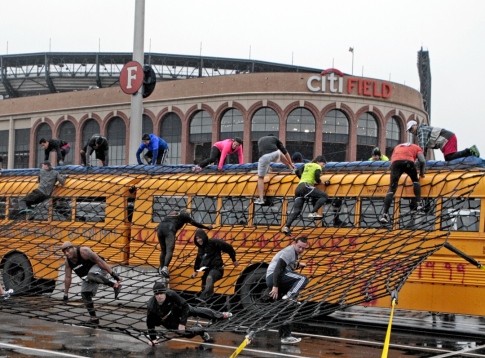
Yesterday’s Urbanathlon was a 10-mile course within Flushing Meadows Corona Park, starting and ending at Citi Field, where baseball’s New York Mets play.

Like so many “adventure races,” including Tough Mudder’s rival Spartan Race (not to mention the CrossFit Games and the American Ninja Warrior competition), the gimmick here is that it’s not just a running race–which adventure race promoters often disparage as “boring”–but an obstacle course with running built in. But with the Urbanathlon, I’d say it was essentially a 10-mile running race with a few not-so-difficult obstacles added in.

For someone like me, who runs about a 10-minute mile (which is not particularly fast) I had hoped to make up some time against faster runners on the obstacles. I have decent upper body strength and can pull up my body weight pretty easily with my arms, so I figured I’d gain at least a few minutes on monkey bars, wall climbs, etc. However the obstacles were fairly easy to complete and I never felt like I made up more than a couple of seconds on them. I can’t remember any obstacle taking more than a minute or two, at which point it became a foot-race again.

Most of the obstacles involved simple over or under moves–including jumping and ducking police barricades–or navigating short tire runs. The course did include monkey bars, but I was through them with just four or five swings. (On the Tough Mudder course, the monkey bars were spaced farther apart and were built like a peaked roof so you had to climb on an incline and then a decline. Also, they were greased up and your hands were already covered in mud, so the level of difficulty was much higher.)

By far the toughest and most unique obstacle I encountered at the Urbanathlon came in the last mile or so of the course, which took us into Citi Field. Once inside, competitors had to walk or run up and down the stands of the stadium for about six sections, a mini tour de stade. (I imagine this would have been much cooler if I was a Met fan.) From there we got to actually run on the warning track of the field–which, even for a Yankee fan, was pretty cool–and eventually out into the parking lot where we crawled under some propped up Volkswagens (sponsor!), jumped over some NYC taxi cabs (I saw a couple of guys do that slide across the hood thing you see in the movies), and up and down a cargo net stretched over a school bus.

I completed the entire course in an hour and 40 minutes, which is just about my usual 10-minute mile running pace (the course was just over 10 miles). Considering my time included conquering 14 obstacles, it’s safe to say they were nothing more than a minor hindrance to my overall pace. Overall I finished in the middle of the pack, 495th out of a field of 1,056.

Speaking of time, I had also assumed that like Tough Mudder, there would be long waits for some of the obstacles due to a high volume of competitors. (That race took me almost five hours to complete 12 miles plus all the obstacles.) But at Urbanathlon, I hardly waited for any of the obstacles besides when the people ahead of me started to slow up on the stair climb.

The Urbanathlon cost about $100 per entrant (slightly more or less depending on how early you registered). For an event of this distance that’s not a bad price, especially if it serves as the motivation for otherwise sedentary competitors to get off the couch and train for it. As for me, who’s generally pretty active, I was hoping to be pushed to my physical limit a little more than just summoning the stamina to run 10 miles. I thought the mud theme at Tough Mudder was a little overdone, but that event also has some really difficult obstacles outside of the mud, a few of which I couldn’t complete.

Obstacles aside, the Urbanathlon NYC course was beautiful as a running race. Most people who live outside of Queens (any many who do) don’t realize how much Corona Park has to offer. Aside from the U.S. Open and Citi Field, the park features baseball and soccer fields, water, biking, and even a small zoo.

For runners who want a little something extra in their races to break up the all the running, the Urbanathlon is exactly that. But for non-runners in the market for a challenging and fun obstacle course that will test both their upper and lower body, I suggest trying out for American Ninja Warrior instead.

If you’ve done any air travel in the last year or so, the airline you’re flying has probably asked you to solve a problem for them—for free. I know I’ve been asked, and I don’t like it.

Because the airline business is apparently a tough racket in which to turn a profit (fuel is expensive, etc.), many airlines now charge customers to check their bags as a way to drum up some more cash (or haven’t you noticed?).

The domino effect of charging for bags, of course, is that more people are carrying on smaller luggage avoid the checked baggage fees. This means that the once-sufficient overhead compartment space on planes is now full of bags that would have been checked (if checking was still free). The lack of overhead space is the problem they’re asking us to solve.

Airlines are now asking passengers with carry-on luggage to volunteer to check their bags (free of charge!) at the gate to cut down on delays when boarding; this was the case on my last few trips with Delta and Sun Country. The thinking is, if we all take our carry-ons onto the plane and there’s no room left in the overheads, some of us will have to check our no-longer-carry-on bags with the flight attendants anyway, which takes more time than if we’d done that up front.

As a Business Insider article points out, it’s unclear what the airlines’ incentive is for even bothering to ask passengers to gate-check Are airlines really concerned about these boarding delays, considering the whole industry constantly experiences customer-facing delays? Is there anyone among us who, when traveling by plane, doesn’t automatically assume their travel will take longer than it’s “supposed to”?

But the part that confuses me is the incentive of a customer to gate-check a carry-on bag for the greater good, i.e. the rest of the passengers on the aircraft, in the hopes of moving things along a bit more quickly.

I have, nor will I ever, volunteer to check my carry-on—which, incidentally, I packed specifically so that I wouldn’t have to check it, and thus wait at baggage claim. How much time does it even save? On my last flight I overheard the flight attendant say that 24 carry-on bags were checked at the gate, and yet there still wasn’t enough room for several of the unlucky last-boarding passengers’ bags in the overheads. (I was fortunate to find some overhead space a few rows behind my my seat, and after we landed another passenger was nice enough to pass my bag forward so I didn’t have to wait for the plane to empty to get it.)

Not to belabor the point, but seriously, why would anyone volunteer to check their bag? I saw a clergyman board my plane this weekend and even he carried his bag on and stuffed it into the remaining space in the overhead!

The aforementioned BI article suggests that the stick, i.e. penalizing non-checkers, is the best way to incentivize people to check a bag at the gate. (He recommends threatening them with no in-flight beverage service.) But I think the carrot would work better for someone like me. Currently, the “reward” for checking at the gate is nothing other than allowing the checkers to board the plane first (after first class, people with young children, disabled people, active duty military personnel, etc.). But in my view, the only benefit to boarding first is to make sure you get a spot for your bag in the overhead. Why do I care if I’m boarding first if I still have to wait at baggage claim when we land???

People like free stuff. Why not simply offer a $10 or $20 credit on the airline, good for future travel or an alcoholic drink or for-purchase food on the plane? Money towards cab fare or parking? A Best Buy gift card? Or literally anything else worth any value to a customer? (Think about it: what would it take for you to agree to gate-check your bag? Not much, but something, right?)

A New York Times columnist recently applied similar logic to the question of reclining one’s seat, which has drawn the attention of the air traveling public. Some planes have had emergency landings because of passengers fighting over leg room gained/lost by a reclined seat. The columnist suggested that if airlines want to avoid this, they should pay passengers not to recline. But I’m not sure the right to recline, knowing it will make the person behind you uncomfortable for the entire flight, is the same as the right to carry-on your carry-on.

I realize that it might not be worth it to the airline to save a few minutes while boarding if they have to pay people to do something (checking at the gate) they were previously asking them to do out of the goodness of their hearts. But if that’s the case, then I’d really like for Delta, Sun Country, or whomever I’m flying, to stop asking its customers—who have already paid for their seat with dollars—to now also donate the most precious currency they have, their time, without getting something in return.

Sitting is the new smoking.

For the last six months or so I’ve seen that phrase pop up in dozens of articles admonishing readers about the dangers of sitting all day at work. Don’t believe me? Go ahead and Google it!

I’m not here to sell you on the veracity of scientific studies that equate desk chairs and couches with cigarettes. I’m here to tell you that I personally have bought into the hype around such studies, and I’ve done something about it.

Like most white collar workers in America, I have spent at least 95% of my work hours in my career sitting at a desk, looking at a computer monitor, only getting up for coffee and bathroom breaks. On most days I eat lunch at my desk.

Outside of work my weekdays tend to be fairly active. I play competitive sports; I sometimes bike to work; I exercise at the company gym; and I run. But one of the bullet points from the many sitting-is-the-new-smoking articles that really got my attention was that despite an office worker’s active lifestyle, sitting actually negates most of the exercise we are getting when not sitting.

One of the solutions to sitting all day at work is, of course, standing. But most of us have desks built at sitting height. Bending over from a standing position to type on a keyboard meant for sitting won’t work long-term. And getting up frequently to stand or walk around is not practical for those of us who need to be at their desks most of the time to answer emails and calls, and to interact with our cubicle-mates.

Seeking possible alternatives to sitting all day, I started reading up on basic standing desks. Like their name suggests, these workstations are meant for working while standing–basically they’re just a higher desk. The problem with standing desks is that standing for our entire workday is no good, either. (I even came across a New York magazine article in which the writer attempted to stand for a whole month.)

After some more research (while sitting, of course) I found the perfect hybrid solution: the sit-stand desk (a.k.a. an adjustable standing desk), which is designed to adjust for both sitting and standing positions (duh), allowing the worker to go back and forth throughout the day.

Earlier in the summer I decided to go ahead and request a sit-stand desk from work. If they said no, I was back where I started and would consider building my own IKEA-based solution.

But they said yes!

I received a Varidesk Pro Plus ($350), which required little set up except to make sure the wires from my laptop, secondary monitor, mouse and keyboard didn’t get caught in the mechanism when I moved it up and down. (There was some trial and error on this part in order to make sure the sit-stand desk, when in sitting position, was flush with my actual desk.)

The Varidesk Pro Plus.

The Varidesk Pro Plus.

As for the standing while working, it has been totally fine. Wearing dress shoes most days, my feet did start to hurt by the end of the day for the first few days. I’d read that a lot of people who use sit-stand desks buy floor mats—just like chefs use—to cushion their feet. I bought the NewLife Comfort Mat for $40, and it has made a huge difference.

Generally I try to stand about 60% of the time, and sit for the other 40%. If I’m working on a spreadsheet or a project that requires intense concentration, I can find myself standing for over an hour without noticing. And when I eventually do notice and sit down, it’s a nice sense of relief for my back, legs and feet. At first I tried to look at the clock to make sure I was sitting and standing enough, but now I mostly just listen to my body. When I feel like sitting, usually towards the end of the day, I sit. And while I still rarely get out during lunch, I make a point to stand after I’ve finished eating.

One unintended consequence of getting a sit-stand desk that I hadn’t considered is all the attention I’m getting from co-workers, many of whom I’ve never spoken to. Generally their reactions fall into one of two camps. About half the people see me standing and say, “Oh wow, that’s so cool!” and then ask a bunch of questions about where I got it, whether I like it, how it works, etc. The other half look at me like I’m from another planet. “So…you’re gonna stand all day? Why?” Even after I talk about the health benefits, and explain that the desk goes up and down and that I can sit whenever I want, they don’t quite get why I would want to go to all this trouble to stand any more than I have to.

I can’t say that I’ve lost any weight in the last month since getting my sit-stand desk, or that I feel physically better than I felt before my new desk. My posture might be a little better but it’s tough to say. I mostly feel the same. A sit-stand desk is hardly a panacea if you have any serious health issues (and as far as I know, it will not help you quit smoking). I like to think about my decision to use a sit-stand desk the same way I think about my decision to take vitamins every day: I know I won’t see any immediate, quantifiable results from doing it, I believe that in the long-term it will benefit me.

I wouldn’t recommend a sit-stand desk for everyone, especially if you’re paying for it out of your own pocket—it could be a costly gamble if you end up hating it. But for me, I’m a month in and very happy with my decision to go for it. And for those of you out there who think I’m crazy, well, I might be. But don’t be surprised if the sit-stand desk comes to a cubicle near you!

What do you think? Am I crazy, or does the sit-stand desk sound kinda cool to you?

***Spoiler alert: Results from the 9/1 episode of American Ninja Warrior, in which Kacy Catanzaro attempted the first stage of the Las Vegas Finals, course are referenced at the bottom of this post.

By now you’ve probably heard about Kacy Catanzaro, the 5-foot, 100-pound former NCAA gymnast who conquered the first two rounds of NBC’s American Ninja Warrior to become the first female competitor in the show’s history to reach the finals in Las Vegas. If you read my blog or follow me on Twitter (or live with me) it would have been pretty hard not to hear about Kacy Catanzaro.


Fans of American Ninja Warrior may have already been somewhat familiar with Catanzaro, who competed last season but failed to finish the first stage. Back then we mostly knew her as the girlfriend and training partner of ANW great Brent Steffensen.

RELATED: American Ninja Warrior Showcases the Best Athletes You’ve Never Heard Of

I don’t think you can bet on American Ninja Warrior (at least not easily or legally) but I wish I could have seen the (theoretical) Vegas odds for Kacy and Brent each making it to the finals here in Season 6. Steffensen is what bettors would have considered a heavy favorite, having already reached the final course, Mount Midoriyama, the last two seasons. Meanwhile Catanzaro would have been a huge underdog considering no woman had ever even completed the first round of American Ninja Warrior, no less the first two to reach the finals. And surely our hypothetical bookies would have factored in Catanzaro’s diminutive stature, making her odds that much longer.

But, as the sports trope goes, that’s why they play the games. Improbably, Kacy Catanzaro did advance to Vegas while this time Brent Steffensen failed to complete the first stage, signifying the end of his season.


While NBC might have been sad to see Steffensen eliminated—American Ninja Warrior’s version of a LeBron James-led NBA team losing in the first round of the playoffs—I’m guessing they were happy to trade their biggest male star for an up-and-coming female one like “Might Kacy” (or #mightykacy on Twitter). And that’s what they now have: Kacy Catanzaro’s historic run is easily the most important narrative of American Ninja Warrior Season 6—maybe the most important narrative the show has ever had.

(Two other women, Michelle Warnky and Meagan Martin, actually finished the first stage with faster times than Catanzaro–but neither completed their respective regional finals courses to advance to the finals.)

In the days after Catanzaro’s landmark run, the media slowly started to take notice. People were interested, including those who had never heard of American Ninja Warrior. Heck, even my mom sent me an email with the subject line #mightykacy: “I can see what you were getting all worked up about! She’s amazing!”

NBC knew* what it had in Kacy. On the July 14 episode of American Ninja Warrior, in which Catanzaro completed the second stage, her run wasn’t aired until the last fifteen minutes of the two-hour broadcast, with the announcers teasing the audiences going into each commercial: And coming up later, Kacy Catanzaro looks to become the first woman to reach the American Ninja Warrior finals in Las Vegas!

*NBC also knew the results in advance of the 7/14 episode. Like the World Series of Poker on ESPN, American Ninja Warrior is not broadcast live. I wouldn’t be surprised if NBC moved to a live format in future seasons. I’m actually quite surprised Kacy Catanzaro’s results weren’t spoiled online by any of the people who were in the crowd for either of the first two stages in Dallas where she competed.

But if you’re an NBC Sports executive who oversees American Ninja Warrior, what are you rooting for? (This question is posed while fully acknowledging that NBC already knows the results of this season.) Part of the show’s appeal is that no American has ever stood atop Mount Midoriyama. If Kacy Catanzaro completes the finals course in Las Vegas in just her second season on American Ninja Warrior, it’ll bring even more short-term attention to the nascent sport–but is it good for the long-term success of the ANW brand? Or would it feel like a magician revealing the secret behind their best trick, in that once you see how it’s done, it suddenly seems a lot less impressive?

UFC star Rhonda Rousey. (www.mmaoddsbreaker.com)

UFC star Rhonda Rousey. mmaoddsbreaker.com

I recently came across an article at Slate.com about the female Ultimate Fighting Championship (UFC) star Rhonda Rousey who, like Kacy Catanzaro, has been a marketer’s dream for her sport. A personable, attractive Olympic judo medalist turned mixed martial arts fighter, Rousey quickly rose to the top of the UFC world. The only problem was no one rose with her. Rousey has remained undefeated in 10 fights since her debut in 2011. Per the Slate article, her trash-talking style along with her perfect record has now made her the sport’s villain on the female side. The article goes on to suggest that maybe, just maybe, Rhonda Rousey losing a match would be the best thing for the sport.

Regardless of which result at Mount Midoriyama would propel American Ninja Warrior’s long-term popularity the most, I’m rooting for Kacy to go all the way. Hey, if ANW doesn’t like it, they can build a tougher course.

RELATED: “‘American Ninja Warrior’ Producer: How Kacy Catanzaro Changed Our Show Forever” (via Entertainment Weekly)

***Update: Unfortunately Kacy Catanzaro did not complete the first stage of the Las Vegas Finals course, falling victim to the Spider Wall. While her size had not hampered her progress up to that point, Catanzaro appeared to have had a tough time reaching either side of the Spider Wall with her arms.

Note: This post was originally published before the 7/14 episode of American Ninja Warrior. If you’ve been paying attention, you probably already know that Kacy Catanzaro has advanced to the finals in Las Vegas and will take on Mount Midoriyama, the first woman to reach this stage of ANWVideo of both her runs so far are included below.

I’ve been very fortunate to grow up in a fantastic era for sports fans.

I was a Bulls fan during Michael Jordan’s prime and saw his famous up-and-under move in real time on TV during the 1991 NBA Finals versus the Lakers.

A lifelong Yankees fan, I witnessed their 1990s dynasty not to mention Derek Jeter’s backhanded “flip” to nab a runner at home plate in the 2001 American League Division Series. Oh yeah, and I’ve been around for Mariano Rivera‘s entire career.

And as a bonus I’ve had the good fortune to watch my hometown football Giants recently win two Super Bowls they, quite frankly, had no business winning against the heavily favored New England Patriots.

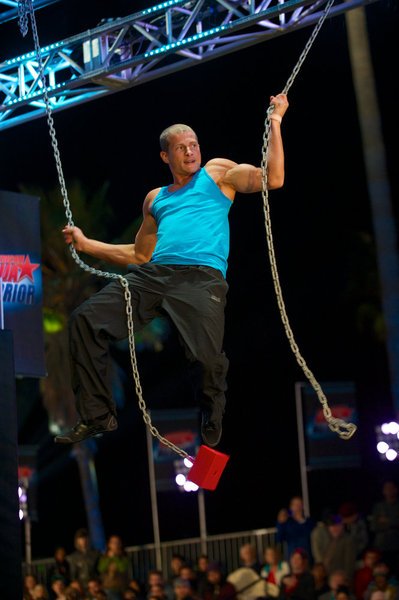
And yet for all the tremendous sports moments I’ve witnessed in my 32 years, it was an obscure “game show” called American Ninja Warrior that provided one of the most incredible athletic feats I’ve ever seen.

American Ninja…What?
An old college buddy introduced me to something called Ninja Warrior back in 2008. On a Sunday morning after a beer-fueled college tennis team reunion (GO HAWKS!) he was fecklessly flipping through the channels on my cable box when he got to the G4 network (now Esquire Network) and exclaimed, “NINJA WARRIOR! THIS SHOW IS AWESOME!”

Ninja Warrior, an edited-for-America version of a Japanese “sports entertainment television special” (to borrow some Wikipedia phraseology) called Sasuke, featured contestants attempting to traverse a series of obstacle courses, each with obstacles that make the popular Tough Mudder competitions or old school American Gladiators episodes look like child’s play.

Obstacles named Salmon Ladder, Unstable Bridge, and Spider Wall were designed to chew competitors up and spit them out, daring them to come back to next year and try again.

Eventually a short-lived G4 series called American Ninja Challenge—allowing Americans to compete for a spot on Sasuke—gave way to the current American Ninja Warrior format, which takes place entirely in the United States, with the final series of courses, i.e. “Mount Midoriyama,” built and filmed in Las Vegas.

Boys’ Club?
The great appeal of American Ninja Warrior is the American Idol-, World Series of Poker-like everyman quality. They are accountants and salesmen and teachers and preachers of all ages (some in their fifties, God bless ‘em!) who are in great physical shape and have any of several athletic hobbies—stuff like rock climbing, gymnastics, or Parkour—that help prepare them to compete, and even thrive, among the best of the best on the ANW course.

Some of these men, early adopters of American Ninja Warrior, have become household names (or at least faces) for those of us who have watched ANW for a few seasons. Guys like James “The Beast” McGrath, Dave “The Godfather” Campbell, and Brent “I Don’t Have a Cool Nickname But I Am A Professional Stuntman” Steffenssen come back each season rededicated despite failed runs at Mount Midoriyama—and despite that fact that no American, in six seasons of the competition, has conquered it.

Brent Steffensen navigating an obstacle. (Photo credit: Brandon Hickman/NBC via www.monstersandcritics.com.)

Brent Steffensen navigating an obstacle. (Photo credit: Brandon Hickman/NBC via http://www.monstersandcritics.com.)

And come back they have, with experience their most valuable asset. Having seen what the course is all about, many competitors construct their own obstacles in the off season to practice. (Heck, you can even buy blueprints of American Ninja Warrior obstacles—and it’s only a matter of time before IKEA starts selling ANW kits.) Knowing that they’re physically capable of conquering an obstacle is half the battle. The other half then becomes like any other sport, with many practice hours (hopefully) bringing out one’s best performance on game day.

While still very much a niche sport, American Ninja Warrior is steadily growing. According to ANW‘s executive producer Kent Weed in an interview with The Hollywood Reporter, the show received 3,000 audition tapes for the current season–more than double the 1,200 it received for the prior season.

While the body types of the competitors can vary from muscular to toned to lanky, one sort of body is conspicuously underrepresented: the female body. In any given episode one woman’s run at the course might be featured for every twenty men (maybe more than that), and typically those women never advance past the first few obstacles in Stage 1. Yet each season for the last three or four that I’ve watched, more and more women are attacking the course—and getting a little farther along each time.

The Mighty Kacy
It stands to reason that a tall woman would have the best shot at completing Stage 1, given that many obstacles rely on jumping and running across wide gaps, swinging and reaching, and pulling one’s own body weight horizontally and vertically. So the first time I saw 5-foot-tall Kacy Catanzaro step up to the starting line I didn’t like her chances—until I learned a little bit about her background.

Kacy Catanzaro negotiates The Ring Toss. (Photo credit: Alexandra Olivia via www.dallasnews.com.)

Kacy Catanzaro negotiates The Ring Toss. (Photo credit: Alexandra Olivia via http://www.dallasnews.com.)

Catanzaro, 24, is a former Division I gymnast at Towson University. The Dallas qualifying round in 2014 was not her first attempt at completing Stage 1 of an ANW course, so she had some experience on her side. Oh, and her training partner (and boyfriend) just happened to one of the most successful ANW competitors of all time, the aforementioned Brent Steffensen.

“Beat That Wall!”
For five minutes and 26 seconds, Catanzaro carefully negotiated an obstacle course built for bigger, stronger humans (she only weights about 100 pounds), culminating with the final obstacle of Stage 1: The Warped Wall, a 15-foot high curved wall just like the ones in Sonic the Hedgehog. (Not familiar with Sonic? Just see the image below.)

(The way she approached each obstacle, focused and purposeful but not scared, was not unlike the way Rivera pitched, especially in his final season. He no longer had the raw athletic ability to dominate hitters as he once did, but he could find a way to piece together three outs in a matter of minutes, as if he knew something the hitters didn’t.)

An American Ninja Warrior contestant attempts The Warped Wall. (Photo credit: www.austin360.com.)

An American Ninja Warrior contestant attempts The Warped Wall. (Photo credit: http://www.austin360.com.)

By the time she reached the wall Kacy Catanzaro already completed several obstacles that many other competitors, men and women, had failed at. Had her run ended with three failed attempts to climb the wall—the maximum allowed before a contestant is disqualified—it still would have been as close as any female had come to completing Stage 1 in six seasons of the show. But it wasn’t good enough for Kacy.

The trick to climbing The Warped Wall in my view—from the couch—is to find that perfect moment while running up the wall to jump towards the top and hopefully grab the ledge and pull yourself up. Some competitors are strong and athletic but never seem to find their perfect moment; others simply rely on an abundance of height to make up for their lack of timing. (There’s some info out there on the physics of The Warped Wall in case you’re thinking of building one in your backyard.)

Catanzaro, who trained for The Warped Wall and other obstacles using replicas she and Steffensen had built for practice, was relying on flawless technique to make up for a dearth of height. On her first attempt at the wall, it seemed she had the timing just right, but her fingers came up short.

With the crowd chanting, “Beat That Wall!”, Catanzaro paused and caught her breath before making her second attempt. Rather than dejection, her face read only of complete focus. Again, she ran full speed ahead, leapt at just the right moment and…she did it! She pulled herself up to the top of the wall, turned around to slam the buzzer that stopped the clock and she was through Stage 1! See Catanzaro’s entire Stage 1 run below.

The announcers howled above the crowd noise as Catanzaro stood above everyone there in Dallas that night, pumping her fist and chanting, “Yes! Yes! Yes!” as Steffensen looked on proudly. I had goosebumps.

ANW event coordinator Michelle Warnky became the second woman to finish the course, making it up The Warped Wall on her first try in just 3:09 in St. Louis (and, actually, making it look really easy), while rock climbing instructor Meagan Martin later completed the course in 4:46 in Denver. It’s a safe bet that we’ll see even more female athletes qualify in 2015.

What’s Next?
On tonight’s episode of American Ninja Warrior, at 9 pm Eastern on NBC, Kacy Catanzaro will try to top her already incredible run by becoming the first woman to complete Stages 2. Perhaps she’s still a year away from that feat, or maybe she’ll ride the momentum she’s created all the way to the next round at Mount Midoriyama.

No matter what happens tonight, Kacy Catanzaro, Michelle Warnky, and Meagan Martin have already changed the game for women and men. Maybe the eventual next step for American Ninja Warrior is to have separate male and female competitions, as we see at the Olympics, CrossFit Games, or sports like tennis or mixed martial arts (e.g. UFC). Whatever comes next for the sport, we already know that American Ninja Warrior has likely found its newest crop of female stars and perhaps more importantly, the new faces of the brand.

**UPDATE** Kacy did it again! On last night’s (7/14) episode of American Ninja Warrior, Catanzaro completed the Stage 2 course and is headed to the finals in Las Vegas! See her full run below.

RELATED: NBC, American Ninja Warrior Go All-In on ‘Mighty’ Kacy Catanzaro

If I asked you what your favorite TV drama was, current and/or all-time, what would you say?

What’s mine? Oh, thank for asking, loyal reader! A few months ago, I’d have been ready with my oft-repeated answer: HBO’s The Wire and AMC’s Breaking Bad. These were my 1 and 1a.

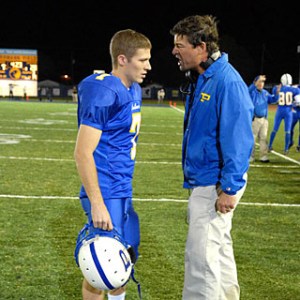
Yet recently another show has emerged that has earned its share of a three-way tie in my TV drama Mount Rushmore: NBC’s Friday Night Lights. The series centers around a high school in the fictional town of Dillon, Texas, and its students, its football team, the team’s first year coach, Eric Taylor, and his wife, Tami Taylor. The Taylors are played by Kyle Chandler and Connie Britton.

What’s strange about this addition to my list is that the Friday Night Lights hasn’t been on the air since 2011, when it wrapped up an improbable five-season, 76-episode run. I say improbable because like The Wire and Breaking BadFriday Night Lights was critically acclaimed but low-rated, and was always on the verge of cancellation due to lack of viewership.

My wife and I binge-watched the final four episodes of the series this past Memorial Day Monday and I’m still pretty amped after the finale. But I’ve been thinking about FNL’s place on my list for a while now, so we’re outside the PH zone when I say it’s one of the best shows I’ve ever seen.

FNL1Netflix-recommended, wife-approved. Friday Night Lights came highly recommended via Netflix’s aptly named “Recommended for Bobby” section. I figured it would become one of my shows, like Louie, to watch when my wife was not home (this, rather than one of our shows, like Orphan Black, which I’m forbidden to watch without her).

One night my wife came home to me watching FNL and realized she’d actually seen the episode I had on. It turned out she’d already seen the entire first season when it had originally aired on NBC. From that point on FNL was officially an our show.

We were, of course, tempted to speed through seasons 2 through 4 in a week or two because we couldn’t get enough. But really there was no time crunch to catch up before the next season started—the supposed “Netflix Effect”—because the show was already off the air (this also effectively eliminated the possibility of reading spoilers online). So we took our time and only watched a few episodes a week—a true test of our collective willpower.

How the hell did I (almost) miss this show??? The one gripe I have with FNL is NBC’s marketing of it back in 2006. When I first heard there was a new show coming out called Friday Night Lights based on the eponymous book and movie (which I saw and enjoyed) I thought, “Now it’s a TV show, too? Haven’t they already squeezed enough out of this one story?” I didn’t know the show would be fictional (i.e. inspired by but not based on the actual 1988 Permian Panthers high school football team from the book and movie), would take place in present day, and would be, well, really freakin’ good.

When the show came out I was 24 years old and exactly the sort of person who would have watched Friday Night Lights—had I known a little more about it. In fact in Grantland’s terrific oral history of Friday Night Lights, co-executive producer John Zinman mentions the lack of clarity of the promotional posters, which made it seem like a football show rather than a drama with football in it.

Gloriously in-your-face product placement. Sometimes product placement on TV programs is seamless, and other times it’s uber obvious. On FNL, two brands’ product placements stood out, but each was pulled off in a way that I didn’t mind as a fan of the show–or as an advertising professional.

The characters on FNL spent a lot of time at Applebee’s. When a scene opened at the leading “neighborhood” family restaurant chain, the external shot always clearly showed the Applebee’s signage. My favorite Applebee’s placement within the placement was Coach Taylor’s quip, “Did they change this menu or what?” (They did, Coach Taylor. Thanks for bringing this to America’s attention.)

Coach Taylor’s teams wear Under Armour uniforms and accessories. There is no mistaking the UA logos that are EVERYWHERE. In season 4 when Coach Taylor’s team is strapped for cash, his friendly Under Armour sales rep is willing to work with him on deferring his payments a while. (And your friendly local Under Armour rep would be willing to work with you as well, America.)

For the record I found product placements far less distracting than the fictitious colleges constantly referenced on the show: TMU? Braemore College? Oklahoma Tech? The Chicago Art Institute?

FNL3

Tough love from Coach Taylor.

The Great Coach Taylor. We’re led to believe that Coach Taylor knows the X’s and O’s of the game better than anyone, but to me it always seemed that he was no better an on-field coach than the next guy (though his play-calling was certainly ballsier than most). What makes him The Great Coach Taylor is his ability to work with teenagers, often whom are inadvertently sabotaging themselves for reasons they don’t entirely understand. As his wife tells him in a moment of self-doubt, “You are a molder of men.”

(Mancrush alert: I became so enamored with the Coach Taylor character that most of my time watching the show I was terrified he would do something “bad” and I’d have to find a new idol. Spoiler: That didn’t happen, and my new mantra is WWCTD?)

Tami Taylor. In that same Grantland piece Connie Britton said she wasn’t willing to reprise her role as the “coach’s wife” (she was Billy Bob Thornton’s wife in the movie version of FNL) unless her character had more depth than simply rooting for the Panthers from the stands.

Talk about ballsy play calling. Britton wasn’t working a ton at that point and could have used a steady gig, even if it was glorified extra work. But she was right: her role on the TV series turned out to be as important as any character’s, including Coach Taylor himself. The balance the character provides as Coach’s counterpart both inside their home as a wife and mom and as a fellow molder of young men and women as a guidance counselor makes the show. As much as I love Coach Taylor (see above), the show just wouldn’t be as strong if he didn’t have Tami to support and challenge him (more on that in the next section).

(Britton’s stellar work on FNL no doubt helped her score her next two TV series, FX’s American Horror Story and ABC’s Nashville.)

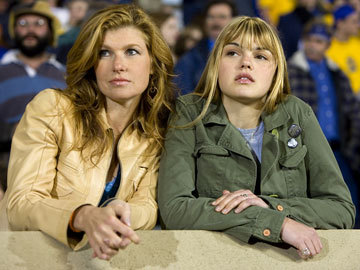
Connie Britton and Aimee Teegarden play mom and daughter, Tami and Julie Taylor.

Connie Britton and Aimee Teegarden play mom and daughter, Tami and Julie Taylor.

Mr. & Mrs. Taylor. Part of me is glad I missed the boat when FNL originally aired on NBC and I was still in my twenties. Now that I’m in my thirties and married I have a much stronger appreciation for Eric and Tami Taylor’s relationship.

If the show is about a handful of subjects—perhaps least of which is high school football in Texas—one such subject is Taylors’ marriage. They negotiate every minor disagreement (Eric invited the entire team to a barbecue at their house and didn’t tell Tami until the last minute!) and major family decision (no examples here as not to spoil!) with mutual respect and are never intentionally hurtful. Coach Taylor: “Marriage requires maturity. Marriage requires two people that will listen, really listen to each other. Marriage most of all requires compromise.” This friggin’ guy.

Football is dangerous. While I respect the fictional Coach Taylor (and the men like him who I’m sure exist in real life) it’s tough to reconcile the ideas that 1) football is a team sport that at its best can build an individual’s character and bonds among teammates that few other activities or sports can, and 2) football at its worst can be extremely dangerous and in some cases deadly.

Many questions about the safety of football have arisen in the last few years since FNL went off the air. I can’t help but wonder whether growing criticism, particularly as it relates to head injuries, might have marred the show’s positive depiction of football in some way. A critical scene in the pilot addresses this—a player is paralyzed as a result of an on-field collision—but rarely again in the series are we reminded how dangerous the game can be.

Needless to say I recommend FNL to anyone who has Netflix and loves compelling stories and great acting. Have you seen FNL? What’s your all-time favorite TV drama?

I started watching ABC’s Shark Tank less than a year ago and since then, I haven’t been able to stop.

The concept of the show is simple: product inventors and/or owners of nascent businesses stand in front of five millionaires and billionaires–would-be investors in their business, or “sharks”–and pitch them on why they should invest their own money in exchange for part ownership (i.e. equity) in a company they’ve never heard of run by someone they’ve never met before.

Most of the presentations are what I’d call “professionally cheesy” (or “cheesily professional”?). They’re rehearsed little 30-second intros that tell the sharks the name of the company and tease what it does or makes, finishing with a flourish in the form of a catchy slogan often uttered in unison. (Jelly company Mango Mango went with, Are you ready for this jelly?) At some point during the little song and dance the entrepreneur(s) (or “treps,” for brevity’s sake) reveals what share of their company they’re selling and for how much equity, e.g. $50,000 in exchange for 20% equity in the company.

Depending on the product, there’s usually a short demo of how it works or what it does, after which the floor is open for sharks to pepper the treps with questions about manufacturing costs, margins, annual sales, their background, and anything else germane to a potential investment.

The better presentations–and the ones most likely to whet a shark’s appetite–are the ones where the treps A) know all the answers to the sharks’ questions and B) have good answers. By good answers I mean the company is profitable, the margins are high (i.e. the product sells for a high price but costs very little to make), and sales have increased year over year.

(One pet peeve of mine related to the Q&A portion is that almost every trep’s answer starts with, “So,” as in, “How much do you make it for and how much do you sell it for?” “So…right now it costs about $5 a unit to produce and we sell it at retail for $9.99.” I know it’s just a stall word in a nerve-wracking situation to let them gather their response, but they do it every time!)

Where was I? I blacked out. Ah yes, the sharks. Each has their own distinct business background (click the links in each shark’s name to learn more), personality, area(s) of expertise, and investment strategy. Episodes features five sharks from a rotation of six. The sharks, far more than the treps, make the show what it is. For the uninitiated, the sharks are:

  • Mark Cuban. The moral compass of the show. Usually very supportive and free with advice even if he doesn’t make a deal with the trep. Calls out his fellow investors for bad deals that don’t favor the trep. Occasionally calls out treps (2:20 mark) whose products/companies he deems specious, irresponsible, or who are on the show for free advertising and not actually seeking a partnership. (Cuban also forced Shark Tank‘s production company to change its policy re: taking 5% of all businesses that appear on the show, regardless of whether a shark chooses to invest his/her own money. What a guy.)
  • Kevin “Mr. Wonderful” O’Leary: Shark Tank’s answer to Simon Cowell and the show’s constant reminder that it’s not a charity—it’s about making money. On almost every episode Kevin will eschew equity and request a royalty deal where he recoups his investment upfront by taking a cut of every unit sold until he’s paid back in full, then taking a smaller royalty for each unit sold “in perpetuity”—meaning FOR-EV-ER.
  • Robert Herjavec: The nice family guy—but don’t jerk him around or he’ll say things like, “I’m a very nice guy, but don’t mistake my kindness for weakness.” Also loves kids and dogs.
  • Lori Greiner: A Chicagoan (listen to the accent) and big player in the QVC world—which is the driver behind most of her deals, as in “This will sell very well on QVC.” (Incidentally, I had no idea QVC was such a huge moneymaker but based on the size of some of the checks she writes, it’s doing a-OK.)
  • Barbara Corcoran: The wacky older woman on the panel–wacky like a fox, that is–also with ties to QVC.
  • Daymond John: Tends not to stray too far from his forte, fashion. Will regularly mention that he started out selling hats on the street (he founded FUBU).

Any time I talk about Shark Tank (which is often) to someone and they’ve actually seen the show, the response is almost always “You watch it, too? I LOVE Shark Tank!”

On May 2 ABC aired a behind-the-scenes special, “Swimming With Sharks” (click the link to view the special) that gave fans a look at the sharks when the camera wasn’t rolling, and some dirt about some of the show’s biggest deals (and non-deals)—as well as some of the stinkers. Below is a recap of each company update:

  • Breathometer ($50): A device that plugs into smartphones and works with a mobile app to perform a self-Breathalyzer test. Per the special, Breathometer expects $10 to 12 million in sales in 2014.
  • Lollacup ($15): A children’s drinking cup with a weighted straw that allows kids to drink even when the cup is not right side up. Profits from Lollacup netted the trep couple who started the company with their $1M dream home.
  • Simple Sugars ($22): All-natural sugar scrubs. Was doing $88,000/year in sales pre-Shark Tank, finished 2013 with $2.1M in sales.
  • Bubba’s Boneless Ribs: A patented process for removing the bones from ribs (without losing the essence of the rib, of course). $200K in first ten days after appearing on Shark Tank.
  • PRO-NRG ($2): A Brandon Jacobs-backed energy drink eventually repackaged as a protein water–after Daymond’s investment and intervention. Per its founder, they’re over $1.5M in sales. During their presentation Mr. Wonderful repeatedly referred to the company as “Pro Nerg.”
  • Stella Valle: A jewerly line made by two female U.S. veterans. $2.5M in sales post-Shark Tank ($50K before).
  • Tipsy Elves ($60): Intentionally ugly Christmas sweaters. No sales figures given.
  • Grace & Lace ($20-36): Lacy women’s socks designed to be seen partially while wearing boots. No sales figures given.
  • Tree T-Pee ($6-7): A mini tent designed to put around trees keep in water from sprinklers to save water. After appearing on the show the trep scored a deal with Home Depot.
  • Voyage Air Guitar ($429): A guitar that folds in half. Working with Kevin, the trep licensed his product to Fender. No sales figures given. Despite their business partnership, the trep and Kevin seem to genuinely dislike each other.
  • Wicked Good Cupcakes ($8): Cupcakes in a jar. Kevin’s royalty deal of 45 cents for every cupcake sold paid off. They’re selling $265K/month.
  • Toygaroo ($40/month): “The Netflix for toys,” lost $200K and went out of business in six weeks. Per Mark, Kevin and the trep had different visions and that caused the company to go under.
  • Copa Di Vino ($3): The trep rejected the sharks on two separate episodes. Mark called him a “gold digger” who was only on the show for the PR. The $300K investment the treo was seeking at the time of his second appearance would have been work $3M today. Now doing $25M in revenue. Trep has a private jet, apparently. Good for him.
  • ReadeREST ($9): A ridiculously simple magnetic hook on which to hang reading or sunglasses. $8.2M in sales so far.
  • Scrub Daddy ($7): A scratch-free scrubbing sponge. The most lucrative trep in Shark Tank history is expected to finish 2014 with $16M in annual sales, and is projected by shark investor Lori to do $30M next year. Within the first hour of their episode airing, Scrub Daddy had 30 to 40K website hits.

Some other thoughts from the special:

  • Mark, according to Robert, is worth more than the rest of the sharks combined ($2.6 billion per Forbes), which I didn’t realize. I’d imagine in some cases, though not all, this gives him an advantage when negotiating against the others.
  • “We are the Mick Jaggers of the business world,” according to Robert. Um…
  • Mark mentioned that it was a family show and people come up to him and say their 9-year-old daughter is obsessed with valuation. Adorable.
  • “Buying a nicer car isn’t as powerful as taking care of my children,” says Robert. He’s so quotable!
  • Interestingly in the “shark on shark” interviews the two female sharks said Mr. Wonderful was a teddy bear, while the guys called him a jerk (excluding Mark Cuban, who wasn’t interviewed, probably because they actually hate each other in real life).
  • We can certainly debate the “realness” of Shark Tank, the vibe I got from all the shark interviews is that it’s genuinely competitive and that none of them wants to be bested by the others. And while this might be viewed as a bunch of rich men and women gambling with these treps’ companies like they’re at a high stakes poker table, the treps stand to gain the most if one of the sharks bets big on them.

Pulling Cables

“Hey Bobby, what’s the weirdest job you ever had?”

No one’s ever actually asked me that, but if they did, I’d pause, pretending to think about my answer as if I wasn’t waiting for someone to ask me that. Then I’d say, “Um, I guess I’d have to say…pulling cables.”

The asker, not trusting their ears, would say, “Did you say waiting tables? What’s so weird about that?”

“No,” I’d say. “I said pulling cables.”

“Wait…what?”

During my senior year of high school I scored a plum job answering phones at a billing center for a prominent medical lab–prominent meaning there’s a good chance this lab has tested your pee and/or blood for something at some point in your life. My friend Nikki’s mom worked there and set us up with the gig through a temp agency. The job paid $10 an hour, plus time-and-a-half overtime, and was just 15 minutes from my parents’ house.

The following August I went away to college and when I came back for winter break that December, the billing center had moved offices–it was now about 30 minutes from my parents’ house. They were still willing to bring me back, but I was worn out from my first semester of college–which included a lot of driving as part of my job as the world’s worst traveling knife salesman–and decided I wasn’t willing to commute a half hour each way for three weeks, even for a job I really liked. (Five  years later, I commuted two hours each way for a year to my first job in the city that paid less than I’d been making at the billing center. Even now, living and working in Manhattan, my commute is 40 minutes each way on a good day.)

The temp agency still had my paperwork on file and my contact there set up my friend Sean and me with a three-week gig for the same rate of $10 an hour.

We were placed at an obscure technology company and told to show up the following Monday for some work “pulling cables.” We, of course, didn’t know what that meant (I’m not sure our contact did, either, but to her credit she kept a straight face when she told us). But for $10 an hour–far more than I’d been making selling knives–we were willing to just about anything for three weeks. Or so we thought.

Imagine an office building in one of those industrial office parks, a la The Office’s Dunder-Mifflin. In that office building, imagine a large room off a drab hallway. The room is filled with a constant humming sound emitted from a few dozen computer servers each about six feet tall–the same kind of server someone decries as being “down” when they can’t get on Facebook at work.

In this room, the floor isn’t really a floor. It’s tiled with 2’ by 2’, removable square panels mounted on a series of metal stanchions. Under the floor is a snake pit of thousands of computer cables that connect the servers to…well, I was never sure what they were connected to.

Our temporary boss was a man who introduced himself to us as Robert–but whose office door had a nameplate on it that said “Moshe”–explained that our assignment for the next three weeks was to pull up any loose cables that were no longer connected to anything at either end and put them in a pile off to the side. We were basically there to remove the dead snakes from the snake pit and leave the live ones alone.

The process of pulling a cable always began at the end of a cable which had already been disconnected from a server at one end of it. I would hold that loose end, then wait for Sean to get in position. Sean would remove one or more of the floor tiles a few feet away in the direction we assumed the cable was running–as I wiggled my part of the cable in my hand–in the hopes of locating any semblance of movement created by my wiggling. If Sean saw movement, he would grab that cable and hang on tight, waiting for me to run ahead to the next spot where I anticipated the cable continued, then lift up those tiles to find the same cable and grab it.

This leapfrogging would go on for sometimes five minutes, other times 20, until we could locate the end of the cable and pull it completely out of the floor. We would then put it on a small pile of cables that we had successfully removed. Our dialogue when tracking and pulling a cable would carry on as follows:

“Do you see it?”

“No.”

“What about now?”

“NO.”

“Okay you should definitely see it now.”

“I STILL DON’T SEE IT.”

“Do you wanna just start over with a new cable?”

“Yeah.”

(The conversation might also have included a string of profanity around the word “STANCHION!” if one of us had banged our shin on a stanchion.)

We made it about four hours into the first day before Sean said, “Bobby, I can’t do this anymore.”

“What do you mean?” I said. The work was mundane as it gets, but I wanted to rack up as many hours as I could. I needed the money.

“I can’t do this for eight hours a day for the next three weeks.”

“Okay, fine,” I said. I, too, was growing mind-numbingly bored, but wasn’t as willing as Sean to admit it just yet.

We finished out the first day but on the next morning, after talking it over some more, we approached Moshe/Robert to explain that at best we could do this work for four hours a day. Any more than that, we said, we’d lose our minds.

Moshe-bert agreed to our reduced hours a little too quickly–making me wonder if we were not the first ones to hold the prestigious cable puller position–and we went to work.

Even four hours a day was brutal, as Sean and I reached a state of delirium that no amount of coffee could remedy. Still, we pulled cables as efficiently as we could, and added them to the pile. When we found a particularly long cable, we cut it in half to make the pile seem bigger. There wasn’t a quota as far as we knew, but “doubling up” made us feel like we’d accomplished slightly more than we actually had.

At the end of our three weeks, our pile was disappointingly small. But by then we didn’t care–the small dent we’d put in the snake pit was negligible (the before and after pictures would have looked identical) and I’m sure Robert-Moshe was left wondering what the hell he’d paid us for.

 —

Pulling cables wasn’t the last time Sean and I worked together. Four years later we were new college graduates looking for the dream jobs we’d been promised our entire academic careers. Instead, with our first student loan payments looming, we settled for part-time sales associate positions at The Sports Authority. The application included a drug screening. My former employer, the medical lab, tested our urine.

The job was pretty miserable, as most retail jobs are. I made $8 an hour but Sean, who had previous forklift experience (not a joke), made $8.50/hour.  We spent our weeknight shifts barely interacting with the bare minimum of customers perusing the teams sports section of the store, offering help on items like hockey sticks and mouthguards, which we knew nothing about.

The rare non-miserable “highlights” of working at TSA were: 1) someone in the receiving department had a “hook-up” at a convenient store and brought in free day-old Krispy Kreme knock-offs; 2) the break room had a VCR and three donated VHS tapes, Home Alone, The Mighty Ducks, and Billy Madison, which we watched literally every time we took a break; and 3) wait no, just two non-miserable highlights.

As Sean and I pondered where we’d gone wrong, how we could have a Bachelor’s degree in hand yet no job prospects worthy of one, our only saving grace–our mantra, really–became, Hey, at least we’re not pulling cables.