Feeds:
Posts
Comments

The Cool Sub

“JEN-ri? Is there a JEN-ri Rodriguez in this class?”

“Uh…it’s Henri,” Jenri said.

I was four minutes into my substitute teaching career, and I was already butchering a student’s name while trying to take attendance.

“Oh, um, sorry about that.” I may as well have been repeating Bueller.

I’d gotten the subbing gig through my mom, who was a middle school teacher on Long Island. It was late 2004 and I was a few months out of college at that point, with little in the way of job prospects. I’d snail-mailed my cover letter and resume to every publishing house in the tri-state area in the hopes of getting something entry level with my journalism degree, with visions of reading manuscripts for a living. But after receiving just one response—a polite but unequivocal “no”—I took a part-time job at The Sports Authority for $8 an hour to hold me over with first student loan payment looming.

The prospect of dealing with 13- and 14-year-olds all day was not appealing to me in the least, but subbing paid $110 a day and didn’t require any teaching experience—plus I’d be out of work by 2 pm every day. Meanwhile, I continued to look for full-time work and kept a couple of shifts a week at The Sports Authority.

Like every substitute teacher in the history of substitute teachers, I was determined to be “the cool sub” who wasn’t a stickler for the rules. After I made a few appearances, all the kids would be glad to see me when their teacher was out. “Nice, we got Mr. Calise subbing today,” they said in my insanely unrealistic fantasyland scenario.

Delusions aside, I knew better than to attempt any actual teaching. I fully understood that my job was to do nothing more than take attendance, hand out whatever busy work the teacher had left for her students, and make sure the kids didn’t fight with each other or destroy the classroom. I was a glorified babysitter.

After my first day my name was in “the system,” meaning that the night before a school day I would receive an auto-dialed call on my cell phone, which would tell me my assignment for the following morning.

There was no ostensible rhyme or reason behind my subbing assignments—as far as I could tell, they simply were pulling my name out of a digital hat. In my short career working at the school, I subbed in just about every subject.

One day they had me covering for a music teacher. His “classwork” for the kids was having them watch the part of the movie Grease they were up to from the last time he’d been out. I had very strict instructions to “fast forward through the sex parts.” By the third or fourth class of the day my censoring was faster than Greased Lightnin’.

The music teacher’s final class of the day was off the middle school campus at an elementary school, where all I had to do was put on a Charlie Brown video for a class of first graders. Unlike the junior high kids, who gave me a hard time about everything I said or did, the first graders were afraid of me. But once I turned off the lights and put on the video, they were entranced and seemed to forget I was there. When a song started in the Charlie Brown movie, they started singing along in unison in their little voices. It was the only time in five months subbing that I actually considered becoming a full-time teacher.

My most coveted subbing assignment was phys ed. (I cannot overstate the satisfaction of being allowed to come to work in a polo shirt and track pants.) The kids were even wilder than they were in their other subjects, but each phys ed class was taught by three teachers, so I pretty much just played with the kids and helped corral any stragglers back to the pack. Usually the “lesson” I co-taught was a game that could be played by fifty or sixty students at a time. One day we did volleyball with a twist—each side had about thirty kids volleying an oversized beachball that required at least five people pushing at the same time to get it over the net.

I didn’t typically interact with the teachers I’d subbed for once they came back to work. I would usually leave a short hand-written note for each period’s class in the teacher’s mailbox, letting them know whether the kids completed their classwork (or at least pretended to work on it) and whether they behaved.

On one occasion, I wrote a scathing note about a science lab class that had given me a particularly tough time. When I came for work the next day, I got called back to that classroom during the period that the class had behaved so poorly the day before. The teacher for whom I had subbed told me, in front of the whole class, that her students were not allowed to do a lab that day because of how badly they’d behaved for me. The kids collectively glared at me for having ratted them out. I did a terrible job of hiding my smirk as I thanked the teacher and left the room.

After almost five months of subbing, I finally found a full-time office job in the city. One of my last assignments before I left was a shop class. I didn’t know the first thing about shop — I hadn’t even taken shop when I was in school — but luckily the teacher had left a video.

I arranged for the audio-video set to be wheeled in, a tall tower with a heavy tube TV and a VCR, just like the ones we used when I was in middle school.

I popped in the VHS, which turned out to be a recording of an NBC Saturday morning TV special about technology from the early ‘90s—remember, this was 2005—hosted by none other than rapper-actor LL Cool J. (About the video: The creators apparently thought the future would be a lot like The Jetsons, minus flying cars and meals in pill form. Strangely, the creators of the special hadn’t seen the iPhone coming.)

Maybe I’d become more comfortable being in front of a room full of kids, or maybe I was a little giddy because I knew I was leaving soon for my new job. Whatever the reason for my newfound jocularity, I decided to make a little off-the-cuff comment to the class about how outdated the video was.

I said: “Looks like this is LL Cool J somewhere between ‘Mama Said Knock You Out’ and In the House.” I smiled goofily at my own humorous observation, as if to say, “Am I right???”

I was met by twenty blank stares from the kids. Immediately, I realized my mistake: LL Cool J’s career-defining hit song, “Mama Said Knock You Out,” came out before they were born, and his moderately successful sitcom In the House was canceled in 1999. Most people my own age would not have gotten that reference, no less a room full of 13-year-olds.

After the class’ complete non-reaction to my “funny” comment, a rare break from the “serious substitute teacher” character I’d played for five months, I slunk back into the darkness for the rest of the period.

Not long after my LL Cool J gaffe, I found myself on the Long Island Rail Road, commuting five days a week, two hours each way, in and out of the city. Staring out the window of the train, my insanely unrealistic fantasyland thinking kicked in again and I wondered briefly if any of the kids had even noticed I was gone.

“Yo what ever happened to Mr. Calise?” Jenri would say. “Who?” Jenri’s friend would ask. “You know,” Jenri would reply, “the cool sub.”

This story was also published on Medium.com.

This past Sunday I called ahead at Pick-a-Bagel so my order would be ready to pick up and pay for when I arrived. I did this to save time waiting on their line, which can be a little long on a Sunday morning.

When I arrived I saw that there was just one line for ordering and paying. I didn’t feel comfortable walking directly to the front of the line to pay for my order—if someone had done this to me while I was waiting to pay for my bagel, I would have hated it—so I went to the middle of the line and asked a few people whether they had already ordered their bagel, or if they were just waiting to pay. I thought a good, non-jerk-y compromise would be to enter the line between those people who had already ordered their food, and those who hadn’t.

I went up to one older woman on the line and asked her if she had ordered already. Her response to my question was, “BACK OF THE LINE.” I explained that I had already ordered over the phone, thanked her for her polite waiting on line advice, and walked to the back of the line.

After a minute or two one of the workers asked me what I wanted. I explained that I had already ordered over the phone. He told me my order was in the front by the cashier and I could just pick it up and pay. But again, I didn’t feel right about cutting the whole line of people, most of whom had ordered and were just waiting to pay like I was.

Ten minutes later—after listening to the palaver of three 20-something guys, about how their friend’s co-worker who came out with them last night was a total, um, witch—I reached the front of the line and paid.

I didn’t lecture the cashier for not having separate lines for called in orders, or throw a fit of any kind. But I learned the lesson that calling in an order at Pick-a-Bagel won’t save me any time—that is unless I want to be the jerk who openly ignores all BACK OF THE LINE opprobrium from old ladies.

I wonder what H&H Bagels’ policy is on call-in orders. Hopefully it’s less rigid than their policy on celebrating new holidays

What do you think? Should I just have gone to the BACK OF THE LINE right away? What would you have done in a similar situation?

Remember Jeremy Lin?

In April 2012 I wrote a blog post about the excitement surrounding the emergence of Lin, the Asian-American Harvard graduate turned starting point guard for the New York Knicks.

By then the “Linsanity” that had overtaken New York City and the basketball world for a few months over the winter had all but died down. Lin would miss the rest of the season with a knee injury and later eventually sign with another team, where he performed well below Linsanity levels.

I got to thinking about Jeremy Lin as I was thinking about the upcoming final episode of Serial, the country’s most popular podcast about a 1999 murder. Serial’s final episode will be available for download on Thursday morning.

The series has elevated the audio format, and has generated interest of all kinds. Besides the Reddit community and others like it, who have no shortage of theories, we have others debating whether Serial is ethical. Whether it’s technically journalism. Whether it should exist at all. (Also, whether it’s okay for a brand to joke about it on Twitter.)

From what I’ve been reading online, most listeners believe there will be no real closure to the story. Serial’s host Sarah Koenig will likely end the show’s first season having accomplished nothing—i.e., nothing but entertain her audience for the last three months.

(Speaking of the end of Serial, here’s my own crackpot theory: Jay had a far bigger role in the murder than he admitted to police, and quite possibly framed Adnan knowing Adnan was an easy target. I say easy target because Adnan was Muslim in a mostly non-Muslim Maryland area—which was clearly a factor for some of the jurorsand Adnan was the victim’s ex-boyfriend. Also, Jay could count on the state’s star witness—himself—to push the investigation away from himself and towards Adnan, meanwhile getting himself a plea deal (and free lawyer) for cooperating with the state. Not crackpot-y enough for ya? I also feel like the popularity of the Scream movies back in the late 1990s somehow played into the idea of this real life 1999 high school murder where someone else may have been framed for the crime.)

Like Jeremy Lin, Serial will go on to play another season. (Thanks to listener donations the show can fund another Serial story—that is, if Sarah Koenig can ever recover from the first one.)

Jeremy Lin hasn’t come close to approximating the excitement he created in New York in 2012; he’s been extremely average as a basketball player. For Serial’s part, I think a second season with an equally specious story—maybe another intriguing cold case, maybe something else entirely—could be great. Will it be great as the first season? Maybe—but probably not.

Perhaps Serial’s legacy, more than its Linsanity-like excitement in the fall of 2014, will be that it opens the door for other would-be podcasters to create long-form, high quality, episodic, intellectual content that people will actual listen to, without producers having to worry about trying to sell audiences on a new (if not recycled) concept. “It’s gonna be the next Serial,” would be their oft-repeated—if slightly exaggerated—mantra.

As for the last episode of Serial’s first season, I haven’t been as pumped for a finale since Breaking Bad’s last episode in 2013. Serial won’t be wrapped up as neatly as I’d like it to be, i.e. Adnan is clearly guilty or clearly innocent based on new evidence Koenig has been holding back from us.

But that’s not really the point anymore.

Got a Serial theory? Let’s hear it.

This post was written in anticipation of MKT, an entrepreneur event hosted by my employer, Horizon Media. The event took place on December 15.

I’d been working at Horizon Media for a few months when I heard the story of how the company’s CEO and founder, Bill Koenigsberg, started his ad agency back in 1989.

Koenigsberg was his early twenties, fresh out of college with a marketing degree in hand, when he went to work for a boutique media buying agency in Manhattan. (When an advertiser wants to buy space on a billboard, in a TV show, or on a website, it typically uses a buying agency to negotiate the price and purchase the ad for them.)

It was meant to be a temporary gig until he found something better. But he had a knack for the ad business, and ended up working at his first agency for six years.

He was doing so well, in fact, that the president of the agency promised Koenigsberg a car as a reward for his hard work. But when it came time to actually give Bill the car, the president reneged. Bill was not happy. When a headhunter called him with a job offer shortly after, he took it.

Koenigsberg eventually parlayed that job (from the headhunter) into an opportunity to buy the company that would later become Horizon Media, which he still owns today.

A small business in a big business’ body
Horizon Media is the largest privately held media agency in the world and boasts a client roster that includes GEICO, Capital One, and Burger King. With nearly a thousand employees across its New York and Los Angeles offices, it’s no mom-and-pop shop.

So it wouldn’t surprise anyone if Horizon’s office culture leaned towards the corporate end of the scale—by which I mean a stuffy, serious workplace straight out of Office Space—considering its size and the brands it reps. But it doesn’t.

Instead, Koenigsberg and Horizon have gone in the other direction when it comes to office culture.

Philanthropy is a major part of Horizon’s identity, forging partnerships with City Harvest, 96 Elephants, NY Cares, and Toys for Tots. Employees are empowered to host charity happy hours on The Terrace, our outdoor space which includes beer taps, with the proceeds going towards important causes.

In late October Horizon invited 75 first graders from a local elementary school to trick-or-treat in our offices. Afterwards the company treated the kids to lunch and surprised them with costumes the agency and its employees had purchased for them.

Horizon employees are also afforded myriad perks—many of which are unheard of at most companies—not to mention everyday use of its gorgeous office space. But at Horizon the extras go beyond happy hours or company sports teams or World Cup viewing parties.

At Horizon’s SoHo office it’s not uncommon to find Stephen Hall, Horizon’s chief marketing officer, in The Dunes—Horizon’s cavernous all-purpose space—interviewing guests like baker and Cronut inventor Dominique Ansel, or Upright Citizens Brigade comedy troupe co-founder Matt Besser. This past September renowned film director Robert Rodriguez stopped by for a talk as part of Horizon’s Hispanic Heritage Month event series.

MKT
In December Horizon will host MKT (pronounced “market”), inviting entrepreneurs to set up pop-up shops in The Dunes and sell their products and services. Businesses run by Horizon employees and their families and friends get first priority, after which vendors from the local small business community like Brooklyn Renegade, Union Square Holiday Market, The Market NYC, Scoutmob and Etsy populate the remaining spots at MKT.

You might be asking what a local marketplace of entrepreneurs selling their wares has to do with planning and buying media, i.e. Horizon’s area of expertise.

Business is Personal is intangible,” says Hall, referring to Horizon’s company tagline. “You have to experience it to believe it.”

Hall points out that every media agency is constantly trying to differentiate itself from the competition to land its next big client. But an event like MKT, he says, “turns words into action.”

The idea for MKT came from Leena Danan, Horizon’s VP of business development. “We started MKT as a celebration of entrepreneurship on [Horizon’s] 25th anniversary.” December 2014 marks Horizon’s third MKT event in two years. “This year,” Danan says, “we had multiple referrals both internally and externally, so we are thrilled that employees and past participants are excited to see MKT succeed.”

Horizon Side Hustle
Several Horizon employees have used MKT to showcase their talents outside of their day job.

Meeting and events specialist Brandon Smith, who raps under the name SMTH (pronounced “Smith”), has performed his songs at several Horizon events, including MKT.

“The second I get out of work it’s just straight to the studio, or straight to a shoot,” says Smith. “Every free minute that I have, I just put it into my music.” The music videos for SMTH’s songs, “Ticket to the Moon” and “Last Straw,” have been featured on MTV.

Alex Pagano has really taken Business is Personal to heart, running events for Horizon during the day—including MKT—and running her own business, Look Sharp Events, by night. Pagano recently organized her company’s largest event yet for beer brand Stella Artois, the “Butcher, Baker, Belgian Beer Maker” series kick off in New York City.

Des’ Sweet Treats was founded by Desiree Walker and her daughter, Shayna, who works in human resources at Horizon. Desiree found baking therapeutic while undergoing chemotherapy for breast cancer. “I began playing around with a simple bread pudding recipe to create a variety of flavors,” she says. “My family and friends were my taste testers since my taste buds were off. … The rave reviews received were encouraging and many people began to suggest that I make baking more than a pastime.” Des’ Sweet Treats has attended every MKT event since it started.

External MKT-ers
Brooklyn-based TGT (pronounced “tight,” as in keeping it tight), founded by entrepreneur Jack Sutter, is one of the most exciting new entrants in this year’s MKT.

“I came up with the idea for TGT because I hated using a bi-fold [wallet]; it wasn’t the product for me,” says Sutter, who was at one point using a broccoli rubber band to carry his money. “I knew there was something better.

“I really had a need for this wallet and I kind of had a vision for what it could be,” says Sutter.

After producing some prototypes using scrap leather from a furniture store, Sutter took to Kickstarter—an online platform for crowdsourcing creative ventures—to fund production of his wallets on a larger scale. His funding goal was $20,000. He has raised $317,424 from more than 7,500 backers.

Sarah and Carlos Perla run Made with Nachos, a t-shirt company out of Brooklyn. The Perlas are design school grads who design all their own shirts, and hand-print them in their home studio. They shared the story behind their unique company name:

The name Made with Nachos came about one night when Sarah was cooking dinner. She asked Carlos if he could taste that “special ingredient.” Knowing she meant “love,” he responded with a wink and a smile “What…nachos?” and from that day forward they described things that made with love as Made with Nachos.

The Karako cousins, Michael, Sean and Daniel, are the founders of the reversible tie company Flip My Tie. The Karakos are the sons of the founders of Karako Suits, established 32 years ago in New York City, so men’s fashion is in their blood. They are participating in MKT for the first time.

Sean Karako says he was inspired to start a fashion line while watching ABC’s Shark Tank, the hit reality TV show where entrepreneurs pitch their ideas to big name (and big bank account) investors. “I saw all these entrepreneurs bringing great ideas and I thought to myself, our fathers have built such great relationships overseas that we should take advantage of it.”

Meanwhile another tie company is making its second MKT appearance. Davor Anic is a former TV producer in Europe with a master’s in fashion design and technology, who moved to the U.S. and started his own tie brand. Anic says he chose to specialize in ties because Croatia, where he’s from, is the “homeland of neckties.” (It’s true. I looked it up.)

It’s a great thing that a company like Horizon Media encourages entrepreneurship—not unlike the kind that Horizon itself was built on. But at the end of the day they still have a media agency to run.

“If everyone [quit Horizon and] did their own start-up we’d have a problem,” Hall jokes, “but we want to create an air of opportunity.

“MKT is like an open mic night,” he says. “If you’ve got some jokes or you can carry a tune, here’s a stage.”

If you’re a frequent visitor to this blog you may start to notice a couple of changes to the site, which I’d like to quickly address.

URL
I recently purchased the URL 250squarefeet.com. I know bobbycalise.wordpress.com has such a nice ring to it, but I figured I’d mix it up a bit. As I mention in the About This Blog section, this is a reference to the size of my first apartment in Manhattan.

Ads
I’m experimenting with some advertising on the site. I don’t expect it to be too intrusive or take away from the reading experience overall.

Content
While I still plan to publish personal essays like “The Macy’s Thanksgiving Day Parade Tradition” and “I Will Never Run the New York City Marathon,” I am shifting my focus a bit to concentrate more on small business. I will profile small businesses, and write about experiences I have had with small businesses from the customer POV. Additionally, I will be doing more TV episode recaps of shows like Shark Tank and The Profit. I realize these sorts of posts may not be everyone’s cup of tea, but that’s where I’m headed.

Aesthetics
If I haven’t done so already by the time you read this, I am planning to change the look of the blog just to freshen things up.

For everyone who’s been following my blog up to this point, I thank you tremendously. It’s hardly a get-rich-quick scheme, but I love doing it when I have time and something to say. As always, you’re welcome to respond in the comments section.

This week’s episode of The Profit has Marcus Lemonis in Surfside Beach, South Carolina, helping ASL Sign Sales and Service. (Why do I have a hunch that the “S” stands for signs?)

ASL’s owner is Anthony Leggio, who you could probably guess from his accent has relocated to SC from Long Island. With a $200K loan from his dad, Louis, Anthony had the shop up and running. Revenue ($441K YTD) seems in pretty good shape, but Anthony, who I’m going to call Strong Island, is apparently very ambitious.

Strong Island is rocking some transition lenses with plastic black frames, a fade with spiked hair, tattoo sleeves and big arms, but is also thick through the mid-section. This has nothing to do with the episode, but it’s a very unique look.

ASL manufactures and sells any kind of sign you can think of. This is a big deal, Marcus says, because I guess most companies that sell signs have to get them manufactured by someone else.

Turns out, ASL is actually Anthony’s, I mean Strong Island’s, initials (middle name Sal because of course it is). But Anthony says ASL could also stand for “American Sign Legion,” which is pure gibberish, but I’m giving myself partial credit for that one. The logo, of course, is a cartoon version of Anthony himself.

It's about to go down... (Photo credit: cnbc.com.)

Just a coupla guys talkin’ about signs. (Photo credit: cnbc.com.)

Anthony’s non-Jersey Shore looking girlfriend Christina Christian (did I hear that right?) works at ASL for free and has no equity. I believe this is the way most Fortune 500 companies do it, so…

In Marcus’ little cartoon infographic he always does in every episode, he says ASL makes a sign for $45 and sells it for $450, so they’re basically printing money.

But Marcus has a wicked burn for ASL when it comes to their sales process: “1985 called and they want their sales process back.” OHHHHHHH SNAP. Don’t forget to tip your waitresses.

Despite his overbearing personality, Anthony is not aggressive enough when engaging a walk-in customer in Marcus’ view.

Marcus asks why Anthony why he called The Profit. If business is good, what does he need an investor for?Anthony is obsessed with growing business as quickly as possible. He reminds me of a young, Italian, tan, stocky Walter White. “I’m getting in the sign business,” Marcus says. “The question is, am I’m getting in the sign business with you.” Sort of a weird thing to say.

I just realized ASL also stands for American Sign Language. Why do I feel like Anthony has never heard of this?

Marcus says he’s not prepared to write a check today. He is putting the check book away.

Other people in the business, including Anthony’s dad (who BTW doesn’t have any equity, either) told Marcus that Anthony is a know-it-all. Also the shop is kind of messy as is the sales process, per the 1985 joke. But all in all the place is making money. It’s still not clear why Anthony would want to give away equity to Marcus for his help, which he doesn’t really seem to need.

Next, Marcus finds out that Anthony has been picking ugly, hard-to-read fonts for customers. Anthony is not a designer. He is also not a sales guy. The Bobs from Office Space and I are wondering, What would ya say…ya do here?

Josh, ASL’s head designer (for the sign company, not the sign language), and Anthony, give a customer conflicting estimates on how long it’ll take to refurbish his sign. Josh conservatively quotes him three weeks, but Anthony says they can bang it out in a week. (Okay, he didn’t say “bang it out,” but it seems like something he would say.) Marcus pulls Anthony aside and he seems to get it…or does he? Five seconds later (in TV time) he reprimands Josh in front of the customer for trying to quote the customer a cost.

Anthony reveals that he doesn’t need money but does want Marcus’ business–I guess making signs for Marcus’ hundreds of businesses? He says he wouldn’t be willing to do a deal with Marcus if Marcus didn’t throw a bunch of business his way.

Okay now a former customer of ASL’s finds out Marcus is in town and tells Marcus that Anthony–crap I was supposed to be calling him Strong Island this whole time–has a bad reputation in Surfside Beach and actually sued this guy. The guy says Anthony/Strong Island has a bad temper.

Later, Marcus walks into the shop and Anthony tells him, “Ya late!” IT’S ON. Only Marcus can call out tardiness on his show. There’s some yelling which is all macho-like, but no one throws a punch and both guys storm off in opposite directions. Lame.

Eventually things cool down and Anthony tells Marcus “I bent ova backwards for that son of a bitch,” re: the disgruntled customer he sued.

“Sometimes you gotta take a pile of poop and stick it in your mouth,” Marcus says, meaning you have to make customers happy even if they give you a hard time. I didn’t go to business school but I assume this poop thing is a common metaphor you learn in the better MBA programs.

With 17 minutes in the episode, Marcus says he’s walking out without doing a deal. I like when this happens, especially when Marcus says that lots of other small businesses can use investments and he’s not going to waste his time with the ones that don’t deserve his money. I couldn’t agree more.

“Marcus kicked me right in my f-ing a$$,” Anthony says through tears, ostensibly realizing the errors of his ways, i.e. trying to scam Marcus into investing in ASL a way to get sign business from him. It’s hard to take him seriously when he’s wearing a shirt with a cartoon of himself on it, but he sort of seems genuine.

Back from commercial and now we’re in…Los Angeles? Marcus is now revisiting a gourmet popcorn company called Planet Popcorn, which he walked away from in another episode of The Profit. Apparently after agreeing to invest, Marcus found issues with accounting and inventory. Also the owner, Sharla, seemed reluctant to make changes.

It kind of seems like Marcus feels bad for Sharla because after the episode aired she came out looking really bad, and she lost a huge account with Disneyland. That’s gotta hurt.

Marcus looks around and sees a more organized office and a more professional-looking Sharla (despite her dress’ plunging neckline) who knows her sh-stuff. But when Marcus asks her about the Disneyland account, Sharla says she doesn’t want to talk about, tears up, and goes into what appears to be a closet to hide. I mean I’m sure it still stings, but, like, get it together when the money man is standing in your office potentially ready to make you a deal.

Aaaaand she’s back. Despite losing Disney and apparently some other accounts and being humiliated on TV, she has picked herself up by her bootstraps (classic entrepreneur word!).

Now they’re sitting down talking business. She offers 20% of her business for $50K; he’s not having it. He’ll take 40% with a 50-cent per popcorn bag royalty, a la Shark Tank‘s Kevin O’Leary. The check book is coming out. Sweet redemption for Sharla and Planet Popcorn! Maybe Marcus will call ASL when Planet Popcorn needs a new sign! Maybe not.

Whenever I quote Dumb & Dumber in front of my mom—which almost always goes over her head, leading me to explain that it’s from the movie—she reminds me of the day she took me to see it.

For whatever reason, she allowed my friend Nicky and I to pick the movie she that day in 1994, and she and her friend Lana agreed to see whatever we chose.

Jim Carrey was fresh off of In Living Color (Fire Marshall Bill, anyone?), and Ace Ventura: Pet Detective and The Mask had already come out that same year. Our pick was a true no-brainer: Dumb & Dumber.

To hear my mom and Lana tell it, it was the worst 107 minutes of their lives. But for Nicky and me, at age 12, it was the funniest movie we’d ever seen.

When I talk about my favorite all-time comedies I still put Dumb & Dumber as my runaway #1 (the rest of the list, in no particular order: Austin Powers: Goldmember (or at least the opening scene), Wedding Crashers, Forgetting Sarah Marshall, Knocked Up, Groundhog Day, My Cousin Vinny and The 40-Year-Old Virgin.

I have many friends with whom I can quote the movie’s most obscure lines and still get a chuckle if the context is just right.

  • If someone asks you if want to grab a bite to eat, you might say, I swallowed a big June bug while we were driving. I’m not really hungry.
  • If you come into work on Monday and someone asks you how your weekend was, you might say, Not bad. Fell off the jet way again.
  • If you are planning a vacation with your significant other, you might say, I want to go someplace where the beer flows like wine.
  • If you and a friend can’t remember someone’s name and then your friend finally gets it, you might say, I was way off! I knew it started with an S, though!
  • If you’re having a singles night out with friends and they want to do a lap, you might say, I’m gonna hang by the bar, put out the vibe.
  • If you’re waiting on line at the post office and the customer in front of you is arguing about needing extra postage for their package, you might say, You can’t triple a double stamp.
  • And if you can’t figure out how to end a conversation, you might say, Big Gulps, huh? All right! Well, see ya later.

When I heard the Farrelly brothers were making a sequel to the movie I considered a comedic masterpiece—and maybe the last Jim Carrey film before he was Jim Carrey—I admit I was bummed. Why mess with perfection? (They made a D&D prequel in 2003, but as far as I know no one from the original movie was involved, so it felt more like a student film homage to my favorite movie. I didn’t see it.)

"Let's go get a coupla bowls of loud mouth soup." (Photo via collider.com.)

“Let’s go get a coupla bowls of loud mouth soup.” (Photo via collider.com.)

Nevertheless, I knew I’d have to go to the movies and see for myself whether a 20-years-later sequel did anything to tarnish Dumb & Dumber’s legacy, à la Rocky V.*

*Until the sixth Rocky movie, Rocky Balboa, came out in 2006, Rocky V was the only Rocky film I’d been old enough to see in theaters, so I had no frame of reference for how bad it truly was relative to the original, or the first three sequels, until years later.

As I was watching Dumb & Dumber To (the sequel) in the theater a few weeks ago, the following thoughts crossed my mind: If I saw the original D&D film for the first time today, as a 32-year-old, would I enjoy it as much as I did when I was 12 years old? And would my 12-year-old self have enjoyed D&D2 if it came out back in 1994?

I have these debates with people every so often, about whether certain movies “hold up” over time. Do they feel outdated if you watch them ten years later? And for comedies in particular, are the best lines from a movie be as funny the second time you hear them, or the fifth, or the hundredth? When you watch the same comedy five years later on TBS (without the curses!) do you even laugh at all? Or by that point is the movie’s value to you solely nostalgia?

Dumb & Dumber To, when judged on a standard of all comedies, is average to below average. The plot is pretty stupid (especially the first scene that explains the last 20 years in Lloyd and Harry’s world, as teased in the first trailer); the main characters are definitely stupid.

The tone was similar to the first film, and to other Farrelly brothers comedies, where the humor borders on mean-spirited until you realize that the joke is always on Lloyd and Harry, even if they’re being jerks to someone else. Most of the jokes ranged from slapstick to overtly crude and/or gross to dumb wordplay misunderstandings (in the original Lloyd uses the phrase “tea and strumpets”; in the sequel he mispronounces “g-nat”), which were all common to the first film.

"I gotta take this. It's my dead dead. (Photo credit: nypost.com.)

“I gotta take this. It’s my dead dead. (Photo credit: nypost.com.)

Over the course of two hours I had a couple of big laughs, a few small laughs, and the rest of the time I sat there thinking about what the sequel does or doesn’t do to the original film’s legacy, if it has one.

Because I was so young when Dumb & Dumber came out in 1994, I can’t recall with great accuracy the climate around comedy films or the movie business in general. But I looked back and it turns out 1994 was actually a ridiculous year for movies. The top grossing films of that year were Forrest Gump (depending on who you ask, this is one of the best movies of all time), The Lion King (arguably the best animated movie of all time), and True Lies (anything James Cameron directs does a gazillion dollars at the box office).

Here are some other titles that came out in 1994: Speed, Pulp Fiction, Interview with the Vampire, Angels in the Outfield, Little Women, Might Ducks 2, Major League 2, oh, and The freakin’ Shawshank Redemption. Not to mention the two OTHER aforementioned Jim Carrey comedies. For the full list of movies from 1994 with box office grosses, go here.

So with all those memorable films, Dumb & Dumber somehow emerged as my favorite comedy of all time. Again, perhaps it was nothing more than the fact that I was 12 years old Jim Carrey was becoming a star. I can’t know that either way.

I don’t care at all what the critics say about D&D2, though I think most of the reviews have been negative (25% on Rotten Tomatoes and 36 on Metacritic). Even if it was just an ersatz version of the original, an unnecessary coda to an already perfect comedy, I don’t care. Because if nothing else it gave me an excuse to replay all the best jokes from the original in my head, and to go out and see a movie with a friend who I don’t see as often as Harry sees Lloyd. And as for Dumb & Dumber‘s legacy, I’d say it’s still in tact.

Big Gulps, huh? All right! Well, see ya later.

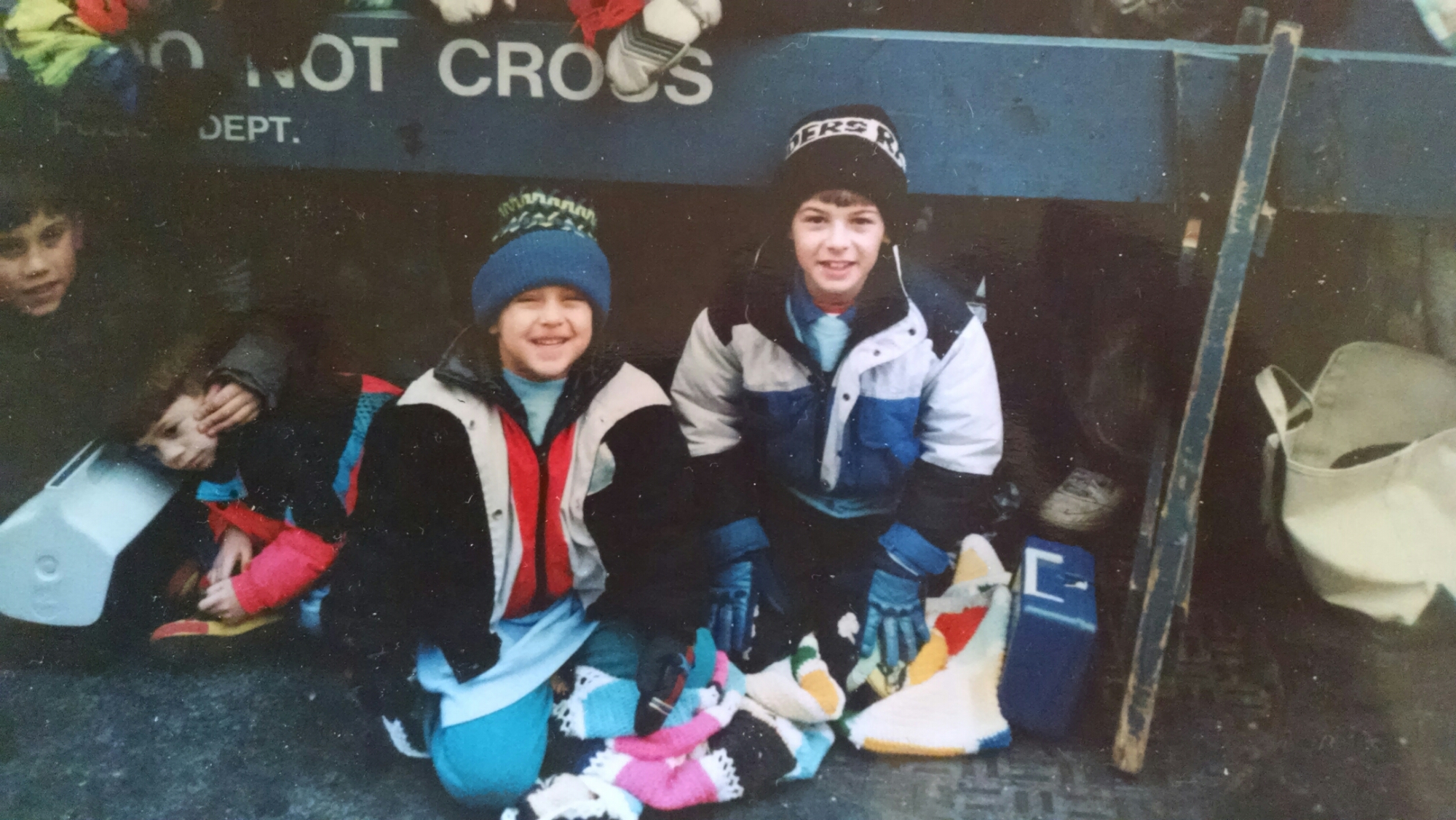
The morning of the Macy’s Thanksgiving Day Parade here in New York City is always the coldest morning of the year. (I have not consulted the farmer’s almanac to confirm this fact but trust me, I’ve been there, and I’ve never been colder.)

From around the time I was five or six years old, until I was about 12, my mom woke us up each Thanksgiving morning while it was still dark. She filled a backpack with bananas and clementines, a few books, and a Thermos of hot chocolate. And with that, my mother, younger brother and I hopped on a subway from Queens into midtown Manhattan to see the Parade.

The Macy’s Thanksgiving Day Parade doesn’t begin until 9 am, leaving from Manhattan’s Upper West Side (just west of Central Park, the same area where they blow up the balloons the night before) and marching south until eventually winding up outside the Macy’s storefront at Herald Square. (That’s the part you see on TV.)

image

My brother Danny and me at the parade. (Photo credit: Mom.)

Of course if you want to see the parade in person, you can’t just show up at 9 am. Our plan each year was to arrive in the city as early as possible, find a spot in the street along the parade route where we could lay out a blanket and my brother and I could sit and have an unblocked view of the floats and balloons; Mom usually ended up somewhere behind us. Standing 5’4” she had a better view of us than she did the parade, which was fine for her.

For a breakdown of our first year attending, I’ll let Mom tell it in her own words:

The first year that we went, I had not done any research. I knew the parade route, what time it started, and I suspected that it would way too crowded at the viewing stand near Macy’s. So we arrived somewhere on Broadway when the parade was well underway and the crowd was 8 to 10 [people] deep.

We walked for blocks behind the crowd with me looking for places where you could squeeze your way through the crowd up to the front. Once I realized that there was not going to be an opportunity for you to move closer to the parade, our next best option was to go up.

On a street corner, there was a tall block of concrete with a flat surface at the top, perfect for viewing a parade if only one could hoist oneself to the top. There was already a person on the top, and not much more room for another. I started to lift you up there, but it was higher than I could lift you. The person at the top, a young man, reached down to you and pulled you up. For the rest of the parade, I stood at the bottom of the concrete block, looking up to make sure you were safe and not about to fall off.

My mom would do her best to entertain us for the hours between our arrival and something actually happening parade-wise. We had our books, maybe a couple of games, and an unending conversation about how freakin’ cold it was. We couldn’t put on enough layers to stay warm on those late November mornings. We found respite in the hot chocolate, though it was a double-edged sword in that the more we drank, the more we’d be tempted to give up our spot to find a bathroom somewhere on Broadway.

Once the parade actually got going it was—as things seen through the eyes of children can sometimes be—magical. Our eyes lit up at the first glimpse of the new balloons featuring our favorite characters (think Teenage Mutant Ninja Turtles). But we also liked the recognizable old school characters who kept coming back, like Snoopy and Woody the Woodpecker. (Incidentally, as a child I always had trouble wrapping my head around the word “float.” If the balloons are actually floating in the air, why are we calling the displays on wheels “floats”?)

The kids all around us were as excited as we were, maybe more so—after all, we were parade veterans by Year Two. One year, I remember parade marchers running alongside the floats throwing confetti up in the air towards us kids in the front row. The younger kids went especially bananas for this, and each time someone who looked like they might have confetti approached, they (okay fine, we) chanted, “CON-FET-TI, CON-FET-TI, CON-FET-TI.” A little boy a few years younger than my brother was sitting next to us, and got so caught up in the chanting despite not knowing the word “confetti” that he chanted, “BET-TY, BET-TY, BET-TY,” just to be a part of the excitement around him.

(While sitting in the front row for the Macy’s Thanksgiving Day Parade might not hold the same cache as, say, sitting in the front row at a Yankee game, it still felt pretty special. Unlike most high-priced event tickets, the Macy’s Thanksgiving Day Parade was first come first serve, and it only cost you a couple of hours of sleep that morning.)

The most memorable celebrity sighting from our years of attending the parade was when we spotted “Michael Jordan” on one of the floats. MJ is in quotes because we were never really sure it was him—in-person parade attendees don’t have the benefit of the inane but occasionally informative TV commentators telling them who’s on which float. My mom snapped a few photos of him, but we’ve never been able to authenticate with 100 percent certainty that the blurry image of a tall, bald black man was in fact my childhood sports idol. Years later we still pored over that photo like it was the missing clue in Girl With the Dragon Tattoo. (Mom says: It was him!)

Another year, we were sitting in a spot across from the Winter Garden Theater, where Cats used to play. Mid-parade, we watched as three actors dressed as cats frolicked across the parade route, from the side where we were sitting and into the Winter Garden. Was this a planned act, maybe even mandated, by the theater as a form or free advertising? (Probably. These days ad executives call this “native advertising.”) Or did the actors decide impulsively that they wanted to be a part of every show in the vicinity of the theater, not just their own? (Less likely, but I’m not ruling it out. Also, they may just have been trying to get a cup of coffee across the street.)

The Parade always closes with Santa Claus and his elves, an unapologetic reminder that Christmas is a month away (and, I suppose, to get your Christmas shopping done at Macy’s). The kids are happy to see Santa coming to town, but sad that he’s the last float they’ll see until next year. (Mom says: We—or maybe just I—always thought that it was so funny that when we arrived home, the tail end of the parade was still on TV and we could say, “We were just there!”)

Despite the early, early morning wake-up and the almost unbearable cold—or perhaps because of it—there was something noble about attending the Thanksgiving Parade each year as our own three-person unit. I’m sure Mom tried to rope in family or friends to join us, but most people would be crazy to accept. Still, when we returned home and joined the rest of the family for Thanksgiving dinner later that day, everyone seemed glad that we had gone. It was as if we were representing everyone we knew who liked the idea of going to the parade, just not the going part. (Mom says: This is definitely true. I remember when we stopped going, Aunt Mary seemed disappointed.)

Last year my wife, her parents and I went to the Parade. It was cold. Really cold. Mom decided to skip it and meet us after. Time served, I suppose.

A few weeks back I blogged about my latest audio obsession, the new Taylor Swift album the Serial podcast.

At that time I made a couple of predictions about the podcast, which have since come true.

My first prediction was “plot” driven—with plot in quotes because this is actually a real-life murder, not a prime time procedural. (It’s also WAY more provocative than the average prime time procedural.) I said that the story Serial’s Sarah Koenig is telling would evolve as people familiar with and/or involved in the case hear the podcast and reach out to her with their input. Sure enough, in episode #9, this happened.

A former classmate of the then-teenagers involved in the case contacted Koenig to refute, with confidence, the prosecutor’s timeline for the murder. This “witness” coming forward was a direct result of her hearing the podcast and wanted to contribute some information she believed Koenig (and the police) didn’t already have.

For the man who sits in jail convicted of murder, Adnan Sayed, it’s not clear whether these out of court testimonies 15 years later will ultimately help or hurt his case, but I suppose they can’t make things much worse for him.

(I also recently came across an article about the complicated ethics of Serial that’s definitely worth a read for fans–even if, like me, you disagree with it.)

The second prediction I made was about the business side of Serial. Serial is a free podcast whose first season has been funded by This American Life, a syndicated public radio show that relies on donations and scant advertising partners (Mail Kimp, anyone?) to keep itself on the air. (Serial is a spin-off of This American Life and debuted its pilot episode on TAL.)

I predicted/suggested that Serial would/should charge something—anything!—for downloads of its episodes. What better time to do it than now, when Serial is the #1 podcast on iTunes? People are clearly into the show, and the mainstream media (plus my blog!) is taking notice.

But rather than charging for episode downloads–now that they have us completely at the mercy of Sarah Koenig’s storytelling (including those bits and pieces she undoubtedly knows but has yet to share)–Serial is doing what public radio usually does: they have asked, rather than required, listeners to contribute money to fund a second season of the show. The suggested donation is $10, which can be done by simply texting SERIAL to 25383.

With the constant debates about how much is too much to pay for content—the cable bundle debate in particular—I think $10 to help fund a show of Serial’s quality is a steal. So far I’ve listened to about five hours of Serial content (all nine episodes of the show) and Koenig has yet to set a final end date or number of episodes for season 1.

Last year I opted not to give money to Zach Braff’s Kickstarter campaign to fund his movie I Wish I Was Here, which was eventually funded without me and made into a pretty good movie. The basis for my decision was that it isn’t my job as the potential consumer to fund the making of creative endeavor such as a film; instead it’s my job to decide, based on trailers, reviews, as well as the creator’s previous body of work (in this case one of my favorite films, Garden State, whether to pay to see the film once it’s made. And that’s what I did.

Serial has given us nine free episodes. Fans have heard enough to know just how good it is. Now it’s on us, by donating a few bucks, to see how good it can be in season two.

Are you a fan of the show? Do you plan to help fund a second season of Serial? Why or why not?

I wasn’t a lemonade stand kind of kid.

Instead, when I was 8 or 9 years old I told my mom that when I grew up, I was going to own an entire fleet of ice cream trucks. Back then ice cream was the most valuable currency I dealt in. So, naturally, my dream job involved having unlimited access to it.

I would sit in an office above an ice cream distribution center—where the ice cream men went to fill up their trucks on in the summer—and do whatever one does in an office when one owns an entire fleet of ice cream trucks. (This was before the internet and even before computers were ubiquitous, so I imagined some sort of hopper for my papers and maybe even a paperweight.) And the best part, I told my mom, was that she could come visit me at work whenever she wanted and I’d give her free ice cream.

More than two decades later, shockingly, I do not own a fleet of ice cream trucks. I do not have an office above an ice cream distribution center. Hell, I barely even eat ice cream anymore. As best laid plans of third graders often go, this one sort of fell apart after I got really into Teenage Mutant Ninja Turtles.

For Alex Blumberg, the host, producer and subject of the new podcast StartUp, there’s a little more at stake than free ice cream.

Blumberg is best known for his work with public radio, including the program This American Life (producer) and podcast Planet Money (founder, co-host). But he recently quit both those gigs to start his own project: he’s starting his own media company which will focus on producing and distributing high-quality audio content via podcasts. Oh, and the best part–for us, anyway–is that he’s letting listeners in on the process. Here’s how Blumberg describes it on his website:

This show follows what happens next – my difficult journey from man to businessman. It’s a classic start-up story, but one that’s recorded in real time. I’ve documented disastrous pitches to investors, difficult conversations with my wife, and tense negotiations with my co-founder. The result is an honest, transparent account of something that happens all the time, but that we can rarely listen in on: starting a business.

StartUp is not a prescriptive how-to guide to starting a business from the ground up (this, despite several episode titles beginning with “How To”). It’s quite the opposite. It’s a show about a guy who knows very little about starting a business, and what happens along the way as he starts to figure it out.

The weekly series, which premiered on September 5, is just seven episodes in. So far Blumberg has taken us through a failed investor pitch, the process of taking on a business partner (after realizing he couldn’t do it alone), figuring out how to share equity with that business partner (a very cool insider’s look at emotional side of the process), assigning a value to a company that doesn’t make any money yet, and even picking a name for the company.

As I’ve written about previously on this blog, I’m big fan of ABC’s Shark Tank. On that hit reality show, entrepreneurs come to the sharks (i.e. potential investors) with a fully (or partially) formed companies asking for investments in exchange for shares of their businesses. Some entrepreneurs get deals, others are sent packing. On the show it all seems so simple.

StartUp is, in many ways, a prequel to Shark Tank.* As of episode #7 Blumberg’s company, Gimlet Media (for the origin of that name, check out episode #5), is still “pre-revenue.” On Shark Tank most pre-revenue business don’t get a deal unless the idea is very, very novel.

 *If StartUp is the prequel to Shark Tank, then shows like Hotel Impossible, Restaurant Impossible, and The Profit–all of which deal with businesses gone bad–are the sequels.

For those of us who have dreamed about owning their own business—for the record the ice cream thing is still on the table, though I haven’t figured out what I’d do all winter yet—and those who haven’t, StartUp gives listeners a fresh look into those steps between concept and actually taking those steps towards turning that concept into a living, breathing, (and hopefully) profitable thing.

The most interesting stuff for the listener tends to be that which is most gut-wrenching to Blumberg–from figuring out how much equity to give his partner (episode #3), to the constant self-doubt that comes with starting a business in your forties when you have a wife and two young children to consider every time you make a decision about anything.

In episode #2 Blumberg debriefs with his wife on the phone after an investor, Matt Mazzeo, in Los Angeles. Blumberg has been out to L.A. before, in episode #1, to meet with Mazzeo’s business partner, Chris Sacca. Mazzeo and Sacca are venture investors and business partners at Lowercase Capital. They have successfully invested in the technology space. After talking with Mazzeo, Blumberg is left with a pit in his stomach:

I’m feeling the same shitty way I’m feeling the last way I was out here. … It just makes me feel like I don’t know what I’m doing. … This is the thing: I’m sitting there talking to this guy and I’m describing something that feels like the biggest thing I’ve ever done, a scale beyond my wildest imaginings, something that I can’t even tell if I can pull off, and it’s totally not big enough. Like it seems small to him.

This is a really important insight, and one that I suspect a lot of startup business owners face when pitching investors. Especially in the tech space.

Can you or I invest in companies like Gimlet Media?
Episode #7 was about crowdfunding Gimlet Media. According to the episode, the 2012 Jumpstart Our Business Startups (JOBS) Act allowed for Americans to invest in private companies like Gimlet Media, which they were formerly not allowed to do. This means that through companies like Alphaworks, would-be investors could go online, find a company they wanted to give money to, and in exchange they’d receive equity in that company. (This is different than sites like Kickstarter, where you “donate” money but don’t receive any equity.) A Shark Tank for the Average Joe, right? Wrong.

Due to current Securities and Exchange Commission regulations, only “accredited investors,” i.e. those who make $200,000 a year and/or have a network worth of $1 million, may do so. (Alphaworks covers this in their FAQ.) If you’re an Above Average Joe, invest to your heart’s content. Otherwise you’re out of luck until the SEC loosens those regulations. Fortunately for Gimlet Media, they had enough friends in high places–in part thanks to attention the StartUp podcast has been getting–to get to their investment goal.

New episodes of StartUp are available about every two weeks. Whether you’re a future ice cream magnate or not, I recommend you give it a listen.

You find the StartUp podcast here: http://hearstartup.com/ – or you can use a podcasting app on your phone or tablet and search for StartUp. Happy listening.