Feeds:
Posts
Comments

Roger Federer, arguably the greatest men’s tennis player of all time, has earned about $3 million in 2011, not including endorsements. His rival, Rafael Nadal, has made in excess of $6 million, and top-ranked Novak Djokovic, who recently completed a historic season that included three major titles, has pocketed nearly $11 million.

If you are one of the top men’s players in the world, a career in tennis can be pretty lucrative. But what if you’re the 978th ranked player in the world?

“I am losing money most weeks,” said Peter Aarts, a professional tennis player from Pound Ridge (Westchester County), N.Y. The 24-year-old Aarts turned pro in August 2009 after graduating from the University of Michigan three months prior with a degree in English.

“Maybe if you are 300th in the world, you can break even if you are wise and a little frugal,” said Aarts.

Though Aarts’ singles rank is in the 900s, he has been ranked as high as 391st in the world in doubles, rotating with three or four different doubles partners depending on who’s in town that week.

Like many American college students who graduated into the recession, Aarts’ career options were limited. He says several of his classmates from Michigan had committed to finance jobs during senior year, only to find out those positions were eliminated before they could claim them. So for Aarts, the decision to turn pro was easier than it might have been.

And yes, playing tennis for a living beats job hunting, resume tweaking, and cover letter writing, but it’s still, unmistakably, work.

“It’s the biggest grind you can imagine,” said Aarts, who travels 31 to 32 weeks a year playing tournaments in the U.S. and abroad. His playing schedule is a mix of “Challengers” and “Futures,” the second and third tiers of professional tennis tournaments below the Association of Tennis Professionals (ATP), which includes majors like the U.S. Open and Wimbledon.

Like many pros at his level, Aarts may as well add “Travel Agent” to his resume. He spends hours on end researching flights online and filing the paperwork for international visas when necessary.

“I usually only book one-way flights,” said Aarts, because he never knows when he’ll be leaving—it all depends on how long he survives in a given tournament. “Some days I wake up and I forget what city I’m in.”

In 2010, Aarts played five tournaments in five weeks in India and China. He also plays in South and Central America as often as he can—the cost of living is more favorable than in the U.S., tournaments are frequent there, and he speaks Spanish.

The entry fees for Challengers and Futures tournaments are about $40, and the prize pool for most tournaments is typically either $10,000 or $15,000, split among all participants based on where they finish. Meaning, if a player wins a $10,000 tournament, he’ll only take home about $1,300.

To help pay for his travel expenses, Aarts has a group of sponsors made up of family friends and other supporters who have known him for most of his tennis life. Some sponsors have contributed money, and one even chipped in with frequent flier miles.

At one point, Aarts set himself up as a limited liability corporation, borrowing that idea from his former assistant coach at Michigan, Michael Kosta. Aarts has since dissolved the LLC, though he maintains the partnership with his sponsors. (Kosta is now a working stand-up comedian in Los Angeles.)

Aarts’ arrangement with his sponsors is as follows: They keep him afloat financially and in exchange, they receive the lion’s share of his earnings. Once his sponsors have recouped their initial investments, the percentages flip and he keeps the majority of his winnings.

Retaining a full-time coach is another luxury common to the top players. But at Aarts’ level, it takes four or five players like himself to pool their resources and hire a coach, whose services they then share for as long as they can afford it—sometimes just for a week at a time.

“And sometimes,” Aarts said, “you just have to figure it out on your own.”

Aarts started the 2011 season hoping to crack the top 600 in singles, which, with his current ranking, could be difficult but not impossible with about two months to go. In his estimation, there’s not much disparity in skill level between the 200th ranked singles player and the 1,000th. The trick, he says, is maintaining a high level of play for longer stretches over the course of the season.

“Anyone can have one or two good weeks,” said Aarts. The question is, “How can I have one or two good months?”

Aarts plans to sit down with his sponsors at the end of the year to evaluate his finances, but says he wants to continue playing professionally through 2012, with a goal of competing in the qualifying tournament for the 2012 U.S. Open.

“Right now, there is nothing that I would rather do tomorrow than get up and be able to try and push myself to become a little better,” said Aarts.

This morning I found myself in the unenviable position of buying a Metrocard (NYC’s public transportation currency) during the morning rush hour. But to my delight I found one short line of about four or five people waiting for the next available of the three (working) machines at the 77th st. 6-train station. (This, rather than the typical three lines, where one is very fast, one is very slow, and I’m forced to play Metrocard machine Russian Roulette, which I usually lose.)

But as I got to the second position on the line, a woman approached the front and said, “Why aren’t there three lines? This makes NO SENSE,” clearly laying the groundwork for an attempt to cut those of us ahead of her in line by starting another one behind the left or right machines.

I decided I had to defend the one-line system and so I spoke up. “Actually, it DOES make sense because whoever’s here first gets the next open machine.” She huffed and walked to the back of the line.

While misguided, this woman at least recognized the opportunity to expose what she perceived to be an inefficiency in the system to anyone within earshot. But for many of the complainers among us, this is as far as we’ll go when it comes to making our voices heard.

Also this morning, I came across this USA Today article, which suggests that not everyone feels that they necessarily want a say in how their public transportation provider or favorite restaurant or mechanic treats its customers. From the article:

Surely, it’s nice to be courted for input, at least sometimes. But some consumers say they’re fed up with giving time-consuming feedback for free, don’t like being drawn into a data web used to evaluate employees or feel companies don’t act on the advice they get. Others say they simply don’t have anything revelatory to impart about, say, ordering a shirt or buying a package of pens.

Anyone who’s read my blog before knows I’m incredibly sensitive to how I’m treated as a customer, both positively and negatively, and so I was surprised to learn that some people would rather forfeit their chance to share their opinion in exchange for just being left alone.

Sure, there are plenty of reasons why we might choose to take or not take a survey. For example, it’s more likely that you’ll fill out a survey or write a review if you’ve had a bad experience versus a good one. You’re also more likely to do it if you’re incentivized with a few bucks, a chance to win a sweepstakes, or some other prize or coupon. (Buffalo Wild Wings offers up free wings for completing a customer service survey.)

I flew Delta over the weekend and was delayed two hours on the way out and another hour on the way back when our arrival gate wasn’t ready and we were forced to deplane in some sort of temporary airplane parking space and take a “people mover” (i.e. a bus), then wait 20 minutes for our luggage.

Having dealt with airlines for many years and understanding how poor that industry is when it comes to customer service (I dare you to debate me on that) I knew my complaints would likely fall on deaf ears and I’d be cast as yet another cranky, disgruntled customer looking for a handout. So I put it behind me, chalking the experience up to a built-in hassle that comes with air travel.

But when I returned from my trip, I had an email from Delta waiting for me, asking me to rate my experience as it related to my delayed flight. They were reaching out to ask for my opinion, and about a negative issue no less.

Though the questions in the survey were mostly meaningless to me and not necessarily actionable for Delta (“Did airline staff alert you in a timely fashion about your delayed flight?”), they did include a comment box so I could elaborate on my issue, which I did.

I still have very little confidence that my complaints to Delta will do anything to reduce future delays in and out of JFK Airport, but at least I feel like they’re trying and I don’t take that for granted.

In the meantime, I’ll hold my breath and wait for the MTA to contact me about whether I prefer a one- or three-line system at the Metrocard machines.

It’s a Monday night in December and I’m sitting in a bar called Mulligan’s in Hoboken, New Jersey, waiting for my buddy Mike to claim the bar stool I’m saving for him. I lived in Hoboken for three years during my mid-20s and spent a lot of that time in bars, but I can’t remember ever seeing Mulligan’s this packed on any night of the week, no less a Monday.

The crowd, which is about 90% dudes, is there for the same reason Mike and I came out: It’s Seinfeld trivia night.

When the trivia host hands us our answer sheet for Round 1, I examine it carefully. It’s made up to look like the cover of a Penthouse magazine–a noticeable departure from the nondescript answer sheets you might find at other trivia nights. The blank white answer spaces, labeled 1 through 10, are strategically placed to cover the otherwise exposed cover models underneath (pictured below). In the bottom right corner, I notice the magazine is addressed to fictitious Seinfeld “dentist to the stars” Dr. Tim Whatley, DDS, who in one episode had an adults only dental practice and a waiting room stocked with adult reading materials.

Not your average answer sheet.

Mike and I are confident going into the first few questions. Between us, we’ve seen every episode 20 or 30 times in reruns. (I’d learn later that our host estimates he’s seen each episode at least 200 times.)

We keep pace with the leaders for the first few rounds, including a perfect 12 out of 12 in Round 2, attributing quotes from the show to the characters who said them. But by Round 4, matching obscure character names to their pictures, and the final round, made up entirely of questions about the “Festivus” episode, we’re toast.

We finish in seventh place. Our only consolation prize is the small laugh we get from the other players when our team name (To See Ramon?) is read aloud.

Still thinking about Seinfeld trivia the following morning, I reached out to Trivia, A.D., the company that put on the event, via Twitter. I wasn’t really sure what I expected to find.

But five days later, I’m sitting in Trivia, A.D. co-founder Dave Oliver’s living room in Hoboken, listening to him tell the story of how the company came to be.

This place looks like The Max from Saved by the Bell! How cool would it be if they had 80s trivia here?

For friends Amy Gerson and Dave Oliver, that epiphany came in May 2009 over drinks and tater tots at their favorite neighborhood haunt, Big Daddy’s on Manhattan’s Upper East Side. Big Daddy’s is an 80s-style diner that doubles as a watering hole for locals, which Oliver describes as “like Johnny Rockets but less cheesy.”

Half-jokingly, they bounced the trivia idea off each other for 10 or 15 minutes, after which Gerson (who freely admits, “I have a big mouth”) approached the manager on duty that night about co-hosting a trivia night with her friend Dave at Big Daddy’s, eventually getting in touch with the restaurant’s general manager.

He said yes.

Management didn’t know what to expect as far as turnout, so they set aside a space for Gerson and Oliver in the back of the diner to hold about 25 people. Big Daddy’s email-blasted their customer database to alert them about the event, and Oliver used his graphic design background to create an eye-catching flyer to hang inside the diner.

After just a few days of promoting, Big Daddy’s had 110 reservations lined up.

That first night went well–so well, in fact, that the nascent trivia hosting team was invited back to do 80s pop culture trivia at Big Daddy’s Gramercy location, and later to host more trivia nights at those locations as well as as at two Duke’s locations (owned by Branded Restaurants USA, the same people who own Big Daddy’s).

Before they knew it, Trivia, A.D. (named for Amy and Dave) had become a four-nights-a-month part-time job.

When Oliver approaches a potential client (i.e. a bar) about hosting a trivia night, they typically request “regular” or general trivia. But when one of his Friends or Saved by the Bell trivia nights brings in 80 to 100 people on a Tuesday night, that’s all the convincing they need.

The concept of a themed trivia night isn’t unheard of, but general trivia–topics like current events, geography, music and sports all rolled into one–is far more common in bars. For Trivia, A.D.’s events, though, people aren’t there simply by happenstance; they show up specifically to play trivia about their favorite TV show or movie because they’re passionate about it.

That passion is never more apparent than when Oliver hosts Seinfeld trivia nights, which he started in July 2009. In fact, Oliver says Seinfeld is one of his three passions in life (the other two are baseball and Pearl Jam), but there’s one couple who might love the show even more than he does.

“To date, we’ve won Seinfeld trivia 17 times,” says Jamie Sclafane, who plays under team name Why No T-Bone? with her husband, Dave. They’ve been attending Trivia, A.D.’s Seinfeld trivia nights since September 2009.

(For some more of Trivia, A.D.’s funniest Seinfeld trivia team names, see the comments section below.)

“We had been waiting for something like this for a long time,” says Sclafane. “When I saw the flyer, I immediately called Dave and was like we need to go to this!”

Why No T-Bone? placed second at Trivia, A.D.’s 2010 Seinfeld Trivia Tournament, which took place over three weeks in July 2010 across four Big Daddy’s and Duke’s locations. “The amount of work and detail [Oliver] put into the … tournament was incredible,” says Scalfane.

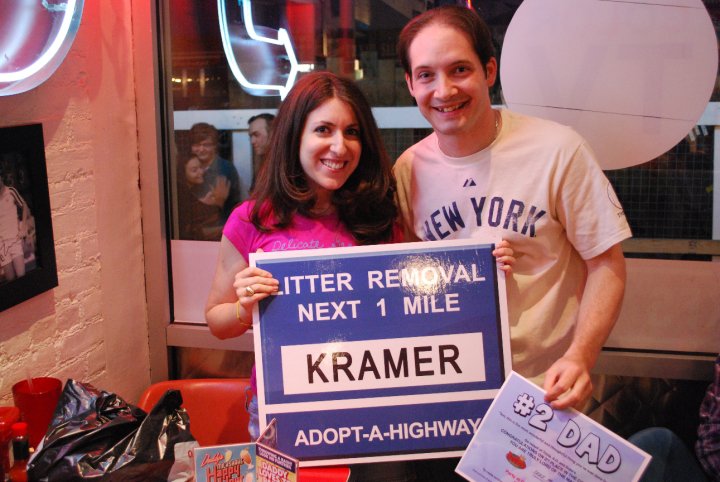
Each team who made the tournament “finale” received a Seinfeld themed gift, such as a giant marble rye or a box of Jujyfruits. “He also made … a giant clown check made out to The Human Fund and the sign to mile marker 114 for the highway Kramer adopted,” Sclafane says, “which we proudly hang in our dining room.”
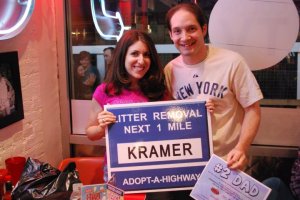
Jamie and Dave Sclafane at Trivia, A.D.'s 2010 Seinfeld Trivia Tournament.

Looking to expand beyond bars and restaurants, Trivia, A.D. hosted a “Festivus”-themed Seinfeld trivia night at Comix comedy club in December 2010. Comix advertised the event in the New York Post and Oliver designed inserts promoting the event to put in the playbills for Long Story Short, the one-man show starring Colin Quinn and directed by Jerry Seinfeld.

Long Story Short donated 16 tickets to their show plus some Seinfeld memorabilia for the winners. Unlike previous Trivia, A.D.-hosted trivia nights, Comix sold tickets to the event ($15 plus a two-drink minimum), but still drew an impressive 125 people.

It’s easy enough to Google “Seinfeld trivia questions,” copy and paste the best ones, and pass them off as your own at a trivia night. But that’s not Trivia, A.D.’s style.

For Seinfeld trivia in particular, Oliver has a database of thousands of questions and answers and says he knows where to find just about any scene for any season within his Seinfeld DVD collection. (I detect a hint of pride in his voice when he tells me this.)

So, if I go to one of your Seinfeld trivia nights this month, and then I go to another one six months later, will I get any of the same questions?

No repeats, he guarantees, not at any of his trivia nights.

As we’re chatting, Oliver’s wife, Kara Oliver, stops in to tell her husband that she’s got a friend “who knows a guy who was in the Pez episode who owns a bar.” He appears to make a mental note to track down that lead once I’ve left.

While Seinfeld trivia is Oliver’s forte, he’s getting more comfortable writing questions and hosting trivia nights for themes in which he’s not as fluent.

“If you’re gonna host, you better know your stuff,” says Oliver. “Die hard fans pick up on that.”

Trivia, A.D. gets tons of requests for new themes. “Right now people want Scrubs trivia.” Oliver’s even heard requests for Little House on the Prairie trivia. (Do not look out for that one at a bar near you in 2012.)

“My favorite part of any trivia night is when we announce all the themes we do and hearing people’s reactions,” says Kara, who has hosted Trivia, A.D. events for Jersey Shore, Mean Girls, Mad Men and Caddyshack. “They get so excited to hear their favorite show or movie.”

Other Trivia, A.D. pop-nostalgia themes have included Star Wars, Beverly Hills 90210, Back to the Future, Sex and the City, and more recently, Arrested Development and Harry Potter. Oliver’s always got his ear to the ground for the next pop culture phenomenon that could make for great for a trivia night.

Just a year and a half after its inception, Trivia, A.D. had taken greater strides than Oliver and Gerson had ever imagined it could, but a series of bad breaks in the first half of 2011 left them wondering whether they’d taken it as far as it could go.

This past February, Oliver hosted a Seinfeld trivia event at Gotham Comedy Club, hoping to repeat the success of the Comix show. But a couple of factors were working against them this time–namely, it was the Monday night after Super Bowl Sunday–and the event drew just 40 people.

And in June, Trivia, A.D. and Big Daddy’s mutually dissolved their long-standing trivia arrangement; the two sides are no longer affiliated.

But Trivia, A.D. has rebounded, adding new venues to its roster in New York and New Jersey, including Croton ReservoirVillage Pourhouse, and Liberty Bar, and it currently has trivia events booked through March 2012.

Without giving too much away, Oliver hints at multi-city expansion beyond the New York metro area, and he’d like to further experiment with trivia events outside of bars and restaurants. “I have big plans,” he says.

Well, how’s this for big plans: On January 30, Oliver will host a Seinfeld trivia night at Tom’s Restaurant. If that name doesn’t sound familiar, it’s because fans of the show may know it better as Monk’s Diner, the coffee shop where Jerry and the gang spent an obscene amount of time during the show’s 10-year run. (Monk’s is based on Tom’s.)

Though the Tom’s event is already booked to capacity, Oliver is always looking to add the finishing touches. He has reached out to every Seinfeld actor he can get a hold of to get them involved in the event, from Bryan Cranston (Tim Whatley) of AMC’s hit series Breaking Bad to Patrick Warburton (the face-painting David Puddy) of CBS’s Rules of Engagement.

And if Jerry Seinfeld himself happens to show up at Tom’s that night, you can bet there will be a spot waiting for him in his old booth–there might even be room for three of his closest friends.

“A company like Anheuser-Busch is a hundred times our size. They literally spill more beer … than I make all year. My passionate life’s work is their industrial waste.” –Jim Koch, founder of The Boston Beer Company, in the 2009 documentary Beer Wars

//

When you think about it, tasting a really good craft beer isn’t all that different from tasting a fine wine.

The process is about the same. You want to know where it’s from and who made it. Once it’s poured into your glass, you examine the color, maybe hold it up to the light and look through it. Next, you give it a sniff to try to pick out notes of chocolate or oranges or coffee. Then it’s time to sip it, swirl it around in your mouth. What other flavors can you pick up?

There is a difference, though, between tasting beer and tasting wine. Unlike wine, beer must be swallowed to fully appreciate its taste. Let’s just say at beer tastings, a spit bucket is a lot less common.

Craft beer, by most definitions, is beer brewed by a small, independent brewery. (See here for a more in-depth explanation.) To put it another way, craft beers come from any microbrewery that strives for creativity and innovation, and have little or nothing to do with Anheuser-Busch or MillerCoors.

Henry Joseph, 30, has been bartending at The Pony Bar, a craft beer bar in Manhattan’s Hell’s Kitchen, since it opened in April 2009.

“The neighborhood was underserved for craft beers,” Henry says.

Unlike most bars, where craft beer tends to be the most expensive beer on the menu, The Pony Bar keeps it simple: all beers cost $5. To further entice its patrons to experiment with new beers, The Pony Bar’s All American program rewards anyone who tries 100 different draft beers (not necessarily in one sitting) with a Pony Bar shirt and their name on the All American plaque and on the website.

To date, 440 people have completed a 100-beer cycle.

The Pony Bar’s star attraction is the two-part menu board hanging on the wall behind the bar: a list of 20 American craft beers on tap, which rotates as often as a keg is kicked. Each line on the list has the name of the brewery, the name of the beer, and the alcohol by volume (ABV)—most beers are served in 14 oz. glasses, with higher alcohol brews served in 8 oz. glasses. For non-craft beer drinkers, The Pony Bar also serves liquor and wine, as well as Bud and Bud Light bottles.

Do you ever sell any Bud Light? I ask Henry. “A few on Saturday nights,” he says. How much do you sell them for? “Five bucks. But we’re thinking of raising it to six.”

With an obvious passion for craft beers and the knowledge to back it up, Henry is happy to help his customers select a beer from the menu board, which can be a little intimidating for a newcomer. “It’s fun to see locals come in and to watch their tastes develop and evolve over time.”

Theme nights at The Pony Bar include “Rocky Mountain High,” during which they only serve Colorado beers. They also run “Tap Takeovers,” which feature beers from one brewery all night. Previous Tap Takeovers have included Sixpoint, Lagunitas, Stone, Victory and Southern Tier.

It’s also a good place to find the latest American seasonal beers, such as pumpkin ales during October. Southern Tier’s Pumpking Imperial Pumpkin Ale has been a big hit this year. “We can’t sell enough Southern Tier pumpkin,” Henry says.

The menu board at The Pony Bar (courtesy of theponybar.com).

//

It’s an exciting and pivotal time for the craft beer business. According to the Brewers Association, the craft beer industry was worth $7.6 billion in 2010. Yet craft beer’s undisputed heavyweight champion, The Boston Brewing Company (which brews Samuel Adamsmade up less than 1% of all beer sales in the U.S. in 2010.

This past March, the craft beer industry made headlines when Chicago-based Goose Island sold to Anheuser-Busch (AB) for $38.8 million. While many craft beer drinkers have mixed feelings about Goose Island’s decision to sell, the deal drew national attention to the brand and shortly after the announcement, Goose Island six-packs started appearing more frequently in the beer aisle of my local grocery store.

What’s your take on the Goose Island acquisition? I ask Henry. “[AB] can’t sell any more Bud Light,” he says. “It was a last ditch effort.” But doesn’t it make Goose Island kind of a sell out? “If the beer continues to taste good, who cares?”

The truth is the lines have been blurred for a while now. Craft Brewers Alliance, which sold its $16.3 million share of Goose Island to AB, still owns smaller outfits including Redhook Ale Brewery, Kona Brewing Company, and Widmer Brothers. This past October, Terrapin Beer Co. sold a minority share to Miller Coors in an effort to fund a $4.5 million expansion project. And Blue Moon, which makes its signature Belgian-style wheat ale as well as several seasonal variations, has been brewed by Coors since its inception in 1995.

Still, Henry points to brewers like Sam Calagione from Delaware-based Dogfish Head Craft Brewed Ales, who have stuck to their guns despite financial pressures. “[Sam] could only brew 60 Minute IPA (India Pale Ale) all day,” Dogfish’s signature and best-selling beer, Henry points out, rather than experimenting constantly with new flavors that are less profitable as he does now. Calagione explains his brewing philosophy in the Beer Wars documentary:

“Big breweries are usually public companies … Their real goal at the end of the day is maximizing shareholder value, whereas our goal is maximizing the flavor of what we’re making for our own enjoyment as the people making it.”

And for other do-it-yourselfers out there, craft beer is more accessible than ever in terms of homebrewing. Amateur brewmasters can replicate their favorite beers just as an amateur baker would follow a recipe in a Paula Dean cookbook. Or, if they’re feeling adventurous, they could put their own unique twist on an old classic.

It seems like every guy I know is brewing his own beer these days, I say to Henry. “Those kids in Brooklyn, now…you can buy one-gallon [craft beer] kits,” Henry says. “The holiday markets in Union Square are selling vanilla bean porter kits. You can put craft beer kits on your [wedding] registry!” They’re even selling craft beer kits at Bed Bath & Beyond.

//

When I met up with Henry at another craft beer bar, this one on the East Side, I’d been drinking $2 mugs of light, drinkable, but unremarkable Checker Cab Blonde Ale. (I’ve had it before—it’s the bar’s Sunday football beer special.) When I was ready for my next round, I asked Henry for a recommendation. He peered at the chalkboard menu and seemed excited about a beer from Barrier Brewing Co. I take it you’ve heard of Barrier before? “Yeah, it’s two guys on Long Island, Evan and Craig, who used to work for [Brooklyn-based brewery] Sixpoint.”

You really know your stuff. “Me and [The Pony Bar owner Dan McLaughlin] are pretty dialed in … I’ll come to a bar like this and try new beers, and say, ‘Hey, we should be pouring this.’”

My own beer palate isn’t as developed as Henry’s but I’ve had enough drafts to know when the beer has gone bad, and every now and then I’ll send one back. “The state of draft beer is horrible,” says Henry. “I would not order draft beer outside of a craft beer bar.” He says the lines—those are the hoses between the kegs and the taps—should be ideally cleaned once every two weeks. The Pony Bar does this, but many places don’t clean nearly as often–if ever.

According to Henry, a lot can go wrong if a bar isn’t maintaining its equipment correctly. And he should know: Henry is a Certified Cicerone, the second of three levels of the Cicerone Certification Program, just below Master Cicerone, of which there are just three in the whole country. From Cicerone.org:

“The Cicerone Certification Program offers that independent assessment and certification so that industry professionals—as well as consumers—can be sure of the knowledge and skills possessed by current and prospective beer servers.”

Henry says one part of the certification process has candidates first taste a “control beer” and then several off-tasting iterations of it to determine what went wrong, such as having been served from a dirty tap, or containing too much diacetyl, which at low levels adds a “slipperiness” to the beer but at high levels can give it an unwanted buttery flavor. Was it like the milk tasting competition in Napoleon Dynamite? I ask. “Yes. Exactly.”

When he’s not tending bar, Henry is the director of events and tastings at Civilization of Beer, a company founded by Sam Merritt whose mission is “to promote, through education and appreciation, the responsible enjoyment of high quality, craft beer in the context of our rapidly changing culinary landscape.”

Before The Pony Bar, Henry had gotten his start in the summer of 2005 in Allston, Mass., working at the Sunset Grill and Tap under owner Marc Kadish. It’s there, he says, where “I truly fell in love with the wide world of beer.”

He went on to work for Craft Brewers Guild outside of Boston. Working as a sales rep, he learned the “business of beer,” and met many people in the industry who shared his passion for craft beer.

Henry describes the craft beer community as “a tight knit group—not cutthroat,” and says, “We’re at a point in history where there are more breweries than ever—more than before Prohibition. More people are passionate about making and drinking beer.”

He credits local bar owners Jimmy Carbone (Jimmy’s #43), Dave Broderick (Blind Tiger), and the late Ray Dieter (d.b.a.) for growing the craft beer business in New York City when no one else wanted to sell the stuff. Without these guys, Henry says, “I wouldn’t have a job.” (On a personal note, I’m indebted to Broderick, too: my girlfriend and I shared pumpkin beers at Blind Tiger on our first date.)

“Craft beer isn’t a fad,” Henry says, attributing an old quote to Brooklyn Brewery co-founder Garrett Oliver. “It’s a return to normalcy.”

The 250 Square Foot View is happy to introduce its first guest blog post from musician (and my younger brother) Danny Calise. A Temple University graduate, Danny spent two years teaching English in China before returning to the States to pursue his music career in Los Angeles. His recent works can be found here.

In an age when the internet affords you the opportunity to download any song, album, movie, book, computer program or TV episode for free (albeit, illegally), I am forced to consider the question, “Why should I buy Drake’s new album?” Or really any new album?

Ok so it’s the best album of the year. Fine. Kudos to Drake.

Will the world keep on spinning if Drake doesn’t receive his cut from my 12 bucks? Well, yea. Would he be pissed at me if we ever met and I admitted to illegally downloading his CD? I would hope not.

On the album’s (Take Care) first single and current #1 rap song in the country, “Headlines,” Drake brags/laments, “I guess it really is just me, myself, and all my millions.” On “The Motto,” a callabo with Lil Wayne, Drake describes himself as “Twenty five, sittin’ on twenty five mill.” Practically every song finds Drake doing what a lot of rappers do: talking about how rich they are. I’m left wondering why he deserves my 12 bucks instead of me. After all, I already have the album.

It makes sense that rappers talk about their lavish lifestyles and the rest of us look on in awe. Like many rap fans, I want to know what it’s like to be these guys. Drake supposedly dated Rihanna and he spent many a line on his debut CD proposing to and flirting with Nicki Minaj. Maybe that’s what you’re paying for, to hear some dude say the “N-word” a lot and imagine Nicki and Rihanna swooning over it. Worth 12 bucks to you yet?

Drake’s new album leaked a week before it’s scheduled release date, November 15th, 2011. Those of us who are privileged enough to understand the concept of torrents are sitting here with the sophomore LP from one of the most exciting artists from any genre, but it feels a little bit like peeking in the closet for Christmas presents a week before Christmas.

Normally, the “cons” section of any pros and cons list regarding illegal downloading would include the idea that it’s not fair to steal from an artist. And for some poor struggling sap selling his CDs at a coffee shop, this makes sense. But when I downloaded Drake’s new LP, or Lil Wayne’s, I didn’t feel one lick of remorse. As a struggling musician myself, I could never carry a Drake CD to the Best Buy cashier with a straight face and spend my money to make him richer. Not in  2011.

Societies like ours have chosen entertainers as their most valuable members, paying them ungodly amounts to do whatever it is they do. In Lil Wayne’s case, he gets paid to get high and say stupid shit like,“My nuts hang like ain’t no curfew” from Take Care’s “HYFR (Hell Ya F*ckin Right).”  That’s a million dollar line if ever I’ve heard one–art at its most artistic. And many rap fans would argue he’s the best rapper of our generation. A most deserving multi-millionaire indeed!

Drake, on the other hand, put his heart and soul into Take Care and spends the album’s 80-minute run time crafting his artistic vision by telling a story. The fact that this LP is a work of art and will sell a million copies in a couple of weeks is something for Drake to be proud of. I see this as the main difference between the two self-proclaimed best rappers in the game.

Lil Wayne’s latest LP sold 300,000 legal downloads in its first four days (with the benefit of a prison sentence to boost his sales) while Kanye West and Jay-Z’s Watch the Throne sold 436,000 copies in its first week. Regardless of how many hundreds of thousands of CDs and downloads Drake moves, at the end of the day, even without my 12 bucks, I’m sure he’s gonna be just fine.

(Note: For those of you in the adult world without the willingness or ability to download music illegally, you can still listen to Take Care legally for free on Spotify.)

The following post is a Q&A with my friend and former co-worker Ross. I thought his story was blogworthy, so I’m having him do it [mostly] in his own words.

I met Ross in February 2005 at my first real job out of college. The low-paying, low-responsibility position we held was supposed to be a stepping stone for us; we were Millenials determined to snag the pie-in-the-sky careers we were promised by our parents and teachers—you know, the ones where we get paid a reasonable salary to do something we love, all the while maintaining a perfect work-life balance.

We both moved on from that job after about a year and a half. Ross went first into sports TV production and later into public relations. As he struggled to figure out what color his parachute was, he spent his time outside of work pursuing his personal interests, launching a successful blog, and diving head first into all things social media. Today it seems he’s found the best of both worlds, blurring the lines between his passion and his profession.

Just before the summer started, you did something rather risky career-wise. What was it?
This past April, I decided to leave a steady and dependable job at a Fortune 500 company that was flush with cash and positioned for long-term success. I did this without having another job lined up. I had been there over three years and while my role at the company had evolved somewhat, I didn’t feel like I was making a difference. My job was within a traditional PR team working for a cosmetics company, in a very corporate atmosphere. Eventually, I came to the realization that I’d never be fulfilled there and it was affecting my personal life.

My creativity and strategy shone when working to educate our 40+ international PR managers on making social media relevant in their markets, but I was stuck in the weeds of a heavily administrative role, planning international press events and pushing press materials.

I was a square peg, invigorated by the shift in marketing caused by social media, trying to fit into the round hole of a great corporation that wasn’t quite ready to make fundamental changes at the speed of culture. I was working long hours and was recently married, so I wasn’t able to dedicate the networking time necessary to switch career paths without taking a calculated risk and voluntarily joining the ever-increasing ranks of the unemployed.

What did the people around you say? Your wife, your former coworkers, your friends?
Everyone I worked with was extremely supportive. They knew that I needed to spread my wings and fly off on a different career path, but would never have pushed me involuntarily. I sat down with the SVP of my department and had a great heart to heart, sharing my candid thoughts and taking in some great advice.

My small network of family and friends knew me well enough that they had seen the writing on the wall. While nobody would recommend it based on the current unemployment rate and uncertainty of the economy, they had heard me talk about “the fundamental shift” in communications, jobs, economics and many other aspects of society so often, they had no choice but to trust that I was doing the right thing.

Most importantly, my wife had a steady job and was willing to support me during the time it took to find another steady source of income. I’m not saying I wouldn’t have made the same decision without my wife, but having her support allowed me to take this risk without having to make a huge lifestyle adjustment.

With a solid support system—emotional and financial—in place, you were able to spend a few months networking, taking meetings, and job hunting. How did that work out?
I recommend that if you’re planning on leaving a job and heading off into the great unknown of unemployment, you do it at the end of April. The long-awaited respite from NYC’s increasingly brutal winters was invigorating and helped to cheer me up on days when things were looking bleak.

My job hunt was extremely calculated. I knew that blasting my current resume around would probably land me some interviews, but most likely in the cosmetics or PR industries. I was feeling entrepreneurial and knew that networking in person would lead me to some interesting opportunities in the startup/tech/social media/agency world. That was where I felt I belonged.

I had my eyes on Big Fuel Communications for some time, even while I was still in my previous position. I even applied to a junior position back in January, just to open up the dialogue. My salary expectations didn’t fit within that role, but I kept in touch with the hiring manager and solicited advice, stayed in tune with the latest agency news, etc.

Then, during my unemployment journey this summer, my networking led me to another person who worked at Big Fuel. It seemed that the stars were aligned, so I applied for a Brand Channel Manager position, leveraging the referral of the well-respected person who I had met via my networking. Less than three months after quitting my previous job, I walked through the doors of Big Fuel for my first day of work a completely changed person.

So after leaving a safe job you hated to pursue a job in a field you were passionate about, you landed on your feet. Well played. Tell me a little more about Big Fuel and what a Brand Channel Manager does?
I started to answer this by saying that hate was a strong word, but then I realized that I really did hate it. I hated not feeling like I was on the cutting edge of the fundamental shift in communications. I hated being stuck in the weeds as a “cog in the wheel,” doing something that anyone else could do. Big Fuel offered something completely different, in a startup-style atmosphere. (Although on the day I signed my offer letter, the company was bought by the Publicis Groupe, the third largest marketing/advertising holding company in the world, with subsidiaries such as Saatchi and Saatchi, VivaKi, Digitas, Razorfish and many more.)

Big Fuel is the only “pure play” social media agency. Huge brands are coming to the realization that social media extends into ALL parts of their organization and they need an agency that works with all of their other agencies (PR, ad, event, etc.) to become the “one throat to choke” when it comes to creating a successful marketing program. Our goal is to leverage our strategic insights into creative content and tell product stories through people. We exist to humanize brands through programs that live on their owned media channels (Facebook, Twitter, YouTube, Google+, Flickr, Tumblr, company blogs) and are distributed on earned media channels (online communities, websites, blogs).

As a Brand Channel Manager, I work with brands to lead development of an ongoing communication strategy and publishing calendar for their branded social media channels (Facebook, Twitter, YouTube, Google+, Foursquare, etc.). One of my passions is consumer advocacy, and in my role, I get to be on the front lines with social consumers who are connecting with brands. It is my job to foster two-way conversations and understand what makes the customers tick by soliciting and acting upon feedback.

Your position at Big Fuel literally didn’t exist when you graduated from Penn State in 2004. Yet seven years later you ended up there anyway. Do you think that’ll be the same story for a lot of kids starting college in the next few years, that their future dream job or company doesn’t even exist yet?
Big Fuel was in the process of being founded when I graduated, but it was completely different than it is today. As a matter of fact, one year ago, Big Fuel was very different than it is today. In social media, you have to move at the speed of culture, and culture is moving pretty fast right now. I think that social media is about to head in a much more academic direction, and it ties as closely to sociology and psychology as it does to marketing/advertising/PR.

Kids in college studying non-technical fields need to think like entrepreneurs. They need to realize that the days of finding a cushy 9-5 job based on their diploma are long gone. For better or for worse, the word “job” is taking on a different meaning–we all have the tools at our disposal to learn more than any college professor can ever teach us. The most successful people of our generation (aside from the developers/engineers/programmers) will be the people who tap into their passion and find a way to make a living that they are fulfilled by and offers some kind of value to the people around them.

In your case, the risk paid off. What’s your advice to other people contemplating a similar decision?
From a practical standpoint, you need to be fully prepared to deal with the worst case scenario if you make a decision as rash as quitting a job without another one lined up. You need to understand your financial limitations and how your lifestyle will be affected if you’re out of work for an extended period of time.

Once you have that minor issue taken care of, you need to have a really honest conversation with yourself, your loved ones, a therapist–whoever. You need to figure out what you are passionate about and research it. Lose all inhibitions and network with everyone and anyone, telling your true story and not shaping your story to fit other people’s needs or expectations.

Find people to network with via personal connections, business connections and websites like meetup.com. Read as much as you can about what you’re passionate about (use the website Instapaper.com to bookmark content you can’t read immediately so you can access it on iOS devices). Get on Twitter, follow people that share your interests and interact with them.

If you have an iPad, download the free Zite app which allows you to follow topics of interest and curates top content based on your social graph and their editors. If you have an iPhone, download the Summify app which will aggregate popular links from your social feeds (based on times shared) and serve it to your device at various times throughout the day.

What I’m saying is that you need to depend on yourself and not on “the system.” If you want to be successful and happy, make yourself indispensable within your field of interest and the rest will fall into place.

I read a story in Harvard Business Review this week about Patagonia’s “Buy Less” campaign, in which the outdoor apparel brand is actually encouraging customers to cut down on their purchasing of Patagonia products. HBR explains:

To put its buy-less idea into action, Patagonia recently partnered with eBay to enable consumers to resell their used Patagonia apparel via the Common Threads Initiative within eBay. In addition, consumers will now be able to resell their used Patagonia apparel on a new Used Clothing & Gear section on Patagonia’s website. The company wants to influence consumer buying behavior as part of its corporate mission. Patagonia (and other sustainability pundits) views individuals’ consumption as a considerable drain on natural resources. And with the global population forecast to swell to over 9 billion by 2050, left unchecked, this drain will become significant.

HBR’s story tries to determine whether this initiative, which it calls “genuine and borderline heroic,” will ultimately increase Patagonia’s revenue. But I’m more interested in how an idea like this affects the customer. When I read about the “Buy Less” campaign, I thought of an old Chris Rock bit:

“The government curing AIDS? That’s like Cadillac making a car that last for fifty years… and you know they can do it! But they ain’t gonna do something that fucking dumb! Shit! They got metal on the space shuttle that can go around the moon and withstand temperatures up to 20,000 degrees. You mean to tell me you don’t think they can make an El Dorado where the fucking bumper don’t fall off?”

If a company makes a product that lasts too long, it’ll be a while before they’ll see any repeat business.

In 2009 I was in the market for a new PC. My Dell Dimension, which I’d received as a Christmas present in 2000, was on its last leg. I consulted my tech-savvy friend Gil about which brands other than Dell I should consider. I was really down on Dell after some poor customer service experiences and was ready for a change. But then Gil made a good point. “You know,” he said, “your last Dell computer lasted you nine years.”

And he was absolutely right. Sure, it took some of Gil’s magic to extend its life—cleaning out viruses more than once, adding new virus protection, and installing new memory—but a nine-year shelf life for a PC is unheard of. Not long after that conversation, I bought another Dell. (FYI I still think the customer service stinks, but the computer works fine.)

But if I called the CEO of Dell and told him that story, he might not be thrilled. After all, between 2001 and 2008, I didn’t buy a single Dell product.

Now imagine if Dell called me up in 2002 and said, “Mr. Calise, our records show your Dell Dimension is two years old. We’d like to buy it back from you. Oh and by the way, Dell now has several new PC models you may be interested in if you’re looking to upgrade.” Well, that seems to be the direction Patagonia (with the help of eBay) is headed in:

It sounds strange to say that encouraging customers to buy less new apparel could actually lead to increased sales volume for Patagonia. Yet this scenario is possible. Two types of customers could be more inclined to buy new Patagonia apparel as a result of Patagonia’s efforts: customers who make decisions based on sustainability considerations and customers who can now sell their used Patagonia apparel for cash to buy new apparel. Indeed, John Donahue, the CEO of Patagonia’s new business partner, eBay, suggested this might be possible: “Patagonia is extending its customer base and increasing it. People who are selling it are likely to turn around, take the money they got, and buy the new Patagonia products.”

For the record, I’ve never bought or owned a Patagonia product. But by encouraging me to Buy Less, Patagonia might actually persuade me to Buy More.

Michael Lewis’ baseball-book-that’s-not-really-about-baseball, Moneyball, has gotten plenty of attention in recent weeks since it’s been made into a feature film starring Brad Pitt. The book suggests that it’s statistical data (and hardcore crunching of that data) that allows us to make the best decisions–not our gut instincts, strong as they may be.

Moneyball ruined, or at least changed, the way many baseball fans enjoyed baseball. We could no longer praise our favorite player for being a dynamite fielder or a clutch hitter when the game was on the line, because if we took a closer look at the newfangled stats we’d realize our perception was nowhere near reality. It was like having a favorite restaurant but knowing that if you went into to its kitchen and saw something gross, you’d never be able to eat there again.

But it also taught us not to take things at face value. That before we make a decision based on what the supposed experts say, maybe we should see what the data says, too. Or, as John Cusack says in High Fidelity, “I’ve come to the conclusion that my guts have shit for brains.”

Oddly enough, my thinking about Moneyball the last few weeks had nothing to do with the hoopla surrounding the movie. It was actually another author, Gary Vaynerchuk, in his book The Thank You Economy. Vaynerchuk, a wine expert and social media guru with a book deal, stresses the importance of  about caring more about your customers than your competitors do as one of the biggest keys to any successful business venture. (And this is done largely through social media channels.)

At conference last year, an audience member asked Vaynerchuk what he says when someone can’t get past the fact that the efficacy of social media isn’t really quantifiable. His response: “If you do not understand what the monetary, financial value of having a relationship with the customer is, you have no fucking idea what business is about.”

Great answer. In his books, Vaynerchuk says lots of stuff like this. You can’t measure how much you care about your customer, same as you can’t measure the emotional impact that caring has on the customer, but you just know it works. Great business practices, he says, produce great business. Makes sense, I guess. But as I read on, I got to thinking. Vaynerchuk is an undoubtedly progressive thinker. However he’s also suggesting we trust our instincts, not the numbers. How un-Moneyball-like!

Steve Jobs was once asked about how much market research went into the iPad.  “None,” he said. “It’s not the customers’ jobs to know what they want.” Arrogantly but correctly, he purported to know more than anyone else what was best. Same as Vaynerchuk, Jobs trusted his gut more than the data.

The other school of thought, as suggested in books like Peter Sims’ Little Bets, is that if you can cheaply and quickly test an idea, it’ll allow you to tweak a good idea until it’s great or rule out a bad idea all together. An example Sims’ uses is comedian Chris Rock, who practices his new stand-up material in small nightclubs rather than assuming it’ll be funny simply because he’s Chris Rock. Some of his new jokes are OK, some are really funny, but many of them stink. But by the time he pieces together an act using the best material from his “market research” and shedding the rest, he’s got the whole room laughing again.

There is, of course, no right answer. It’s hard to argue with the methods of anyone who’s reached the top of their field–they obviously knew enough to have gotten there in the first place, right?

Each of us has to do a little research (or not) to find our own style. What’s yours?

A few weeks ago on this blog I said farewell to Entourage, a show that while in its prime, reached a generation of 20- and 30-something guys who could escape their real life problems for 23 minutes at a time to live vicariously through the boys from Queens.

Meanwhile, I belatedly discovered (courtesy of HBO on Demand) a very Entourage-like show, How to Make It in America, which premiered in February 2010 and made its season 2 debut last night.

In season 1, Ben and Cam, two late 20s underachieving wannabe entrepreneurs, haven’t yet found the financial success they crave. Either for lack of ambition, know-how, or follow through, they seem to stall at every turn. The polar opposite of Vinny Chase and his pals, for whom everything seemed to go right, nothing works out for Ben and Cam.

When Entourage debuted in 2004, the pilot opened with Vince at a premiere for his first starring role in a fictitious feature film, Head On, co-starring Jessica Alba. So when we meet Vince for the first time, he is already a star. The rest of the episode focused on choosing his next multi-million dollar script and whether he should attend his 10-year high school reunion.

But when we meet Ben and Cam, they’re still smarting from a skateboard business venture gone bad which has resulted in some money trouble. Rather than getting the “how to” manual implicit in the show’s title, we’re not really sure if things will work out for Ben and Cam. We have to keep watching.

Eventually, if Ben and Cam do Make It in America, loyal viewers like myself will probably complain that they’ve become too successful and that the show was more entertaining when they were struggling.

But for now, I’m rooting for them.

Friday Night Round-Up

As I stay in on a Friday night watching Yankees-Tigers Game 1 Karate Kid Part II to get mentally prepared for my half marathon tomorrow morning, I have a built in excuse to blog for the first time in almost two weeks. Here goes.

When I studied abroad in England in the fall of 2002, I expected to make tons of friends and future pen pals with some native Brits. Instead, though, our group of friends–American students from New York, Florida, Connecticut, and Massachusetts–spent every day and night hanging out together and seldom interacting with the English. Granted, we had a great time, but I no longer speak to any of them and I regret it a little that I didn’t do a better job immersing myself in European culture. And speaking of European culture…

Jersey Shore
When I first heard Jersey Shore was doing a season in Italy, I thought, “Wow, that Sallyann Salsano has done it again!” The gang brings their shenanigans to Italy and mix it up with the locals? Awesome, right?

Turns out, not that awesome.

Apart from Deena’s mini hook-up with a waiter named Ellis (and seriously, an Italian-born Italian named Ellis?), the roommates have pretty much kept to themselves. Even Situation’s situation finds him caught up with an American blonde stalker named Brittany.

The failure to assimilate themselves into Italian culture came to a head last night when Snooki declared it a Karma night in the house, where everyone would dress up, drink and dance like they were back in Jersey, with Pauly D supplying the music because he brought his DJ equipment (i.e his laptop). I guess I set my expectations for this season a little high. I’ll need to re-calibrate them for the home stretch.

Undercover Boss
I caught my first episode of Undercover Boss last night (I was still reeling from Jersey Shore, but UB broke my fall). I am way late on this one, since it apparently premiered in February 2010. But I’m hooked.

Is UB a little gimmicky? Sure. Is it basically free advertising and completely self-serving for the companies whose bosses go undercover? Sure. But it’s actually pretty watchable. (This is a massive understatement. I said, “I love this show!” to my girlfriend at least five times during the hour-long episode. Eyes were rolled.)

In this particular episode, the CEO of 7-Eleven goes undercover for a week: he works clerk shifts at three store locations across the country; he helps make donuts in a factory; and he rides shotgun with a delivery truck driver. He sees lots of good stuff (friendly, generous, and dedicated employees) and some bad (employees throwing out tons of unsold food that’s supposed to be earmarked for food banks), and takes his learnings back to HQ in Dallas, summoning his “bosses” from the previous week to Texas for the big reveal: the man they knew as a curious new employee was actually their boss!!! OH SNAP.

At this point, it got a little Wizard of Oz-ish. So enriched by his experiences, the CEO rewards his employees based on their needs: the older female store manager on dialysis gets an organ donation awareness program set up in her name; the young Pakistani store manager/criminal justice student is offered a call-me-any-time offer for mentorship from the CEO; the happy truck driver gets a resort vacation with his wife who he never spends time with because of his graveyard shifts; and the donut-maker (who’s also an amateur artist) gets hooked up with 7-Eleven’s marketing department to do some freelance artwork.

Bottom line: When I’m a boss some day, you can bet I will find some way to go undercover. Hopefully the show is still on the air at that point.

The Kindle Might Be Worth It After All
A while back I wrote that I didn’t think the Kindle was worth its price tag, and a big part of my reasoning was that ebooks at my public library weren’t compatible with the Kindle. Well, now they are.

Today I successfully and easily downloaded my first library ebook from the New York Public Library, The Thank You Economy by Gary Vaynerchuk. I’m very excited to read it.

As demand for ebooks starts to outpace libraries’ supply, we’ll likely see the same backlog many now have for print books. But I trust the 14 to 23 people who read my blog will keep this our little secret, at least for the time being.

Zappos Pays Employees 3 Grand–to Quit
Apparently this policy has been in place for a few years, but I just became aware of it this week after listening to a Freakonomics podcast. In an effort to weed out employees who are “only in it for the paycheck,” Zappos offers its new hires increasing monetary incentives to walk away from the company.

There are plenty of reasons why this won’t work at many (or most) companies, but Zappos’ approach is progressive, and it reminds me of a scene from one of my all-time favorite movies, A Bronx Tale.

Teenager Cologero is chasing a guy who owes him $20. Sonny, his role model and neighborhood mafia boss, stops him and explains:

“You don’t even like him. There’s your answer right there. Look at it this way, it cost you twenty dollars to get rid of him. Right? He’s never gonna bother you again. He’s never gonna ask you for money again. He’s out of your life for 20 dollars. You got off cheap. Fughgeddaboutit.”

Zappos isn’t getting off quite as cheap as Cologero did, but for a relatively small sum (to them), they can say fughgeddaboutit to any jerk who’s just working there for a paycheck–I mean, the nerve!