Feeds:
Posts
Comments

Archive for the ‘Small Business’ Category

Please note: This post has been updated from its original version, “Review: Hotel Impossible, Sandy Part 1.” In this revised version, I have included an update at the end of the post based on the “Sandy, Part 2” episode, focusing on the controversial Thunderbird Motel project.

I’m a big fan of the business makeover shows, including Restaurant Impossible and Hotel Impossible. As someone who doesn’t own my own business, but might like to some day, it’s interesting to see how someone at the top of their profession can quickly get to the bottom of why a business is failing.

But my biggest frustration with these shows, as I’ve written about before on this blog, is the projects they select. More often than not the biggest reason why a hotel or restaurant fails–at least on these shows–is the ownership. They’re typically lazy (kitchens or hotel rooms are filthy, obvious repairs aren’t made, the customer service is half-assed, etc.) or clueless (“We thought it would be fun to buy a restaurant!”). I have yet to see an episode where a hotel or restaurant owner is doing mostly everything right but is still struggling to turn a profit. While that would be decidedly less “impossible” to turn around, I might prefer that every once in a while to helping people who have been unable or unwilling to help themselves.

In the most recent episode of Hotel Impossible, hotel guru Anthony Melchiorri takes his talents down to the Jersey Shore to help reverse some of the damage done by Hurricane Sandy last October. A worthy cause, or so it seemed.

The episode takes place about a week before July 4, the following summer after Sandy. As he arrives, Anthony seems genuinely shocked at the condition of the hotel he’s there to fix, the Thunderbird Motel in Seaside Heights, NJ (a.k.a. the town where Jersey Shore was filmed), nine months later. The rooms on the ground floor are still being gutted and he’s been told that 20% of the hotel’s inventory is not ready to be sold.

When Anthony questions the family–a couple in their fifties and a grown son and daughter–as to why so little has been done, they talk about how the insurance money was slow to come in. The patriarch tells Anthony about the Thunderbird: “You’re lookin’ at my 401K here” and that the hotel was meant to be the parents’ retirement.

Anthony goes in for a room inspection–a room the son has assured him is ready to be rented immediately–and finds the usual stuff he always finds: dirt, dead bugs, filthy shower heads, and, of course, a week-old pizza box in the fridge (with one slice left!). The son, Ray Jr., goes into the contrite routine we see often of hotel owners on the show, falsely accepting the blame but clearly believing it’s someone else’s fault, in this case housekeeping

Anthony, in classic straight-shooter Melchiorri style, tells Ray Jr. (who believes he runs the hotel), that he is not general manager material. Anthony leaves, and Ray Jr. follows a few minutes behind him, cursing Anthony under his breath. Later, Ray Sr. is recorded behind closed doors saying that he wants to chop Anthony’s head off–so there that is.

Meanwhile, the rest of the family gangs up on Anthony, telling him that they were too hard on Ray Jr. (Direct quote from Ray Jr.’s mom: “He didn’t have to chew my son sixteen new a**holes.”) As he usually does, Anthony gives the family a chance to cool down and explains that he’s there to help, and he can only do that if he’s completely honest. The family seems to get it, sort of, but Ray Jr. still won’t speak to Anthony. Given a chance to walk away from the project and cut his losses, Anthony chooses to stick it out.

Next, Ray Sr. and Anthony take a drive, having apparently patched things up after the whole “chop off his head” thing. Ray Sr. casually points out other real estate in the area he owns, explaining that his assets total about $40 million. Yup.

Anthony doesn’t start screaming at him (as some of us might have) but calmly asks him why, if the hotel was so important to him, he didn’t consider selling off some of his other assets to pay for the repairs. Ray Jr. replies, “I prioritized. I don’t like digging into capital.” Totally see his point. I mean, who does?

Later, Anthony has another closed door conversation with the family, where Ray Jr. asks him to delete the footage of the hotel inspection from the beginning of the episode that shows Ray Jr. in a negative light. Anthony refuses, saying the only way the footage would be deleted is if they cancel the show. Ray Jr. walks out.

Then, still behind closed doors, it is revealed that Ray Jr. was not actually being tapped to be the general manager, and that a new GM the family had already hired would be starting in a few months. This is the last straw for Anthony, who pulls his crew off the set. He declares that he never leaves a job unfinished, but that he can’t deal with the family’s dishonesty. He believes he’s being “played.” If that’s true, it’s hard to see what the family’s game plan was, since Ray Jr. blatantly told Anthony about his substantial assets without any probing. Nevertheless, Anthony is outta there.

The show ends with previews of Part 2 of the Sandy episode, which has Anthony helping other Jersey Shore hoteliers get back on their feet (plus a cameo by NJ Governor Chris Christie!). Disappointingly, the last scene of the preview has Anthony trying to reconcile with the family from the Thunderbird.

Meanwhile the family that owns the Thunderbird Motel is none too happy about how they were portrayed on the show, as scammers. If I came off the way they did, I wouldn’t be, either. Not to mention, $40 million doesn’t go as far as it used to.

***UPDATE!*** 
The end of Sandy, Part 1, teased that Anthony would attempt to reconcile with the Braun family, who own the Thunderbird Motel. Reconciliation proved, well, impossible.

Ray Jr. was barely willing to look at Anthony when he tried to open a dialogue about restarting the project. Meanwhile Ray Sr. expressed, again, that he felt the family was blindsided and that Anthony’s crew had come in and wrecked his hotel. (This statement was confusing, as I don’t believe they actually did any work on the hotel apart from Anthony taking a week-old pizza out of the fridge in one of the rooms.)

Anthony and Ray Sr. shook hands and went their separate ways. However the dialogue continued between Ray Sr. and Anthony’s camera crew, who apparently brought bodyguards. Ray Sr. took offense to HI‘s “muscle,” and said he would bring his own muscle next time.

After they shook hands–which was about as forced as Ray Sr.’s previous handshake with Anthony–Ray Jr. asked whether HI still planned to use the footage from the beginning of the first episode, which he felt made him look foolish. The producer said that they would be using the footage, which was a different story than the one Anthony told him at the end of the first episode. Anthony had told him the footage would be deleted if the show was canceled–but clearly it was not…

I don’t feel great about the way things played out, especially considering that it seemed like Anthony lied (or at least misspoke) about the footage. While the Braun family clearly did not deserve Anthony’s help, they were basically used by the producers to create enough footage for an entire episode and didn’t end up getting a hotel renovation out of it. I don’t know about the waivers they might have signed or the legalities involved, but it seems kinda messed up.

Finally, Anthony goes back to the Thunderbird one last time. As a peace offering, he tells Ray Sr. that his designer had had three rooms and a front desk’s worth custom cabinets made for the Thunderbird already, and that if he wanted them, they were his (on the house). In a cliffhanger that only a reality hotel renovation show can have, HI cuts to commercial before we find out whether Ray Sr. will accept the free cabinets. I can tell you it was a VERY long ninety seconds waiting to find out if Ray Sr. would, in fact, accept the free cabinets. (He did.)

Oh yeah and a bunch of other stuff happened in Part 2, including some hotel renovations. Here are the TripAdvisor pages for all the hotels in the two episodes:

Thunderbird Motel: 4/5 rating on 17 reviews (but none since Hurricane Sandy)
Palm Villa Suites Motel: 3.5/5 rating on 51 reviews
Tradewinds Motor Lodge: 4/5 rating on 14 reviews
Charlroy Motel: 3/5 rating on 49 reviews

Did you watch both episodes? What do you think?

RELATED: Hotel Impossible’s First Mission: Gurney’s Inn on Long Island

RELATED: Hotel Impossible: After Anthony Special – A Review

Read Full Post »

From the time I moved to the post-college paradise that is Hoboken, New Jersey, in 2006, until the day I moved out of the oft-flooded mile-square city in 2008, I’d never heard of Buddy Valastro.

I also didn’t know much about his bakery, Carlo’s Bake Shop, though I’d walked past it hundreds of times on Hoboken’s main drag, Washington Street. With its picturesque storefront window and classic gold on maroon signage, Carlo’s always felt very upscale from the outside; it was the kind of place that someone like me, who routinely ate mac and cheese with cut-up hot dogs for dinner, should walk right past without a second glance.

But what I also didn’t know was this: that behind that fancy storefront window I’d been so intimated by, Buddy Valastro was busy building an empire.

Having his cake…
It was my fiancée who introduced me to Valastro’s cable reality show, Cake Boss, in 2009. The show is about a family-owned bakery in Hoboken starring the son of the bakery’s late owner, Bartolo “Buddy” Valastro Sr.

Buddy Jr.’s supporting cast is made up of the other people who work in the bakery, many of them related to him by blood or marriage. They play innocuous pranks on each other, bicker like family often does, and produce elaborate works of edible art in each episode.

Even since the TLC show debuted, I would guess the bakery still sells more pastries like cannoli, cupcakes, and lobster tails than it does its $25,000 masterpieces. Yet it’s the higher profile clients and cakes that the show centers around; they represent a new challenge to Buddy and his bakers in each episode.

CB_roulette

Always bet on red…velvet! Am I right??? (Photo credit: http://www.mediaglare.wordpress.com)

Cake Boss, which begun its sixth season this past Memorial Day, is a lot like the storefront window at Carlo’s in that it’s been a showcase for the talents of Buddy and his staff. They’ve made everything from a wedding cake that was fitted to house two live doves, to a roulette table and wheel cake for a local men’s social club. (For Cake Boss‘s “Top 5 Most Impressive Cakes,” click here.)

Upon each cake’s delivery on the show, often by Buddy himself, the client thanks the Cake Boss effusively for using his artistic medium, cake, to transform their vision into a gorgeous and delicious homage to the person, place or thing they’re celebrating. And Buddy, always modest and deferential, seems to understand that the client isn’t really a customer, but a patron of the arts who allows him to make a lucrative living doing what he loves to do.

…and Eating It, Too
For many of us, it would have been enough to propel our family’s mom-and-pop bake shop into a multi-million dollar business with its own accompanying reality show. But Buddy, so it appears, is far more ambitious than his goofy, avuncular, PG-rated disposition might suggest.

The Next Great Baker, his competition reality show, just wrapped up its third season in February 2013. From 2011 to 2012 he hosted two seasons of yet another TLC show called Kitchen Boss, a cooking show where Buddy traded in eggs, sugar and flower for tomato sauce, pasta and meatballs, and shared his family’s Italian food recipes.

Meanwhile, after opening up another facility at the Lackawanna Center in Jersey City to keep up with the high volume of national orders–more voluminous thanks to Cake Boss‘s popularity–he has since expanded, opening a second Carlo’s Bake Shop in Ridgewood, New Jersey. He’s also got a small shop in Times Square. I get the sense he won’t stop there.

Sure, A&E’s Duck Dynasty may have stolen some of the cable reality headlines recently. The hit show has emerged as a ratings machine, beating everything in the Wednesday 10 pm time slot including broadcast network programming.

Like Willie Robertson, the CEO of Duck Commander born into a family whose patriarch started a modest duck call business, Valastro has benefited by being at the right place–and in the right family–at the right time, as the oldest son of a baker with his own bake shop. And yes, if you asked Valastro he might tell you how blessed he feels to be where he is today. But it hasn’t been all roses for Valastro, who lost his father in 1994 and whose mother, as documented on Cake Boss, was recently diagnosed with ALS.

Yet the Cake Boss machine rolls on, all Buddy’s hard work seemingly less about avarice than about honoring the family tradition he was destined to carry on.

Taking His Talents to Upstate New York
Despite everything on his cake plate, Buddy is apparently still up for a new challenge.

Joining Restaurant Impossible‘s Robert Irvine and Hotel Impossibles Anthony Melchiorri, Buddy Valastro is looking to become the next star in reality TV’s small business renovation sub-genre. After all, if you needed advice on running your family-owned bakery, wouldn’t Valastro be the first guy you’d want to talk to?

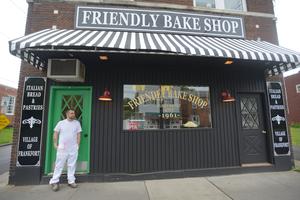
In the premiere episode of his latest TLC show, Bakery Boss, last Monday night, Valastro visited Friendly Bake Shop upstate in Frankfort, New York. (About 200 miles away from Carlo’s, Friendly is safely outside Valastro’s customer base. For now.)

Friendly Bake Shop after the Buddy treatment.

Friendly Bake Shop after the Buddy treatment. (Photo credit: herkimertelegram.com)

With three old, tired men at the helm of Friendly and their three grown children working devotedly (but fecklessly) for them, it seemed that the former were lacking energy to keep the bakery going, while the latter were lacking the know-how. Buddy’s visit was their last chance to turn things around.

As you might expect with any episode in this genre–as we’ve seen so many made-for-reality-TV miracles performed by Irvine and Melchiorri before–Buddy shapes up Friendly Bake Shop in just a few days. He demands a full cleaning of the shop and its equipment, revises the menu with some of his own best-sellers and shows the staff how to make them, and renovates the storefront to look more like Carlo’s than a crappy dive bar in the middle of nowhere.

Early reports say the shop is now flourishing since the episode aired, though Yelp has just one review from someone in California.

Success Story or Sell-Out?
Former New York Yankee great Yogi Berra once reportedly said about a popular restaurant, “Nobody goes there anymore. It’s too crowded.”

Many of us can relate to the idea of liking things before it was cool. Our favorite indie band gets mainstream radio airplay, and suddenly we can’t get tickets to their concerts. Our favorite TV show, which so aptly captured the zeitgeist of people our age, suddenly got popular among the masses and became prosaic beyond recognition.

So should we stop rooting for guys like Buddy, who was once a great upstart story but has since saturated the market with pre-made cakes sold in grocery stores, a line of baking equipment, and enough TV shows to start his own cable network? There’s no right answer to that, of course, but for me it’s always felt strange rooting for the underdog only until they’re not the underdog anymore.

En route to our Memorial Day weekend away at the beach, my fiancée and I stopped off at Carlo’s to get some treats before getting onto the New Jersey Turnpike.

Arriving on Friday morning, we hoped they would still have plenty of their signature coffee cake–my fiancee’s mom’s favorite–with the crumbs the size of small boulders. Our only concern, with a tight schedule and a long drive ahead, was the length of the line.

As it turns out we were right to be concerned. We had apparently showed up just a few minutes behind a bus full of tourists who had made a special trip to wait on line at the famous bakery from TV. They were queued up along the sidewalk, blocking the path of Hoboken residents whose formerly cute little local Italian bakery was now a nuisance to walk past.

We chose not to wait. In that moment we would have loved to have pulled up and seen no line so we could get in and out. I’m sure Buddy would disagree.

I’ll still be rooting from Buddy from afar, like a high school friend I don’t speak to but keep up with all the goings on in their life via Facebook. In the meantime there’s no shortage of up-and-coming reality stars to latch onto, perhaps even the next Buddy Valastro.

Read Full Post »

Back in April last year, I wrote a blog post detailing the first ever episode of Hotel Impossible. It’s become one of my most popular posts, so I thought it would be appropriate to write a follow up as Anthony Melchiorri, hotel fixer extraordinaire and star of the show, visits six of the hotels from the first season to see how they’re doing since he left them on last night’s episode.

Like I wrote in my last post, my favorite part of watching shows like Hotel Impossible and Restaurant Impossible is looking up the properties after the fact to see what the reviews say. (Full disclosure: If the owners hesitate, even slightly, to listen to Anthony, I start rooting against them hardcore like a Deal or No Deal contestant who went against the mathematical odds for a chance at the million-dollar suitcase instead of cashing in for $250K.)

Here’s what I hoped to find out from this follow-up edition of Hotel Impossible: Was it, in fact, possible to revamp these properties? Did Anthony’s tough love and business strategies pay off? Did the owners ultimately heed his advice, or did they just yes him to death until he was gone, then go back to their old ways?

Here’s a brief recap of each follow-up, as well as a few tweets Anthony (@AnthonyHotels) sent out in real time last night:

Ocean Manor Resort Hotel (Fort Lauderdale, FL), 10 months later
The hotel seems to be doing better now that the owner is less involved and the GM is running the show, but it’s still receiving negative reviews on TripAdvisor. A January 28 review called it “The worst hotel ever!” Not a ringing endorsement for the job Anthony did, but I appreciate the show tellin’ it like it is by actually mentioning the negative reviews in its recap. My favorite line from the follow-up came from the owner, who said that since Anthony left, they’ve renovated “over 37 rooms.” So…38?

Dude Rancher Lodge (Billings, MT), 5 months later
There was nothing too remarkable about this hotel’s recovery. During the initial visit, Anthony won over the curmudgeonly sales manager, but she retired and they hired a younger manager from the area to replace her. This seemed to be working out just swimmingly until THERE WAS A SHOOT-OUT BETWEEN POLICE AND A CRAZED GUNMAN AT THE HOTEL. (The police eventually shot him dead, in case you were wondering.) Still, the recent reviews are mostly positive…

Purple Orchid Inn, Resort & Spa (Livermore, CA), 8 months later
A couple-owned hotel and spa, this appeared to be one of Anthony’s easier missions. The property is gorgeous; the spa just needed a little updating. Also, Anthony persuaded the couple to put on some events to promote their own wine and that of other local vineyards. According to the owners, who have since had a son, they’ve now gotten 150,000 visits to their website and they’re doing 300 spa appointments per month (previously they were doing about two appointments per week), which is what Anthony said a spa in the area should be handling in order to maximize its profits. See their reviews here.

Purple Orchid Resort & Spa in Livermore, CA

Purple Orchid Resort & Spa in Livermore, CA

Dream Inn (Daytona Beach, FL), 5 months later
This place was being run by an older couple (the mother was recently diagnosed with cancer) before her son took over the day-to-day operations. It was a pretty classic case of a hotel that was being run by people who, despite the hotel being their only source of income, didn’t know (or care) how to help themselves. The rooms need to be CLEANED? The hotel staff should wear UNIFORMS? We NEVER woulda thought of that! (Also, the property was overrun with dolphin statutes, like a lot of dolphin statues, which was just weird.) Since Anthony’s visit, the owners replaced their housekeeping staff with a professional cleaning service, and guests no longer have to clean their own dishes (in the original episode, leaving a dirty dish would have cost a guest a $25 charge at check-out). Per the owners, revenue is up 25%, occupancy up 10%. With the hotel’s phenomenal view of the ocean, Anthony thinks it can do even better than that. Still, the recent reviews are very strong.

La Jolla Cove Suites (La Jolla, San Diego, CA), 7 months later
Like Purple Orchid, Anthony’s primary role in fixing this place was to consult on the marketing front. And like Dream Inn, the view was not the problem. The owner wasn’t utilizing the roof space, they launched a marketing event to get locals up there to expose them to the view. The owners were also in the process of renovating the rooms but ran out of money. Since Anthony’s visit, the owners didn’t disappoint. They replicated the sample room Anthony’s designer created 22 times, all rooms have new mattresses, and Anthony’s famous “face plant” method–falling face-first onto the mattress–is now used the staff to test the mattress softness. Meanwhile Anthony struck gold with his suggestion to use the roof top as the hotel’s main selling point: since he left, La Jolla Cove Suites has hosted 29 weddings and 35 corporate events on roof deck. Per the owner, the hotel was named the second-best wedding venue in the county, and she says people mention Hotel Impossible when they call to inquire about rooms and events. Occupancy is up 22% occupancy, and there’s been a $400,000 increase in revenue (I believe that number was year over year) in the last five months. Anthony earned his paycheck on that one. Here are the reviews.

New Yorker Boutique Hotel (Miami, FL), 10 months later
As with the Dream Inn, this too was couple-owned and the co-owner wife had been recently diagnosed with MS. Meanwhile the financial struggles piled up, with the owners’ whole family living in a small apartment in the back of the hotel, now $1 million in debt. They seemed generally clueless about how to run a hotel, in one instance admitting that they let emails sit in their inbox for several days, even for a corporate client inquiring about rates for 150 nights a year (Anthony, incredulous, closed the guy over the phone in about two minutes for $85 a night). But after Anthony’s visit, which included a few lessons in marketing in sales, the couple says they’ve paid off 50% of their debt, and the co-owner is better able to manage her health and see doctors more often. Meanwhile, they report the hotel’s occupancy is at 80-95%. The reviews, on the other hand, are a mixed bag (don’t stay in room 223, apparently).

Much like Robert Irvine’s drill sergeant style on RI, Melchiorri’s New York Italian brashness was not always well-received by his would-be clients. (As the viewer, I didn’t mind the brashness, perhaps because it wasn’t my failures as a businessman he was exposing on a TV show whose title posits these hotels may be “impossible” to fix, or simply because I’m a New York Italian.) There was often resistance in the form of crying, yelling, or just, well, interesting comments from hotel owners like, “paper never crashes” in response to Anthony’s insistence that they invest in a computer system to track reservations rather than just writing them down and filing them away.

Of course I’m sure many moments were played up or down for the cameras, but Anthony seems to be having a positive effect on these hotels, if nothing else than for some increased visibility as “that hotel from the TV.” Perhaps Melchiorri’s reputation will start to proceed him as the show becomes more and more popular and he’ll have fewer clashes with these failing hotel owners, who might actually just shut up and listen. But then, where would the fun be in that?

Hotel Impossible can be seen on Mondays at 10 pm on Travel Channel.

RELATED: Hotel Impossible’s First Mission: Gurney’s Inn on Long Island

RELATED: Hotel Renovation Proves ‘Impossible’ for Anthony Melchiorri

Read Full Post »

In between my last-minute Christmas shopping this past weekend, I found myself at a local Long Island hardware store. I had broken the pull chain that turns the light on my mom’s ceiling fan on and off, and I thought I would attempt to fix it myself rather than choosing my usual solution to household repairs: calling someone else to do it.

The first stop was the local hardware shop. It seemed busier than normal, but not unbearable. My mom and I found the electrical aisle and selected the closest (but not exact) match to the part we were trying to replace, then sought someone who worked there to walk us through the repair.

I flagged down one associate, who told me she would go get “Jim” to help us. But no one came. We then tracked down a teenaged employee who tried to be helpful but didn’t know too much about electrical work. (“Plumbing is more my thing,” he said.) Sensing our frustration at his lack of knowledge on the subject, he went to get his manager. He came back a few minutes later, without his manager, and told us that the part he was selling us “should work,” according to the manager, who hadn’t bothered to speak to us himself. When I asked how we were supposed to install the part if we didn’t–and he didn’t–know about electrical work, he said, “I could Google it for you.” “Well,” I replied, “I could Google it, too.” My mom and I decided that the small business experiment was over and we walked out empty-handed.

Ten minutes later we were standing in Lowe’s, where we spoke to an associate who showed us where to find the exact match for our missing part. When we asked about how to install it, she referred us to a more senior employee, John. John explained exactly what needed to be done and even sent us off with a half roll of electrical tape, on the house. He seemed less interested in selling us this $7 replacement part and “up selling” us on tape than he did on actually helping us with the repair.

Once we got home, I was able to fix the pull chain within 15 minutes and get the light working again. I was proud of myself–a lifelong renter–for not needing to call someone else to do a simple job like this. But I was also still irked about our experience at the local hardware store. Didn’t they know that they effectively lost a customer today by not putting us in touch with a manager for five minutes to talk out our repair? The heart of small business is the personal attention you can get there that you typically can’t find at a larger chain. Once they lose that advantage, why would I ever go back?

I also couldn’t help but think a lot about what will happen as handymen like John are replaced by teenagers who don’t know much except how to Google things. Sure, Google is a one-stop shop for information about literally anything, but I think developing an expertise is important, too. Are we better off with energetic novices who are willing to scour the internet to find an answer online, or experts like John who are experienced enough to simply know the answers?

Read Full Post »

Remember video stores? When Independence Day became available, we flocked to Blockbuster or our local video store to score a VHS copy before it ran out? Otherwise we were at the mercy of previous renters to bring it back on time.

Of course Netflix destroyed that model, making it so easy to get our favorite movies and TV shows on DVD that brick-and-mortar video stores became an anachronism by the mid-2000s.

But today, getting the last breaths of fresh air before Hurricane Sandy descends upon Manhattan, my fiancée and I had occasion to check out an independent video store on Third Avenue in the upper-70s. This strategy, we hoped, would be like asking out the prettiest girl in school because we knew none of the other guys were too intimidated to; if everyone else dismissed the idea of stopping in at a local video store, surely their shelves would be ripe for the pickin’.

Below are some the real conversations we witnessed in our five minutes inside the store. Enjoy.

Customer #1: Do you have the second disc for this movie?
Video Store Clerk #1: There is no second disc.
Customer #1: The website says there is a second disc. Why won’t you just check the system to see if there is a second disc?
Clerk #1: The website probably meant the VHS.
[At this point, both are becoming increasingly aggravated, each believing the other is a moron.]
Customer #1: Can you just check?
[Clerk “checks” the computer, but is more likely just live tweeting the interaction.]
Clerk #1: No, we don’t have the second disc.
[Customer turns around leaves angrily.]

Customer #2: So are these movies for sale, or just to rent?
Clerk #2: Pretty much just to rent.
Customer #2: So how do I know which ones are in stock?
Clerk #2: I know. You have to ask me.
Customer #2: No, like how does the customer know just from looking at the shelves?
Clerk #2: They don’t.
Customer #2: Oh…OK. [Walks away.]

Customer #3: Do you have any of the Lethal Weapon movies?
Clerk #1: Yes, I believe so.
Customer #3: Which one should I get?
Clerk #1: Uh, #4 is pretty good. You don’t really need to see the ones that came before to follow the plot.
Customer #3: Hmm…OK. I’ll take #2 and #3.

Me: [Hands the empty box for the TV series Revenge to the clerk.] Hey, do you have these in stock?
Clerk #2: I’ll check. [Checks a huge wooden box of discs.] Uh, we only have discs 3, 4 and 5.
Me: Um…OK. Do you have this one? [Hands him the empty box for the movie Ruby Sparks.]
Clerk #2: No, I just rented that out earlier.
Me: OK…thanks. [Leaves.]

Check back in next week when we visit a post office.

Read Full Post »

The movies is a term that’s generally associated with long lines on Friday and Saturday nights at multiplexes and megaplexes, big-budget summer blockbusters, and giant tubs of butter-doused popcorn. But for the subculture of so-called “art house” moviegoers, which eschews nearly all of those things (save for, perhaps, the popcorn) the movies means something entirely different. This other type of moviegoer isn’t there for big explosions or surround sound; no, they just want to be told a compelling story and will often go to great lengths to find one.

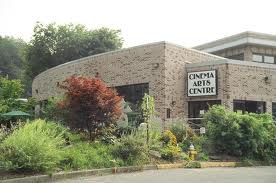
If you weren’t looking for the Cinema Arts Centre, you might never notice it. Tucked away on the suburban side streets of Huntington, Long Island, the single-level building looks like it might be a library or a community center or maybe a day care facility–anything but a movie theater.

In 1973 two film-loving ex-Manhattanites, Vic Skolnick and Charlotte Sky, started their New Community Cinema–which later became the Cinema Arts Centre–with little more than a projector borrowed from the public library and a bed sheet hung on the wall of a friend’s dance studio.

“It’s hard to picture how little was going on in the suburbs,” says Dylan Skolnick, CAC co-director and son of Vic and Charlotte, about Long Island in the 1970s. “Here was chain theaters with new movies, that was it. No cable, no DVDs, no VHS. Just The Late Show on TV. Instead of grumbling and being miserable, they started showing movies.”

The Cinema Arts Centre in Huntington, Long Island. (Photo courtesy of petrocelliinc.com).

Ginger Polisner and her husband Stuart, who sponsor two annual events at the theater, have been CAC members for over 30 years. “We had seen a small ad somewhere and we were looking for something different to do,” says Mrs. Polisner, recounting the first time they attended one of Vic and Charlotte’s film nights. “We watched a film about freedom fighters. The film kept breaking, so everyone would huddle over a fire escape, smoke cigarettes, and wait for them to fix the film. The bed sheet would move, the subtitles weren’t legible. [Afterwards] we looked at one another and said, ‘I don’t know what they put in the water, but we gotta go back to that place.’”

Today, with 8,000 members, the CAC is a long way from bed sheets and borrowed equipment. Originally “membership” entailed a suggested donation of $1 to help rent the following week’s film reel; a CAC membership now costs $55 annually and includes discounted tickets ($6 versus the non-member price of $11). For their part, the CAC–a nonprofit organization–gets cash up front to pour back into the theater.

“When you come to see Moonrise Kingdom, 50% of every dollar goes to Focus Features–we  only get to keep half,” says Skolnick. “When you buy a membership, it’s all ours to use on the many, many bills and expenses we have.” But membership fees are not just about paying the bills, says Skolnick. “We want people to feel that when they become a member, that they’re a part of our cinema family and they have involvement and feel like it’s their place.”

Though movie theaters large and small must give a large chunk of their ticket sales back to the studios, they get to keep their earnings from concessions sales. This is why moviegoers see such huge markups on items like soda, candy and popcorn at most chain movie theaters. But the CAC even does its food a little differently. Sure, they sell popcorn–organic popcorn–but their menu also includes soups, salads, wraps, and even quiche. By way of movie “candy,” they offer a variety of gourmet-style pastries and snacks. The CAC also has an intriguing weekday special: for $28, filmgoers get lunch, a movie, and a post-screening discussion with Charlotte and Dylan.

As you might guess, an art house theater like the CAC tends to skew older in terms of demographics. “The older audience is undervalued,” says Skolnick. “The younger audience might have a lot of other things they might be doing. They’re fickle.”

One attempt to expand its audience base is the CAC’s Youth Advisory Board, a project designed to engage a young film fans in the community thorough a special film series. Board members will help program the films, promote events, and fundraise.  The CAC also participates in the Summer Camp Cinema Series, which features cult classic double features during summer Friday nights such as The Matrix and Inception, to draw a younger crowd to the theater.

Jacob Stebel, 30, has been a large part of the CAC’s youth movement. Stebel has worked full-time for the CAC since he was 23, and had been a patron before that since age 15. An amateur filmmaker himself, Stebel even premiered his own film, Freaks Nerds and Romantics, at the CAC in 2010. “Vic Skolnick … gave us advice all the way through,” says Stebel about the late CAC co-founder, who passed away in June 2010. “The cinema is a fantastic resource for filmmakers. Our [theater] directors have seen more films than anyone you’ve ever met. Who better to critique your film?”

The CAC has seen many talented and notable filmmakers and actors pass through its doors over the years, from Ang Lee to Spike Lee, Carol Burnett, Steve Buscemi and Tony Shalhoub. “That’s the ace up our sleeve,” says Stebel, who believes events like these, for which someone associated with the film is invited to speak, can draw a broader audience to the theater and add value beyond just the film itself.

“I always say [the CAC] is the place my parents thought they sent me to get a college degree,” says Mrs. Polisner about the education she’s received from the theater over the years. “[College] didn’t prepare me for life the way the Cinema has. Every side of political issues, economic, environmental. Speakers from all over the world, all walks of life, actors, filmmakers, musicians, anthropologists, scientists, the Tuskegee airmen before anyone knew about them.”

Despite a loyal following and a slew of famous friends, running this or any independent theater in 2012 is not without its challenges. As movie studios are on the brink of moving exclusively to digital prints–meaning no more physical film reels–smaller theaters without the resources to upgrade to digital projectors may start to disappear.

Digital projectors, according to Skolnick, run about $70,000 apiece–meaning it would cost about $200,000 in total to upgrade his three auditoriums. “It’s unfortunate. Technology changes, the world changes. You have to move forward,” says Skolnick. On its website, the CAC has launched the Digital Cinema Campaign in an effort to raise money for its new projectors with donations from the community. (At this writing, the CAC has collected about $60,000 in donations.)

That fundraising campaign may be bittersweet for some of the long-time members like the Polisners when it comes to exposing the hidden gem they’ve enjoyed for so many years. “The Cinema is still a secret that we both want to share and guard jealously,” says Mrs. Polisner.

Still, Skolnick seems confident that the CAC is staying put, no matter what challenges it may face. “I think we’re gonna be alright.”

Read Full Post »

A shared pastime of my fiancée and me is to watch an episode of the Food Network’s Restaurant: Impossible and then, once it’s over, to Yelp the featured restaurant to see if they were able to turn things around once the camera crew packed up and left. It’s not that we don’t trust Sir Robert Irvine, the ex-military Brit with a heart of gold shrouded in an exterior of tough love and culinary expertise. It’s that we don’t always trust the restaurateurs to stick to the blueprint Irvine has laid out for them.

Inevitably, we’ll find reviews like this one, which reference the restaurant’s appearance on the show, often telling other would-be diners that it’s still the same old dump. In some cases, we find out the restaurant closed shortly after Irvine’s intervention. And while it’s sad to see, there are thousands of other restaurants that don’t have the benefit of a deus ex machina like Irvine. Instead, if they want to survive in the business they have to, you know,  run their restaurant correctly.

Still, we love the show and so we were quite pleased to stumble upon the series premiere of Travel Channel’s Hotel Impossible last night. Hotel Impossible is centered around an expert in the hospitality field and hotel “fixer,” Anthony Melchiorri, with a brash style similar to Irvine’s. In Hotel Impossible’s first episode, Melchiorri goes out to Montauk, Long Island, to rescue Gurney’s Inn, a family-run hotel that has seen a steady decline since the family patriarch and general manager passed away two years ago.

Melchiorri immediately diagnoses Gurney’s biggest issues: crappy service, outdated decor, and the general ineptitude of the management, who are all members of the family. In one scene, he asks the current GM to round up the staff for a 10 am meeting on the beach, and by 10:30 no one’s there. When Melchiorri confronts the GM, his excuse is that everyone’s “on Montauk time.” About fifteen minutes in, we already hate the GM if not the entire family. The head chef, one of the few relatives who actually seems competent, admits on camera that some of the other family members would not have a job at Gurney’s if they weren’t flesh and blood. It’s as if their father left them a coveted masterpiece, and they can’t be bothered to dust the frame from time to time.

OK, we get it: it’s a TV show; there’s got to be some conflict. If they only tackled projects where ownership was totally willing to adopt every change Melchiorri suggested, it wouldn’t seem quite so “impossible.” (Or, for that matter they wouldn’t be in so much trouble in the first place.) But throughout the episode, Melchiorri makes references to the other newer, hungrier hotels in Montauk who can’t wait to “eat their lunch” if Gurney’s keeps going the way it is, and that the only thing saving them is the gorgeous view of the ocean from their property, which this generation can hardly take credit for.

Wouldn’t it make for a decent, and similarly impossible show, if Melchiorri, or Irvine for that matter, helped out one of those competing hotels or restaurants to put a bigger one out of business? While the Impossible shows are entertaining, I can’t help but think that if these were baseball teams instead of service businesses, they’d be swooping in to help the New York Yankees spend their $200 million payroll more efficiently, while the financially challenged Oakland A’s looked around and said, “What about us?”

All that said, there are probably hundreds of newer, hungrier hotels, restaurants, pet shops, bakeries, food trucks, writers, and yes, even baseball teams, who are slowly making headway in their respective industries, chipping away at the market share–all without the help of a TV show. But for their sake, let’s hope that Melchiorri or Irvine don’t show up one day to help their competitors across the street.

RELATED: Hotel Renovation Proves ‘Impossible’ for Anthony Melchiorri

RELATED: Hotel Impossible: After Anthony Special – A Review

Read Full Post »

When I attended my first Seinfeld trivia night back in December, I never anticipated the chain of events I’d set into motion: I’d interview the trivia host, Dave Oliver and we’d become fast friends; I’d write my most-read blog post ever based on that interview; I’d join Dave’s company, Trivia, A.D., as a consultant; and I’d help him host a Seinfeld trivia night at Tom’s Restaurant, a.k.a. Monk’s Diner from the show.

Still, none of the above is so unbelievable that you’d doubt it if I put it in a blog post.

Slightly more unbelievable, though, is that on the night of the Tom’s event, I’d find myself in an Italian restaurant a few doors down from the diner, explaining to Jeremiah Birkett (the guy who played oversleeping marathoner Jean-Paul Jean-Paul on Seinfeld) and Lou Cutell (who played Dr. Cooperman, a.k.a. The Assman) that in about a minute, I’d be bringing them down the block and through the front door of Tom’s for their surprise guest appearance in front of a crowd of 80 trivia players.

What separates Tom’s Restaurant from any other coffee shop or diner I’ve ever been to is, well, not much, actually. If I didn’t know it was “the coffee shop from Seinfeld”–or recognize the neon “RESTAURANT” sign on the outside–I never would have figured it out once I was sitting inside eating my grilled cheese and rice pudding at the counter.

There’s a blurb in the menu that mentions the diner’s famous connections, but it’s understated and easy to miss:

Tom’s restaurant on upper Broadway and 112th Street has been serving Columbia University and the surrounding communities since the 1940’s. Tom’s became a legend through Recording Artist Susan Vega’s “Tom’s Diner” Song and even more so after appearing repeatedly on the world famous Seinfeld TV program.

On the wall to the right, there are a few enlarged and framed TV Guide covers featuring Jerry, George, Elaine and Kramer. And in the very corner, tucked between the front window and the counter, is “The Kramer” portrait, which Tom’s sells as a poster for $12. I decided not to ask the owner–Mike, not Tom–whether anyone has ever bought one.

To the locals–for whom Tom’s closed its doors for two hours while the trivia was going on–it’s just a diner where they go sometimes for a cup of coffee and a piece of pie. A wi-fi-less place for Columbia students to take a study break. A rare NYC eatery that doesn’t serve alcohol and only takes cash.

As trivia teams started to file in, Mike checked names off his list of reservations. I asked him whether his place was usually this full on a Monday night. He smiled and shook his head.

The guest list for the evening was invitation only, based on those teams who had been to Dave’s Seinfeld trivia nights before. The list of team names read like a Kentucky Derby race card if Jerry Seinfeld owned all the horses: Spongeworthy, I Was in the Pool, Mulva, What About the Driver?, and the odds-on favorite, Why No T-Bone?

The pre-trivia buzz for an average Seinfeld trivia night typically carries the nonchalance of any weeknight happy hour. But at Tom’s, the atmosphere seemed a little more tense. As teams assembled and claimed their booths or spots at the counter, I gleaned bits of one team’s conversation as they quizzed each on the minute details of specific episodes. I even heard one woman say, “I was studying my flash cards last night,” with a straight face.

And when Dave read the first question–“In the episode, ‘The Doodle,’ Kramer and Newman wait all year long for the Mackinaw peaches. Where do they come from?”*–the diner grew eerily silent as everyone considered their answer, knowing any misstep, even on the first question, could cost them. It felt like we were proctoring the SATs.

Hoping to raise the event’s profile, Dave had reached out to the agents and publicists for every Seinfeld actor he could think of in the months leading up to the event. Who knew, maybe one of them would actually show up. While most were either out of town or simply too busy to come, many sent gracious and genuine responses as well as signed headshots to give away as prizes at the event.

Dave only told a handful of people that Lou “The Assman” Cutell was going to be there–just in case Lou had to cancel last minute–but he was clearly excited. Every couple of weeks I’d get an email or text to the effect of, “I just talked to The Assman on the phone for 40 minutes!”

Jeremiah “Jean-Paul Jean-Paul” Birkett’s appearance that night was a surprise even to Dave, who explained that in earlier conversations with JPJP’s “people,” it seemed as though they didn’t want him doing anything without an appearance fee. But Dave’s shoestring budget didn’t have room for anything like that, so he crossed him off the list and moved on.

Outside the context of a Seinfeld trivia night, it might be hard to place Jeremiah Birkett’s face. He’s a Caribbean guy in his early forties and in good shape, walking around Manhattan’s Upper West Side in a fitted black t-shirt, a leather jacket and jeans. But inside the four walls of Tom’s, even 16 years after the Jean-Paul episode (“The Hot Tub”) originally aired on NBC, he was recognized instantly as Jean-Paul, even before Dave could announce him.

I led Lou in next, holding up the famous ASSMAN license plate out in front of him to help people connect the dots. He got an equally warm reception, after which Dave handed him the microphone to guest host the final round of questions–all of which referenced the episode in which he appeared, “The Fusilli Jerry.”

A professional performer for decades, Lou looked over at Dave as if to say, “What should I say?”, then proceeded to tell a couple of stories about Life After Assman which all ended similarly: “I’ve been in over 70 films, I’ve done Shakespeare on Broadway [yada yada yada] but I’m still remembered as The Assman!”

Lou then read the last round of questions, pausing comically in disbelief every so often to scratch his head and say things like, “Who would know this stuff?”

After the round was over, a few of us feverishly graded the answer sheets and tallied up the scores to determine a winner. Jeremiah bought us a little time, following Lou’s lead and telling a story about being hassled at the airport a few years ago on his way back from Amsterdam with his wife. A security guard looked at him funny for a few moments until realizing who he was, then proceeded to point at him, shout “Seinfeld! Seinfeld!” and eventually let him pass.

When it was time to crown a champion, Why No T-Bone? had edged out Spongeworthy by a single point to win the night. It was retribution for Why No T-Bone?, who has won nearly every one of Dave’s Seinfeld trivia nights but finished second in his 2010 Seinfeld trivia tournament.

Once Tom’s cleared out, Dave sat down–for the first time all night–with those of us who’d helped him throughout the event. As we sat there eating burgers, fries, and root beer floats, something seemed eerily familiar about a few friends sitting in a booth, having a conversation about nothing.

The next morning, Dave looked in his bag and discovered Jeremiah had autographed a head shot for him. It read, “Thanks Dave, you son of a bitch.”

*The Macinaw peaches came from Oregon. Several teams got this one right.

Read Full Post »

It’s a Monday night in December and I’m sitting in a bar called Mulligan’s in Hoboken, New Jersey, waiting for my buddy Mike to claim the bar stool I’m saving for him. I lived in Hoboken for three years during my mid-20s and spent a lot of that time in bars, but I can’t remember ever seeing Mulligan’s this packed on any night of the week, no less a Monday.

The crowd, which is about 90% dudes, is there for the same reason Mike and I came out: It’s Seinfeld trivia night.

When the trivia host hands us our answer sheet for Round 1, I examine it carefully. It’s made up to look like the cover of a Penthouse magazine–a noticeable departure from the nondescript answer sheets you might find at other trivia nights. The blank white answer spaces, labeled 1 through 10, are strategically placed to cover the otherwise exposed cover models underneath (pictured below). In the bottom right corner, I notice the magazine is addressed to fictitious Seinfeld “dentist to the stars” Dr. Tim Whatley, DDS, who in one episode had an adults only dental practice and a waiting room stocked with adult reading materials.

Not your average answer sheet.

Mike and I are confident going into the first few questions. Between us, we’ve seen every episode 20 or 30 times in reruns. (I’d learn later that our host estimates he’s seen each episode at least 200 times.)

We keep pace with the leaders for the first few rounds, including a perfect 12 out of 12 in Round 2, attributing quotes from the show to the characters who said them. But by Round 4, matching obscure character names to their pictures, and the final round, made up entirely of questions about the “Festivus” episode, we’re toast.

We finish in seventh place. Our only consolation prize is the small laugh we get from the other players when our team name (To See Ramon?) is read aloud.

Still thinking about Seinfeld trivia the following morning, I reached out to Trivia, A.D., the company that put on the event, via Twitter. I wasn’t really sure what I expected to find.

But five days later, I’m sitting in Trivia, A.D. co-founder Dave Oliver’s living room in Hoboken, listening to him tell the story of how the company came to be.

This place looks like The Max from Saved by the Bell! How cool would it be if they had 80s trivia here?

For friends Amy Gerson and Dave Oliver, that epiphany came in May 2009 over drinks and tater tots at their favorite neighborhood haunt, Big Daddy’s on Manhattan’s Upper East Side. Big Daddy’s is an 80s-style diner that doubles as a watering hole for locals, which Oliver describes as “like Johnny Rockets but less cheesy.”

Half-jokingly, they bounced the trivia idea off each other for 10 or 15 minutes, after which Gerson (who freely admits, “I have a big mouth”) approached the manager on duty that night about co-hosting a trivia night with her friend Dave at Big Daddy’s, eventually getting in touch with the restaurant’s general manager.

He said yes.

Management didn’t know what to expect as far as turnout, so they set aside a space for Gerson and Oliver in the back of the diner to hold about 25 people. Big Daddy’s email-blasted their customer database to alert them about the event, and Oliver used his graphic design background to create an eye-catching flyer to hang inside the diner.

After just a few days of promoting, Big Daddy’s had 110 reservations lined up.

That first night went well–so well, in fact, that the nascent trivia hosting team was invited back to do 80s pop culture trivia at Big Daddy’s Gramercy location, and later to host more trivia nights at those locations as well as as at two Duke’s locations (owned by Branded Restaurants USA, the same people who own Big Daddy’s).

Before they knew it, Trivia, A.D. (named for Amy and Dave) had become a four-nights-a-month part-time job.

When Oliver approaches a potential client (i.e. a bar) about hosting a trivia night, they typically request “regular” or general trivia. But when one of his Friends or Saved by the Bell trivia nights brings in 80 to 100 people on a Tuesday night, that’s all the convincing they need.

The concept of a themed trivia night isn’t unheard of, but general trivia–topics like current events, geography, music and sports all rolled into one–is far more common in bars. For Trivia, A.D.’s events, though, people aren’t there simply by happenstance; they show up specifically to play trivia about their favorite TV show or movie because they’re passionate about it.

That passion is never more apparent than when Oliver hosts Seinfeld trivia nights, which he started in July 2009. In fact, Oliver says Seinfeld is one of his three passions in life (the other two are baseball and Pearl Jam), but there’s one couple who might love the show even more than he does.

“To date, we’ve won Seinfeld trivia 17 times,” says Jamie Sclafane, who plays under team name Why No T-Bone? with her husband, Dave. They’ve been attending Trivia, A.D.’s Seinfeld trivia nights since September 2009.

(For some more of Trivia, A.D.’s funniest Seinfeld trivia team names, see the comments section below.)

“We had been waiting for something like this for a long time,” says Sclafane. “When I saw the flyer, I immediately called Dave and was like we need to go to this!”

Why No T-Bone? placed second at Trivia, A.D.’s 2010 Seinfeld Trivia Tournament, which took place over three weeks in July 2010 across four Big Daddy’s and Duke’s locations. “The amount of work and detail [Oliver] put into the … tournament was incredible,” says Scalfane.

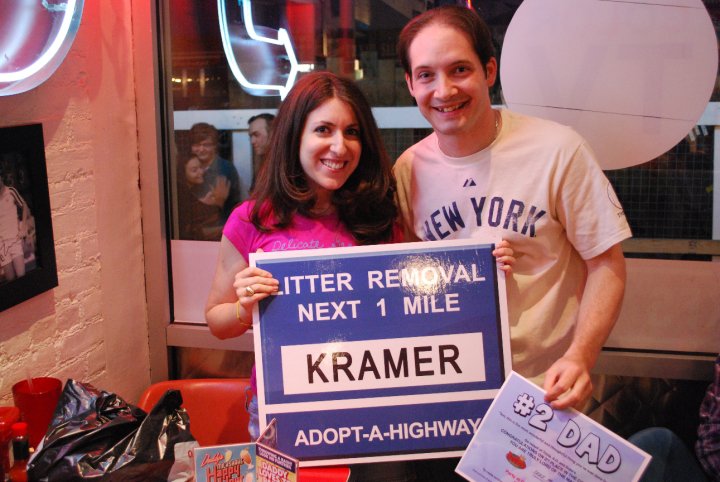
Each team who made the tournament “finale” received a Seinfeld themed gift, such as a giant marble rye or a box of Jujyfruits. “He also made … a giant clown check made out to The Human Fund and the sign to mile marker 114 for the highway Kramer adopted,” Sclafane says, “which we proudly hang in our dining room.”

Jamie and Dave Sclafane at Trivia, A.D.'s 2010 Seinfeld Trivia Tournament.

Looking to expand beyond bars and restaurants, Trivia, A.D. hosted a “Festivus”-themed Seinfeld trivia night at Comix comedy club in December 2010. Comix advertised the event in the New York Post and Oliver designed inserts promoting the event to put in the playbills for Long Story Short, the one-man show starring Colin Quinn and directed by Jerry Seinfeld.

Long Story Short donated 16 tickets to their show plus some Seinfeld memorabilia for the winners. Unlike previous Trivia, A.D.-hosted trivia nights, Comix sold tickets to the event ($15 plus a two-drink minimum), but still drew an impressive 125 people.

It’s easy enough to Google “Seinfeld trivia questions,” copy and paste the best ones, and pass them off as your own at a trivia night. But that’s not Trivia, A.D.’s style.

For Seinfeld trivia in particular, Oliver has a database of thousands of questions and answers and says he knows where to find just about any scene for any season within his Seinfeld DVD collection. (I detect a hint of pride in his voice when he tells me this.)

So, if I go to one of your Seinfeld trivia nights this month, and then I go to another one six months later, will I get any of the same questions?

No repeats, he guarantees, not at any of his trivia nights.

As we’re chatting, Oliver’s wife, Kara Oliver, stops in to tell her husband that she’s got a friend “who knows a guy who was in the Pez episode who owns a bar.” He appears to make a mental note to track down that lead once I’ve left.

While Seinfeld trivia is Oliver’s forte, he’s getting more comfortable writing questions and hosting trivia nights for themes in which he’s not as fluent.

“If you’re gonna host, you better know your stuff,” says Oliver. “Die hard fans pick up on that.”

Trivia, A.D. gets tons of requests for new themes. “Right now people want Scrubs trivia.” Oliver’s even heard requests for Little House on the Prairie trivia. (Do not look out for that one at a bar near you in 2012.)

“My favorite part of any trivia night is when we announce all the themes we do and hearing people’s reactions,” says Kara, who has hosted Trivia, A.D. events for Jersey Shore, Mean Girls, Mad Men and Caddyshack. “They get so excited to hear their favorite show or movie.”

Other Trivia, A.D. pop-nostalgia themes have included Star Wars, Beverly Hills 90210, Back to the Future, Sex and the City, and more recently, Arrested Development and Harry Potter. Oliver’s always got his ear to the ground for the next pop culture phenomenon that could make for great for a trivia night.

Just a year and a half after its inception, Trivia, A.D. had taken greater strides than Oliver and Gerson had ever imagined it could, but a series of bad breaks in the first half of 2011 left them wondering whether they’d taken it as far as it could go.

This past February, Oliver hosted a Seinfeld trivia event at Gotham Comedy Club, hoping to repeat the success of the Comix show. But a couple of factors were working against them this time–namely, it was the Monday night after Super Bowl Sunday–and the event drew just 40 people.

And in June, Trivia, A.D. and Big Daddy’s mutually dissolved their long-standing trivia arrangement; the two sides are no longer affiliated.

But Trivia, A.D. has rebounded, adding new venues to its roster in New York and New Jersey, including Croton ReservoirVillage Pourhouse, and Liberty Bar, and it currently has trivia events booked through March 2012.

Without giving too much away, Oliver hints at multi-city expansion beyond the New York metro area, and he’d like to further experiment with trivia events outside of bars and restaurants. “I have big plans,” he says.

Well, how’s this for big plans: On January 30, Oliver will host a Seinfeld trivia night at Tom’s Restaurant. If that name doesn’t sound familiar, it’s because fans of the show may know it better as Monk’s Diner, the coffee shop where Jerry and the gang spent an obscene amount of time during the show’s 10-year run. (Monk’s is based on Tom’s.)

Though the Tom’s event is already booked to capacity, Oliver is always looking to add the finishing touches. He has reached out to every Seinfeld actor he can get a hold of to get them involved in the event, from Bryan Cranston (Tim Whatley) of AMC’s hit series Breaking Bad to Patrick Warburton (the face-painting David Puddy) of CBS’s Rules of Engagement.

And if Jerry Seinfeld himself happens to show up at Tom’s that night, you can bet there will be a spot waiting for him in his old booth–there might even be room for three of his closest friends.

Read Full Post »

“A company like Anheuser-Busch is a hundred times our size. They literally spill more beer … than I make all year. My passionate life’s work is their industrial waste.” –Jim Koch, founder of The Boston Beer Company, in the 2009 documentary Beer Wars

//

When you think about it, tasting a really good craft beer isn’t all that different from tasting a fine wine.

The process is about the same. You want to know where it’s from and who made it. Once it’s poured into your glass, you examine the color, maybe hold it up to the light and look through it. Next, you give it a sniff to try to pick out notes of chocolate or oranges or coffee. Then it’s time to sip it, swirl it around in your mouth. What other flavors can you pick up?

There is a difference, though, between tasting beer and tasting wine. Unlike wine, beer must be swallowed to fully appreciate its taste. Let’s just say at beer tastings, a spit bucket is a lot less common.

Craft beer, by most definitions, is beer brewed by a small, independent brewery. (See here for a more in-depth explanation.) To put it another way, craft beers come from any microbrewery that strives for creativity and innovation, and have little or nothing to do with Anheuser-Busch or MillerCoors.

Henry Joseph, 30, has been bartending at The Pony Bar, a craft beer bar in Manhattan’s Hell’s Kitchen, since it opened in April 2009.

“The neighborhood was underserved for craft beers,” Henry says.

Unlike most bars, where craft beer tends to be the most expensive beer on the menu, The Pony Bar keeps it simple: all beers cost $5. To further entice its patrons to experiment with new beers, The Pony Bar’s All American program rewards anyone who tries 100 different draft beers (not necessarily in one sitting) with a Pony Bar shirt and their name on the All American plaque and on the website.

To date, 440 people have completed a 100-beer cycle.

The Pony Bar’s star attraction is the two-part menu board hanging on the wall behind the bar: a list of 20 American craft beers on tap, which rotates as often as a keg is kicked. Each line on the list has the name of the brewery, the name of the beer, and the alcohol by volume (ABV)—most beers are served in 14 oz. glasses, with higher alcohol brews served in 8 oz. glasses. For non-craft beer drinkers, The Pony Bar also serves liquor and wine, as well as Bud and Bud Light bottles.

Do you ever sell any Bud Light? I ask Henry. “A few on Saturday nights,” he says. How much do you sell them for? “Five bucks. But we’re thinking of raising it to six.”

With an obvious passion for craft beers and the knowledge to back it up, Henry is happy to help his customers select a beer from the menu board, which can be a little intimidating for a newcomer. “It’s fun to see locals come in and to watch their tastes develop and evolve over time.”

Theme nights at The Pony Bar include “Rocky Mountain High,” during which they only serve Colorado beers. They also run “Tap Takeovers,” which feature beers from one brewery all night. Previous Tap Takeovers have included Sixpoint, Lagunitas, Stone, Victory and Southern Tier.

It’s also a good place to find the latest American seasonal beers, such as pumpkin ales during October. Southern Tier’s Pumpking Imperial Pumpkin Ale has been a big hit this year. “We can’t sell enough Southern Tier pumpkin,” Henry says.

The menu board at The Pony Bar (courtesy of theponybar.com).

//

It’s an exciting and pivotal time for the craft beer business. According to the Brewers Association, the craft beer industry was worth $7.6 billion in 2010. Yet craft beer’s undisputed heavyweight champion, The Boston Brewing Company (which brews Samuel Adamsmade up less than 1% of all beer sales in the U.S. in 2010.

This past March, the craft beer industry made headlines when Chicago-based Goose Island sold to Anheuser-Busch (AB) for $38.8 million. While many craft beer drinkers have mixed feelings about Goose Island’s decision to sell, the deal drew national attention to the brand and shortly after the announcement, Goose Island six-packs started appearing more frequently in the beer aisle of my local grocery store.

What’s your take on the Goose Island acquisition? I ask Henry. “[AB] can’t sell any more Bud Light,” he says. “It was a last ditch effort.” But doesn’t it make Goose Island kind of a sell out? “If the beer continues to taste good, who cares?”

The truth is the lines have been blurred for a while now. Craft Brewers Alliance, which sold its $16.3 million share of Goose Island to AB, still owns smaller outfits including Redhook Ale Brewery, Kona Brewing Company, and Widmer Brothers. This past October, Terrapin Beer Co. sold a minority share to Miller Coors in an effort to fund a $4.5 million expansion project. And Blue Moon, which makes its signature Belgian-style wheat ale as well as several seasonal variations, has been brewed by Coors since its inception in 1995.

Still, Henry points to brewers like Sam Calagione from Delaware-based Dogfish Head Craft Brewed Ales, who have stuck to their guns despite financial pressures. “[Sam] could only brew 60 Minute IPA (India Pale Ale) all day,” Dogfish’s signature and best-selling beer, Henry points out, rather than experimenting constantly with new flavors that are less profitable as he does now. Calagione explains his brewing philosophy in the Beer Wars documentary:

“Big breweries are usually public companies … Their real goal at the end of the day is maximizing shareholder value, whereas our goal is maximizing the flavor of what we’re making for our own enjoyment as the people making it.”

And for other do-it-yourselfers out there, craft beer is more accessible than ever in terms of homebrewing. Amateur brewmasters can replicate their favorite beers just as an amateur baker would follow a recipe in a Paula Dean cookbook. Or, if they’re feeling adventurous, they could put their own unique twist on an old classic.

It seems like every guy I know is brewing his own beer these days, I say to Henry. “Those kids in Brooklyn, now…you can buy one-gallon [craft beer] kits,” Henry says. “The holiday markets in Union Square are selling vanilla bean porter kits. You can put craft beer kits on your [wedding] registry!” They’re even selling craft beer kits at Bed Bath & Beyond.

//

When I met up with Henry at another craft beer bar, this one on the East Side, I’d been drinking $2 mugs of light, drinkable, but unremarkable Checker Cab Blonde Ale. (I’ve had it before—it’s the bar’s Sunday football beer special.) When I was ready for my next round, I asked Henry for a recommendation. He peered at the chalkboard menu and seemed excited about a beer from Barrier Brewing Co. I take it you’ve heard of Barrier before? “Yeah, it’s two guys on Long Island, Evan and Craig, who used to work for [Brooklyn-based brewery] Sixpoint.”

You really know your stuff. “Me and [The Pony Bar owner Dan McLaughlin] are pretty dialed in … I’ll come to a bar like this and try new beers, and say, ‘Hey, we should be pouring this.’”

My own beer palate isn’t as developed as Henry’s but I’ve had enough drafts to know when the beer has gone bad, and every now and then I’ll send one back. “The state of draft beer is horrible,” says Henry. “I would not order draft beer outside of a craft beer bar.” He says the lines—those are the hoses between the kegs and the taps—should be ideally cleaned once every two weeks. The Pony Bar does this, but many places don’t clean nearly as often–if ever.

According to Henry, a lot can go wrong if a bar isn’t maintaining its equipment correctly. And he should know: Henry is a Certified Cicerone, the second of three levels of the Cicerone Certification Program, just below Master Cicerone, of which there are just three in the whole country. From Cicerone.org:

“The Cicerone Certification Program offers that independent assessment and certification so that industry professionals—as well as consumers—can be sure of the knowledge and skills possessed by current and prospective beer servers.”

Henry says one part of the certification process has candidates first taste a “control beer” and then several off-tasting iterations of it to determine what went wrong, such as having been served from a dirty tap, or containing too much diacetyl, which at low levels adds a “slipperiness” to the beer but at high levels can give it an unwanted buttery flavor. Was it like the milk tasting competition in Napoleon Dynamite? I ask. “Yes. Exactly.”

When he’s not tending bar, Henry is the director of events and tastings at Civilization of Beer, a company founded by Sam Merritt whose mission is “to promote, through education and appreciation, the responsible enjoyment of high quality, craft beer in the context of our rapidly changing culinary landscape.”

Before The Pony Bar, Henry had gotten his start in the summer of 2005 in Allston, Mass., working at the Sunset Grill and Tap under owner Marc Kadish. It’s there, he says, where “I truly fell in love with the wide world of beer.”

He went on to work for Craft Brewers Guild outside of Boston. Working as a sales rep, he learned the “business of beer,” and met many people in the industry who shared his passion for craft beer.

Henry describes the craft beer community as “a tight knit group—not cutthroat,” and says, “We’re at a point in history where there are more breweries than ever—more than before Prohibition. More people are passionate about making and drinking beer.”

He credits local bar owners Jimmy Carbone (Jimmy’s #43), Dave Broderick (Blind Tiger), and the late Ray Dieter (d.b.a.) for growing the craft beer business in New York City when no one else wanted to sell the stuff. Without these guys, Henry says, “I wouldn’t have a job.” (On a personal note, I’m indebted to Broderick, too: my girlfriend and I shared pumpkin beers at Blind Tiger on our first date.)

“Craft beer isn’t a fad,” Henry says, attributing an old quote to Brooklyn Brewery co-founder Garrett Oliver. “It’s a return to normalcy.”

Read Full Post »

« Newer Posts - Older Posts »