Feeds:
Posts
Comments

Archive for the ‘Personal Essays’ Category

Have you ever stuck with a TV show long after it jumped the shark?

Most of us have done this at some point in our lives–we invest so much time and emotional capital in a show that no matter how much it frustrates us from week to week, we can’t bring ourselves to give up on it until it eventually, mercifully, it goes off the air.

For me, that show was Lost.

Lost aired from 2005 to 2010 and was set in the aftermath of a plane crash that left its surviving passengers–nearly all of them with movie star looks–on a desert island. The show was designed to manipulate viewers’ perceptions as we struggled each week to figure out what was going on. Was the island actually a metaphor for purgatory? Are The Others good or bad? And what the hell is with that black smoke monster???

The black smoke monster just kinda hangin’ out.

As the plot confused us more and more each week–driving viewers like me to seek out any crazy theory the internet could come up with–Lost‘s only saving grace, perhaps, was its character development. The show’s format in the first few seasons focused on one main character each week, jumping back and forth between the their lives on the island (post-crash) and off the island (pre-crash).

My favorite character was Sawyer, the good-looking conman with the southern drawl who called everyone only by sarcastic nicknames. I was always pumped when I found out next week’s episode was “a Sawyer.”

But as the writers dug themselves deeper into a hole and it became obvious that many of the questions posed in season 1 through 5 weren’t going to get answered during season 6, the final season, my interest in the show began to wane. Yet I couldn’t make myself walk away. When the finale aired on May 23, 2010, I wasn’t exactly satisfied. Really, I was just relieved.

I found myself watching a rerun of Lost two Mondays ago on G4, an off-day during the Yankees-Tigers playoff series. (I recommend every fan of the show try this at least once–watching the show completely out of context is trippy.)

At that point the Yankees were in the midst of their own crash. Their sputtering offense could hardly manage to score any runs and their shortstop/team captain/my favorite player, Derek Jeter, broke his ankle late in Game 1 and was sidelined for the remainder of the playoffs.

Back in 1996, I was the biggest Yankee fan I knew. At age 14, the Yankees were more important to me than anything. I wore Yankee gear as often as my laundry rotation would allow, except for days after the team had lost the night before–I suppose I did this so no one would call me out for wearing the colors of a team that lost occasionally. Keep in mind the Yankees hadn’t won a World Series in 18 years, so younger fans of the team hadn’t yet developed the braggadocio they have today.

This was also before the internet really exploded and we were able to know all the intimate details about the players’ personal lives. For the most part we only knew about them on the field. The team featured “characters” like the soft-spoken center fielder Bernie Williams; the hot-headed right fielder Paul O’Neill who would punish a Gatorade in the cooler after making an out; and the former rival from the Red Sox turned Yankee Wade Boggs, who was known for superstitiously eating chicken before every game. It was also Jeter’s first full season on the team. (I remember having conversations about Jeter with friends, trying to figure out his ethnic background based on his last name and his looks–he’s half white, half black–because back then there was no such thing as Googling “Derek Jeter ethnicity.”)

If you go to a game today, you’ll still see the names and numbers of those guys from the 1996 team on the backs of fans. Incidentally, I wonder how many fans will be wearing the names and numbers of guys from the 2012 team in 16 years.

But by 2011, nearly all the guys from those 90s teams had retired, leaving only the “Core Four”–Jeter, Mariano Rivera, Andy Pettitte, and Jorge Posada–the players who were drafted as young men by the Yankees and came through their farm system, then went on to win five championships with the team.

As Jeter was carried off the field, the Core Four had lost yet another member: Posada had retired after the 2011 season; Rivera suffered a season-ending injury back in May; and Pettitte, who retired after the 2010 season then unretired before the 2012 season, pitched well in this year’s playoffs but also missed a large chunk of the season to an injury.

Meanwhile Alex Rodriguez, known more commonly as A-Rod, became the character Yankee fans loved to hate, a role he was not unfamiliar with. As A-Rod continued to struggle at the plate during this most recent playoff run, it was almost comical to watch him pick up a bat in a crucial situation, only to strikeout and hear the boos from the home fans at Yankee Stadium.

I’m not prone to booing, especially a guy on one’s own team (unless he displays a lack of effort) but A-Rod brings a lot of the ill will upon himself. He has been awful in October (except for 2009, when his play carried the team to a World Series–but Yankee fans have already forgotten about that). His off-the-field behavior–a high-profile divorce followed by a series of even higher-profile relationships with celebrities–is perceived by some as a distraction. He’s an admitted steroid-user, though only in 2002 to 2004, when he wasn’t playing for the Yankees. And he makes a lot of money. Like a lot of money. The Yankees owe him $114 million over the next five seasons, making it unlikely he’ll play for any other team other than the Yankees until after he turns 42, because no other team is crazy enough to take on that contract.

A guy like that is just more fun to root against than for.

Perhaps A-Rod simply came along in the wrong era. If he had played 20 or 30 years ago when the contracts weren’t yet so big, or the media wasn’t quite so ubiquitous, he might’ve been able to fly under the radar a little more if he wanted to. But others say he’s an ego-maniac who loves the attention, even if it’s negative, which is why he still insists he wants to be a Yankee even after another dreadful post-season performance that had fans calling for his head–he reminds me of a TV show character fans hope will be killed off.

Not even going to bother captioning this one.

For contrast, Yankee first baseman Mark Teixeira generally seems to be liked by Yankee fans. He’s a very good hitter, an outstanding fielder, and though he also makes a lot of money, he doesn’t get booed nearly as often as A-Rod. His personal life is so quiet–I’ve heard literally nothing about him off the field–that many fans would probably consider him the most boring Yankee on the team (maybe ever?). He’s only there, seemingly, to help move the plot along.

When Jeter became a free agent a few years back and the Yankees played hardball during contract negotiations, it seemed that there was a real possibility he wouldn’t be a Yankee for much longer. I contemplated whether I would still be a Yankee if Jeter was wearing another team’s uniform. Luckily the two sides came to terms and I didn’t  have to make that decision. But when Jeter eventually retires, I’m not sure which Yankee character’s story I’ll care about enough to follow for the next 20 years or so.

Unlike Lost, which I knew would eventually go off the air and release me from its black smokey grip, the Yankees are a show that will go on forever.

A-Rod, who’s actually a year younger than Jeter, may end up being the last man standing. Yankee fans many want to be careful about trying to run A-Rod out of town, because once the rest of the Core Four are gone, he may be the only character we have left to root for–or against.

Read Full Post »

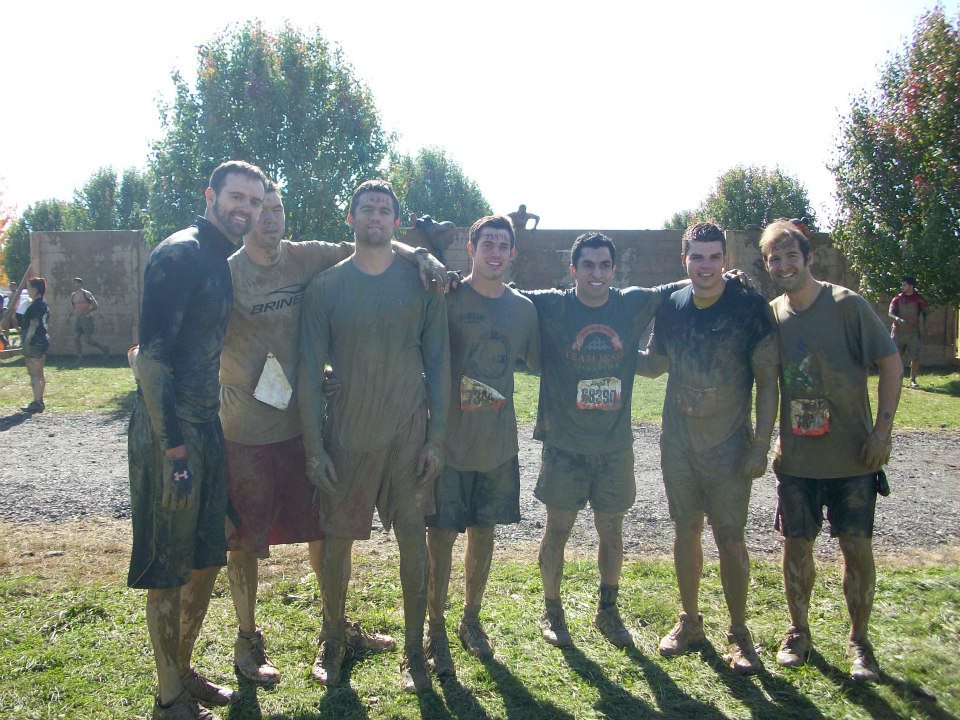
I am a Tough Mudder.

That’s right. This past Saturday I completed the 2012 Tri-State Tough Mudder event at Raceway Park in Englishtown, New Jersey.

For those not familiar with Tough Mudder, I’ll let them tell you what they’re about (from their website):

Tough Mudder events are hardcore 10-12 mile obstacle courses designed by British Special Forces to test your all around strength, stamina, mental grit, and camaraderie. As the leading company in the booming obstacle course industry, Tough Mudder has already challenged half a million inspiring participants worldwide and raised more than $3 million dollars for the Wounded Warrior Project. But Tough Mudder is more than an event, it’s a way of thinking. By running a Tough Mudder challenge, you’ll unlock a true sense of accomplishment, have a great time, and discover a camaraderie with your fellow participants that’s experienced all too rarely these days.

I got the idea to run the event from my friend Mike, who was looking for a new physical challenge beyond his normal gym routine. He recruited me and eight others, and we had our squad.

I’m running the New York City Marathon in two weeks, so my first priority was surviving the course without a major injury that might jeopardize my marathon hopes. I’m happy to report that I completed the course relatively unscathed apart from a few knee scrapes.

Tough Mudder prides itself on its badassness. Its branding is all about being a counter-culture event, more exciting and physically demanding than distance running. In fact, here are Tough Mudder’s thoughts on marathons:

Marathon running is boring. And the only thing more boring than doing a marathon is watching a marathon. Road-running may give you a healthy set of lungs, but will leave you with as much upper body strength as Keira Knightley. At Tough Mudder, we want to test your all-around mettle, not just your ability to run in a straight line, on your own, for hours on end, getting bored out of your mind. Our obstacle courses are designed by British Special Forces to test you in every way and are meant only for truly exceptional all-around people, not for people who have enough time and money to train their knees to run 26 miles.

Well, having completed my first Tough Mudder, I can say that any of my longer training runs (13+ miles) have been physically tougher. (I can neither confirm nor deny whether I have a stronger upper body than Keira Knightley.) Still, if it takes that sort of in your face rhetoric to drum up business, I can’t fault them for it–besides, it seems to be working.

Rather than taking you step-by-step through the event, here are some of my thoughts from the day:

Smells like team spirit. Tough Mudder is incredibly rah-rah, meaning it’s a lot of pump-me-up, Jock Jams kind of stuff–which I’m not a big fan of. Before we could begin the event, our emcee did a 20-minute spiel that included many a “hoo-rah.” I just wanted to start the race.

Once I got past all the hootin’ and hollerin’ and hit the course running, I realized that the spirit of the event is genuine. Anyone who needed a push, whether it was over a wall, through a tunnel, or up a muddy hill, got one. And there always seemed to be someone standing on the other side with an outstretched hand to pull you through. It was very cool to see that sort of teamwork from people who didn’t know each other.

During one of the mud hill climbs, a team of men wearing blue shirts with the Wounded Warrior logo formed a line and set up a pulley system with rope. It appeared that they were clearing space so that only they could use the rope. Several among us started to question them–it seemed against the spirit of the event that they brought a rope but were only allowing their own group to use it. However that notion quickly vanished when we realized that they were clearing space to haul a man in a wheelchair–an actual Wounded Warrior–up the hill. As we all started to realize what was happening and the crowd broke out into hearty applause.

One of many Tough Mudder walls that needed climbing. (Photo credit: Linda Germann)

Yeah, no…we get it…it’s very muddy. The majority of the obstacles involved athletics running through, being submerged in, or slipping in mud or muddy water. While I fully understand that the event is called Tough Mudder, the amount of mud on the course seemed borderline gimmicky. Nevertheless most of the obstacles were challenging. Here are my favorites:

  • Arctic Enema: The very first obstacle, it’s nothing more than a plunge into ice water. We got lucky with gorgeous weather so hypothermia wasn’t an issue, but this would have been much tougher on a cold day.
  • Funky Monkey: Monkey bars are set up over some muddy water. The bars are spaced far apart and slippery with mud. The first half of the bars inclined, and the second half declined. Despite my lack of height, I managed to get across.
  • Hangin’ Tough: Five hanging gymnastics rings are set up, you guessed it, over muddy water. I was happy to have completed this one without the entire contraption falling on me–as we waited in line for our group’s turn, we noticed repairmen fixing a few of the rings with duct tape.
  • Twinkle Toes: The goal here is to walk across a thin wooden beam, else you fall into muddy wa…you get the point. I nailed it, Gabby Douglas style.
  • Everest: The final hurdle before tasting sweet victory (and a free pint of Dos Equis), you must take a running start and run as far as you can up a half pipe, and either grab the top of the wall or catch a fellow Mudder’s outstretched hand to pull yourself over. My teammates were standing by and, with their help, I got up on the first try.

Who the hell would pay $100 to run in mud for four hours? Though most participants seemed reasonably fit, you need not be physically elite to complete the course. Tough Mudder hits you over the head about it being a teamwork event, not a race to the finish. Conquering all the course’s obstacles isn’t mandatory, but I didn’t see too many people who didn’t at least attempt an obstacle before deciding to skip it.

It was great to see so many women participating–I’d guess it was about 20% female–and all the ones I saw handled the course as well or better than their male counterparts. There was no, “Let me help you with that, sweetie” stuff either. On the Tough Mudder course, everyone is treated as an equal. (According to Tough Mudder’s site, 25% of registrants are female.)

Many people wore costumes while running the event. I don’t know if it had to do with Halloween or just because. I saw a couple of princesses, a guy in an ape mask, and four dudes wearing nothing but leopard print thongs. In hindsight, as I’m still figuring out how to de-muddify my own clothes from that day, the thong guys might have had the smartest outfit of all.

Did I mention it was muddy? (Photo credit: Linda Germann)

A few gripes. I’d be remiss if I didn’t point out the few negatives of what was largely a really positive experience:

  • Wait times for baggage were very long and didn’t seem particularly organized.
  • The “showers” were literally garden hoses with no hot water and no water pressure. (In fairness, I didn’t think they’d even have showers, so I can’t complain that they at least had something to wash off the caked mud and allow me to be semi-comfortable on my way home.)
  • The parking lots were 40 minutes from the site of the event by shuttle bus, which is a long way after a four-hour race.
  • They nickel-and-dimed participants, charging $10 for parking if your car didn’t contain at least four people; and spectators were charged $20 to watch the event (or $40 if they hadn’t bought their tickets in advance).

I’ve participated in a lot of running events, many in Central Park through New York Road Runners, and save for the above points, I thought that overall, Tough Mudder, was pretty well run. Tip: If you decide to do the event, sign up as early as possible–it’s $95 for early entry and the price increases as you get closer to the event. I can’t say for sure whether I’ll do the event again, but I feel like I got my money’s worth.

Read Full Post »

When my fiancee’s father, a superfan of the great tennis player Roger Federer, found himself traveling on his way back from a vacation on the Sunday of this year’s men’s Wimbledon championship match, he set out to do the impossible: avoid the match results until he arrived home and could watch it on his DVR.

Federer was playing in that final against Scottish hopeful Andy Murray, a highly anticipated match which, if Federer won, would improbably launch him back to the #1 ranking for the first time in two years. (If Murray won, it would mark his first major title and the first time a British male had won Wimbledon since 1936.)

My fiancee’s dad only made it as far as his plane change in Dallas before accidentally gleaning the result from a TV in the waiting area that was tuned to the news. Though I knew he’d have no real chance to avoid the score for an entire day, I still felt his pain. It wasn’t all that long ago that people relied on the next morning’s newspaper to tell them everything that happened since, well, the previous morning’s newspaper. Of course the internet changed the immediacy with which we receive news forever which is, generally speaking, a good thing. But when it comes to sports, and in particular, the Olympics, I find myself in the same boat as my future father-in-law, meaning I’m looking for less news.

The Summer and Winter Olympics only come around every four years, respectively, and the fact that most of the sports they include are scarcely televised or talked about other than during the Olympics. You couldn’t pay most Americans to watch gymnastics in an odd year but come the Summer Olympics they fall in love with their favorite American gymnast who, just moments earlier, they didn’t know existed. The same goes for the media-fueled rivalries like Phelps versus Lochte that no one was paying attention for the past few years.

Last week while on vacation, I found myself checking Twitter on my iPhone. Twitter has become my #1 news source, customized with the types of updates I want based on the people I follow–all 971 of them. I suppose it was naive of me to think that once there, all 971 people would keep it a secret who won that day’s swimming events, and that I’d get to watch it on tape delay later that night without knowing the results ahead of time. (Media outlets like ESPN, for that matter, had no motivation to keep it a secret and let competing network NBC rack up the ratings if it could spoil the results for would-be viewers.)

With modern television the way it is, where a large chunk of the best content is time-shifted with DVRs and online video streaming, we’re at the point where “appointment viewing” and the next morning’s water cooler conversations have all but disappeared. As a result, it seems to me that sports–particularly those that we only get to see every four years–might be the last remaining and most purest form of drama on TV.

I’ve watched most of these Summer Olympics without the word “LIVE” in the top right corner of my TV screen. In fact, as I write this I’m awaiting the start of the women’s beach volleyball gold medal match, featuring legendary pair Misty May-Treanor and Kerri Walsh Jennings. The match started about five hours ago in London and probably ended while I was wrapping up my workday. But I don’t know the result because I’ve avoided the internet all day in search of a genuine fan experience. The internet has brought me more information than I could ever hope to retain, but tonight, ignorance is bliss.

Read Full Post »

Sorry Means Nothing

Most of us can recall a handful of expressions our parents repeated to us throughout our childhoods. Things like, “I’ll turn this car right around if you don’t behave!” or “I’m not mad, I’m just disappointed.” I’ve written a lot about my mom on this blog, most recently in “Camp” (which received some really positive feedback–not so much for my writing but for my mom’s mad parenting skillz). There was one saying my mom used to use that stuck with me more than some of the others. If my brother or I screwed up and tried to apologize, hoping those magic words would automatically erase whatever mistake I made, she’d tell us, sorry means nothing.

I know what you’re thinking–that’s a pretty harsh thing to say to a kid. But I spent many years reflecting on and ultimately understanding that expression, and I assure you its meaning is more profound than it sounds. Rather than letting my us get away scot-free with bad behavior just by thoughtlessly apologizing and going back outside to play, my mom was trying to make us hold ourselves accountable. The words that make up an apology truly mean nothing unless you don’t repeat–or at least make a real effort not to repeat–the sort of behavior that has you apologizing in the first place.

The worst on the spectrum of meaningless apologies, the public apology, has become fashionable in the last few years among athletes and celebrities. Perhaps the most famous in recent memory was Tiger Woods’ 14-minute apology press conference. And just last week, comedian Daniel Tosh issued a half-hearted Twitter apology for some questionable jokes he made at the expense of a heckler at one of his stand-up shows. Whenever I hear about these forced public apologies, I think of that episode of The Simpsons when Bart is forced to apologize to the Australian government.

Bart: No problem. I’m great at fake apologies!
Marge: Bart!
Bart: I’m sorry…

I was the victim of a less-than-genuine apology a few months ago while out to dinner with family. We had reservations for later that night, but two members of our party stopped into the restaurant during the day to request the round table situated closest to the front window. The daytime hostess made a note to seat us there when we came back later, but when we arrived for dinner we noticed another party of the same size was sitting at the round table and was just starting their meal. The nighttime hostess sat us at another table and went to track down the owner.

By the time the owner came over to our table, we’d been apologized to by the hostess, who apparently never got a message from the other hostess about saving us the table, and our server, who may have been concerned that we’d take out our frustrations on his tip (we didn’t, though he later semi-apologized again when one of our entrees was wrong, saying “Sorry…but it’s not my fault”). The owner told us he was sorry for the miscommunication and explained that the group that got our table were his friends from out of town. In other words, he was sorry we were upset, but if the same circumstances arose again, we would still not get the table because we were not his friends from out of town. Sorry means nothing.

Semi-phony apologies are extremely common in customer service situations because sometimes just hearing the word sorry, even if it’s disingenuous, can often assuage a customer’s negative experience to some degree. (It might also soften an otherwise harsh Yelp review.) Comedian Louis C.K. has a great bit where he talks about hanging up on an airline customer service representative from Pakistan–where they likely have bigger problems than a long layover–because he knows whatever contrition she offers is purely fabricated. Instead he’d rather speak with the saccharine woman from Texas who seems more sympathetic to his plight.

On the subject of fake apologies, there’s one last kind that comes to mind–one that any tennis player should know. When a player unintentionally hits a ball that grazes the top of the net and barely trickles over–making it impossible to return–often the player will put his head down and his hand up, as if to say, “Sorry, I didn’t mean to win the point that way.” It’s meant as a gesture of sportsmanship, but you’d be hard-pressed to find a tennis player who would offer a “do-over” in that situation rather than keeping the point for himself. (Next time you’re watching pro tennis, look for the Fake I’m Sorry Wave.)

Every one of us will give and receive a fake apology at some point out of politeness, nervousness, self-interest, or even professional pressure. For my part I’d like to think that when I do decide to issue a genuine apology, when I’m legitimately remorseful for my actions or words, the recipient will know that it means something.

Read Full Post »

Camp

At age 30, my life is busier than I ever thought it could be and even the arrival of summer offers little respite compared to when I was a kid. For those of us with office jobs and a few weeks vacation a year, it’s tough to get away for too long and even when we do, it’s nearly impossible to capture the carefree feeling that came with the last day of school and a summer spent outdoors.

My younger brother and I were fortunate enough to maximize our fun for three or four summers when we attended day camp on Long Island. For a single-mother, two-child home, the tuition for camp was way out of our lower middle class summer fun budget. But we got a free ride because my mom, who had the summers off from teaching, took a job at the camp as a head counselor. She also drove a mini-bus to and from the camp every day. In exchange for her service, the fee for my brother and I to attend the camp was waived.

Ah, to be young…

In retrospect I have no idea how nice the camp actually was relative to the average health club or college campus, but for two scrappy kids from Queens, it was state of the art. Basketball courts with nets and glass backboards. Manicured soccer fields with lines. Indoor and outdoor pools so we could swim every day, even if it rained. And annual trips to places like King’s Dominion and Medieval Times. Despite the stereotype that only coddled rich kids got to go to camp, most of them were down to earth and it didn’t really matter how their parents made money. Of course there were a few spoiled brats would would bring an entire treasure chest of candy on an overnight trip (plus eight cans of Silly String), and others who would dangle the threat of a smaller end-of-summer tip to a counselor who tried to discipline them. But generally speaking it was a decent group of kids.

For the last two years I went, at ages 13 and 14, I found myself in the oldest age group they had, the Seniors, with about 60 other male campers. We were divided into four smaller groups, each with our own counselor plus one head counselor overseeing the entire Seniors group. In the Seniors, the entire summer was one huge fantasy sports league. Whether we were playing basketball or just eating lunch, points were added and subtracted based on our performance and our behavior during the activity. If someone on our team would pull a prank on another kid and get caught, we all gave him a hard time for setting us back a few hundred points in the standings.

About halfway through one summer, my group traded one of our campers to another group. We swapped out one of our most athletic but troublesome guys for a smaller and less athletic but much better behaved kid. Thinking this would be just the thing we needed to “win the summer,” I was ecstatic the trade had gone through. I ran across the grass to hug and high five my group counselor, Keith, like I’d just won the Superbowl. My mom happened to be watching this scene from across the camp. She’d tell me years later that seeing me so happy in that moment was just the reminder she needed as to why she was giving up her summers off to work at the camp.

I became good friends with Keith,  who was a college student and from Queens like me. We bonded over baseball–he was around the same age as my uncle, who also played baseball and who I idolized–but also over other non-sports interests such as live theater. (My mom had always taken us to shows growing up whenever she could find discounted tickets.) So when he invited me to join him and some of the other counselors to see his favorite show, Miss Saigon, on Broadway, I jumped at the chance. It was a great feeling being invited to hang out with some of the older guys outside the camp setting.

The next summer after I “graduated” from the Seniors, I was 15. I was too old to come back for another year as a camper. I had the option of returning as a C.I.T.–counselor-in-training–but it just wasn’t the same. Instead I spent that summer mostly hanging around the apartment, walking to the movie theater across the street for matinees, and watering the landlords’ front lawn when they were out of town. By the following summer I had my working papers in hand and entered the workforce as a part-timer at McDonald’s for the then-minimum wage of $5.15 an hour. After that, it wasn’t too often that I didn’t have some kind of part- or full-time job.

These days most of us will settle for three-day weekends or Summer Fridays or maybe just lunch hours spent reading on a park bench, trying to recapture the carefree feeling of the summers of our respective childhoods. And if we’re lucky, maybe we’ll stop what we’re doing to remember a particular summer moment that makes us smile.

What’s your favorite childhood summer memory?

Read Full Post »

In the weeks leading up to my 30th birthday this past February and in the weeks following, I sat down several times to write a thoughtful blog post about what turning 30 meant to me. What had I learned? What would I have done differently? What wisdom could I share with someone a few years younger than me, like my brother, to save them a few headaches and heartaches? I was going to call it “Reflections on 30.” But ultimately I felt the piece was too preachy and I decided to scrap it. (If this was 20 years ago, I’d have a little garbage can filled and surrounded with crumpled up balls of paper–instead, there was only an unpublished draft sitting in my WordPress queue.)

I had all but forgotten about my failed blog post until this past Thursday when I came across an article called “Turning 30: 10 Things I Know Now About Getting Older” by Melanie Curtin via The Huffington Post. I was excited to read it. As a part-time writer, I always like to see how someone else might tackle a subject I’ve written about, or tried to write about, myself. And as a 30-year-old, I was curious to see what sorts of reflections Ms. Curtin had gleaned from her own three decades on this planet. Would she have reached any of the same conclusions I had about relationships, family, money, career, or social awareness?

Before we get to her piece, I’d like to explain myself. I realize how lazy and hacky it may seem to give up on my own “turning 30” piece only to critique someone else’s writing about the very same subject I myself had failed to articulate, so I hope you’ll forgive what seems like judgment and see it instead as a second opinion that in no way negates Ms. Curtin’s thoughts or feelings based on her own life experience up to this point.  Okay, onto some of her Reflections…

Reflection #10: I am impressed with myself for simply ‘getting by.’
Since graduating, I’ve supported myself with limited credit card debt (<$6k) and without relying on things like antidepressants. This is probably a better track record than at least 40% of the American population. I’m going at life full-out, experiencing it all without numbing it or dumbing it down. Every day. That makes me proud.

I had this very same thought many times throughout my 20s. In New York City, but really anywhere, being able to support yourself when you’re just starting out is almost miraculous. Just ask the college kids graduating now and the ever-increasing numbers of under-25s who are forced to live at home because the job market is so tight. If getting by at 30 (for me, anyway) means I can make my rent every month, afford to feed myself, and occasionally bring home flowers for my fiancée, that’s a pretty nice worst case scenario.

But I think we can do better than the worst case scenario. Some of us—myself included—may never do any better than getting by. I don’t think that means we can’t set our sights a little higher.

Reflection #9: No job will be entirely perfect.
There are a lot of ways to do good in the world. Some pay better than others. I’ve worked as a highly-paid tutor teaching French to kids, and I’ve worked as an advocate on behalf of survivors of sexual abuse. One isn’t better than the other, and sometimes it’s OK to get a job just because it pays well. Do-gooders can be self-righteous. Finance people can be kind and giving parents. Sometimes it’s OK to chase the money.

Ms. Curtin is right on the money here. There’s no right answer to the question of whether to chase passion or security, money or fulfillment. Very few people get all those things all in one career, and even fewer get it right on the first try. If you’re not one of those people, that doesn’t mean you’ve necessarily settled.

The book on Millenials–a term which describes those of us born in the 1980s–is that we’re entitled (a nice way of saying we’re spoiled brats). We feel that just for being born, we deserve to have everything life has to offer. We eschew paying dues because we all think we’re wunderkinds who will change the world some day.

And with that mindset, many of us struggle when we don’t end up with the careers our teachers and parents promised us. We’re ready to cash in our thousands of hours of homework and studying and SAT prep and AP credits for a high paying–but also intellectually stimulating and emotionally rewarding–career. Only we’re starting to realize that it might not exist, or that it does exist but when nearing age 30, it’s too late to switch career paths (or that in this economy, we should be thankful to have a job at all). That makes us frustrated and confused and pissed off. Curtin’s suggestion, to simply accept that no job is perfect, might be the best solution as long as you’re relatively happy in the other more important aspects of your life, i.e. your personal relationships.

Reflection #4: I am fortunate to have solely first world problems … and my problems aren’t insignificant.
Should I get a Kindle or a Nook? What should I do with my life? Maybe I should see a show tomorrow, instead of staying in. What do I do about the fact that I wore the shoes today so my feet are wet — do I buy new ones? Should I eat my Luna bar now, or later? Who left the toilet seat up!? #firstworldproblems.

I don’t have children to feed or schlep up and down subway stairs. I don’t have HIV/AIDS. I don’t have to walk two miles to a well every day, twice a day, that might have malaria in it anyway. I’m not an orphan. I’m not addicted. I have access to clean bathrooms (with soap) and potable water — the water that comes out of my shower is drinkable, for crying out loud.

At the same time, the emotional growth I’ve done has been extremely confronting and arduous. It’s not better or worse, it’s just distinct. There are lots of types of challenges in the world. I used to be ashamed that my problems weren’t ‘enough’ or ‘valid.’ Now I feel grateful that I’m physically housed, clothed, and fed, but I also recognize that the work I’m doing in this lifetime is also legitimate — it’s just different.

I believe Ms. Curtin is trying to say this: Each person’s problems, and in turn their happiness, is relative to their environment. Her point is valid to a degree, but I don’t like the way she makes that point. Problems like “Kindle or Nook” aren’t insignificant problems because they’re not problems. When those of us fortunate enough to have #firstworldproblems start comparing ourselves to people who don’t have access to clean water, I think we’ve lost sight of what constitutes an actual problem.

Don’t get me wrong. I am absolutely guilty of complaining about the exact same stuff she’s talking about. But can I really compare slow service at a restaurant or losing hot water in my apartment for a few hours to being an orphan or contracting malaria? OF COURSE NOT! And when I actually take the time to think about that, I feel like spoiled a-hole…and I probably should.

I give  money to a few different charities, but I can probably afford to give a little more. I’ve done some volunteer work, but not nearly as much as I could be doing. While it might not be realistic to donate large portions of your money and time to the less fortunate, I also don’t think it’s okay to let yourself off the hook for those things under the guise of “my problems are as valid as anyone else’s.”

Since I spent most of this post dissecting Ms. Curtin’s Reflections, I decided it was only fair to share some of my own Reflections after all. Here goes:

There is a HUGE difference between good coffee and bad coffee, and between good beer and bad beer. (But boxed wine is just fine.)

My best friends are the ones who would still be my best friends even if Facebook didn’t exist.

Texting is a completely valid form of communication, just not when you’re asking a girl on first date.

On many the happiest days of my twenties, my bank account was empty.

And here’s one last Reflection that was common to both my list and Ms. Curtin’s:

Reflection #2: I still look pretty hot for 30.
Booyah.

Read Full Post »

This past Saturday night, New York City let me down. I’ll explain.

My fiancée and I scored great tickets–Row A of the Loge section–for my favorite band, Death Cab For Cutie, at the Beacon Theatre on Manhattan’s Upper West Side. We’ve seen Death Cab once before, last summer at the Williamsburg Waterfront in Brooklyn. It was one of the best concerts either of us had ever been to. At that show, an outdoor concert, there were no seats; everyone stood and faced the stage, free to move about the giant lawn to dance, sway, or buy another beer, as the Manhattan skyline loomed at our backs. No one was fighting or jockeying for position; when people bumped  into you, they apologized.

Fast forward to Saturday night at the Beacon. The venue is beautiful inside–it reminded me of an opera house–and seemed fitting for Death Cab’s three performances over the weekend, which included an eight-piece orchestra accompanying their four usual band members.

The crowd seemed a little subdued. From our seats in Loge, one level above the Orchestra section, we could see a few heads bobbing but no one was standing up or dancing in their seats. But by the middle of the set, a few brave souls decided to stand, swaying and singing along. And by the time the set was over, everyone in the Orchestra was on their feet. (There had been tickets available in Orchestra, but I thought the first row of Loge would be a better value than the back of the Orchestra. I was incorrect.)

Meanwhile in our section no one was standing, save for a couple of energetic people next to us. When Death Cab came out for their encore, which is usually five or six more songs, my fiancée and I decided to stand up in our seats as the Orchestra fans were doing below us. That’s when we heard the people behind us. “Sit down please. Sit down please!”

We turned to address the angry couple behind us. “Are you kidding me?” I said. “This is a concert. It’s the encore! You could stand, too.” The male half of the couple said, “If we stand then the people behind us are going to hassle us.” Still incredulous, I implored them. “But it’s a concert!”

Then I got a response from the guy’s girlfriend that floored me: “This is the Beacon. If you want to stand, go to Brooklyn.”

Furious and frustrated (and a little confused by what the hell that even meant), we took to the aisle to stand, staying out of everyone’s way and hoping to enjoy the rest of the show. Within seconds, security ushered us right back to our seats, which meant we had two options: 1) stand and deal with the lames behind us for five more songs, or 2) give in and sit, and try to enjoy the rest of the concert on our butts. We opted for #2; as much as I enjoy arguing with strangers, I paid good money for Death Cab and they were my priority.

When Death Cab left the stage, my fiancée immediately turned back to our buddies behind us for a parting shot–but they were gone. While we were staying seated for their benefit (and to avoid the headache they were giving us) they had snuck out before the last note in an effort to avoid a confrontation. We couldn’t help feel a little disappointed–we were  hoping to get further explanation on the Brooklyn comment…

As I write this now, a day later, I’m still stunned. I don’t even know where to begin. Much has been made the last few days about fan etiquette after an incident at a Rangers-Yankees baseball game. And I’ve written before about fan behavior and  etiquette at the U.S Open. Part of going out to live sports or music event means dealing with people, many of whom have different opinions and habits than your own. But I’ve been to enough concerts to know that unless you’re at the opera (or possibly seeing the Beach Boys at Jones Beach), people are going to stand up to engage with the performance on stage. To look behind me and see 20 rows of people not standing–and yelling at us when we did–was and still is mind-boggling.

I don’t often ask for reader feedback on this blog, but I’m dying to know what you think. To sit or stand, that is the question!

UPDATE (11/7/12): I posed the question–sit or stand?–to the New York Times’ new The Ethicist columnist Chuck Klosterman. He settled the debate, kind of.

Read Full Post »

Late last week news broke that Jeremy Lin, star of New York’s short-lived Lisanity movement, would miss the rest of the season due to a knee injury that required surgery. This marked the official end to Linsanity, and the already-waning interest many casual basketball fans had in the fate of the 2011-12 New York Knicks.

Rather than mourning this loss, or hatching conspiracy theories to fill the sports pages once dominated by Lincredible headlines, I’d like to look back about two months to the height of Linsanity. It was the quintessential bandwagon-y sort of sports phenomenon we don’t get to see that often: short-lived, unsustainable, and exciting as all hell while it lasted.

On a Friday in February, I was celebrating the start of my thirtieth birthday weekend in Chinatown. A visiting relative offered to treat us to dinner at his favorite Vietnamese restaurant in the city, a thank you for letting him crash on our pull-out couch while he was in town for a few nights.

It was about 7:15 when the three of us met up for pre-dinner drinks at Whiskey Tavern, a pub that seemed out of place among the Asian restaurants and fish stores that make up most of Chinatown. But it was loud and packed for the Knicks game.

The Knicks had been improbably led by Asian-American and Harvard graduate point guard Jeremy Lin for the past week or so. Now on a three-game win streak, they were on the verge of reclaiming their status as the hottest ticket in town as they hosted Kobe Bryant and the Lakers.

During the week, the media had goaded the Lakers’ star to look ahead to the Knicks game. Classic Kobe, he replied with a caustic and dismissive “Jeremy Lin who?” response, downplaying the match-up as just another game on the schedule. After all, he’s a future hall of famer with five championship rings, and Jeremy Lin is…well, a guy who was sitting at the end of the bench about a week ago.

We stuck around for the first quarter of the game, had a couple of beers and a celebratory round of Whiskey Tavern’s specialty, the “pickle back shot,” then left the bar to head next door for dinner. Afterwards, we went back to Whiskey Tavern for the second half, just as Jeremy Lin was going off on the Lakers, eventually tallying 38 points.

Whiskey Tavern ohhhh-ed with every made basket. Onlookers shook their head Lincredulously with every spin move and teardrop and bank shot. If–no, when–they make a movie about Jeremy Lin, and they do the cutaway to crowded local bar (the one that every sports movie has), it will look a lot like Whiskey Tavern looked like that night.

New York hasn’t been this excited about the Knicks in a long time. With the recent success of the Yankees and Giants and even the Rangers this season, the Knicks were becoming the least relevant team in New York City. But Linsanity brought them back. The next morning after the Laker game, my girlfriend gave me my birthday present: tickets to see the Knicks at Madison Square Garden the following Friday, which she had the foresight to buy just before the previous night’s game. After Jeremy Lin’s 38 against the Lakers, the Knicks were officially the hottest ticket in town and, on this rare occasion, we had it.

Hundreds of articles were written about Jeremy Lin during the height of Linsanity. About how he’s a Tim Tebow-like role model, how he was an underdog looked over by several NBA teams because he played for an Ivy League school (or because he’s Asian-American), how he was a target for one ESPN headline writer (a “Chink in the Armor” moment of poor judgement cost said writer his job), how the Knicks’ top scorer Carmelo Anthony is going to have to move over for Lin, and how not even Linsanity could save the Knicks’ head coach’s job.

Jay Caspian Kang at Grantland wrote a piece about the future of Jeremy Lin from a basketball standpoint. It was an interesting read, but to be honest, I don’t really care. The rest of Jeremy Lin’s career could manifest in a number of ways, including a path that’s completely devoid of basketball–he’s got a freakin’ degree in economics from Harvard–but he’ll never recapture the excitement he created during the Linsanity era.

The lesson I’ve taken away from all of this is this: As satisfying to your ego as it may be to dismiss something as a fad, it’s incalculably more fun to get caught up in it. Every so often, go ahead and embrace the Linsanity, the Lincredible, and the Linpossible. There’s always room on the bandwagon.

Read Full Post »

This past Monday and Tuesday, I “completed” my jury duty, which is to say I sat in big rooms for two days waiting for my name to be called, got asked a handful of questions designed to determine whether I’d be a fair juror, and was ultimately told I didn’t have the right stuff and to come back in six years.

I’ll skip the part where I talk about how terrible jury duty is—the 20-minute wait in the cold to get through security (and having to take my belt off every time), the various mispronunciations of my last name (the worst being “Cassell”—really?), and the general inefficiency with which our group of 50 people was herded like cattle from room to room for seven hours—and instead I’ll jump to the part where I actually found the process, dare I say it, interesting from the eyes of a prospective juror.

The past two days reminded me of a job interview I went on when I was 22 or 23. It was for some sort of newspaper or newsletter that covered the fluctuation of oil prices by the barrel, a topic I had no knowledge of or interest in. But it was a full-time, paid writing gig and would have been my first job after college, so I told myself it was fascinating and hoped I’d be selected.

After getting through the first round, I met with a higher-up who spent a half hour telling me how tedious the process of writing about the ever-rising and falling cost of a barrel of oil can be, and how I might find the job boring after a while. He was offering me the chance to eliminate myself as a candidate. I just had to say the magic words, I imagine something to the effect of, “You know what? This job actually does sound pretty boring. Thanks anyway. I’ll let myself out.”

I wanted the job, though, so I did my best to feign interest in oil prices, but he saw through me and I wasn’t called back. That’s sort of how I felt the last two days while waiting to be selected for a jury.

One by one, prospective jurors tried out their pre-meditated excuses why they couldn’t serve as a juror on a drug case:

“I don’t speak or understand English…though I’ve lived in the U.S. for 40 years.” (Probably the most common one I heard. The judge would ask a follow-up question after this excuse and they’d always say, “What? No, I don’t understand.”)

“My cousin had a drug problem…or sold drugs…or counsels former addicts…or served time for drug-related charges.” (This was a popular one, and leads me to believe there should be an HBO series about Manhattan residents’ cousins and the drug trade. David Simon: call me.)

“My uncle is a police officer.” (OK…)

“I can’t serve in this case for personal reasons.” (Not very imaginative, but apparently good enough to be excused.)

“I find it rude when someone speaks to me indoors while wearing sunglasses.” (This one’s weirdly specific, I know. The defense attorney, who was a bit of a schmuck, had those Richard Belzer tinted lenses. When the prospective juror said this, the attorney’s response was, “I’M BLIND!”)

Meanwhile, I was content to be myself, without any spin or slant, and hope that some obscure detail about me, like my clothes or my tone of voice or maybe even the existence of this very blog, would rule me out without having to fabricate or exaggerate some damning, “un-juror-like” detail.

As it turned out, the defense attorney, the “blind” guy (though I suspect his eyes were just light-sensitive), didn’t care for me. In his final few minutes of voir dire, he expressed that he was “worried” about me because he thought my personal feelings towards an overly aggressive, sometimes rude defense attorney might cloud my judgment. This might have been true, though I don’t remember telling him my personal feelings. Do eye rolls count?

A while later, I was dismissed and thrown back into the jury pool.

From what I could gather, the first part of the selection process was about who could serve as a juror (must speak English, must live in the correct borough, must be available for the next two weeks if necessary), and the rest was spent allowing every lousy excuse why someone couldn’t serve as a juror, like the sunglasses thing.

I don’t know what the answer is to making the process of jury selection more efficient and I don’t expect the courts to listen even if I had one, no matter how much I might tweet it from the mountain tops. But it did confirm the suspicions I’ve have for the 12 jury duty-less years I’ve lived since I turned 18.

Jury duty does, in fact, suck.

Read Full Post »

The Flood Apartment

It was a Sunday morning in April 2007. The rain was coming down hard outside my basement apartment, the perfect excuse to sleep late. The backyard was already starting to look like a moat.

The fridge was empty except for beer, so my breakfast was a basket of Easter candy my mom had given me the week before.

I stepped down from my bed to walk to the bathroom, my only scheduled cardio for the day. The floor felt wet through my socks; I thought maybe I’d kicked over one of last night’s unfinished beer bottles, but the entire floor was a puddle. Upon closer inspection, it wasn’t a spill; the water was coming up through the floor boards.

My roommate, Mike, was an accountant at the tail end of a three-month stretch of 80-hour weeks. It was April 15, Tax Day, and his office had him come in on the last Sunday of the season to tie up any loose ends. He’d already been working every Saturday since mid-January, except for his one allowed “refresher Saturday,” when we hosted a Hoboken St. Patrick’s Day party. I could tell how excited he was for tax season to finally be over. As far as I’m concerned, April 16 may as well be Christmas Morning for an accountant.

I’d met Mike through Nikki, a close friend from high school; Nikki and Mike went to college together. Mike was looking for a new roommate at his place in Hoboken, New Jersey. He’d been unlucky with roommates so far.

When Mike first moved out of his parents’ place and into Hoboken, he’d rented a room in a two-bedroom apartment where another tenant, a woman, was already living. It was clear early on that he and his new roommate weren’t a match. Apparently, he had a bad habit of forgetting to close the kitchen cabinets sometimes, which she abhorred.

After a couple of months and one too many cabinetry calamities, she asked him to move out. So Mike packed up and left one day while she wasn’t home, but not before leaving every cabinet in the kitchen wide open. Take that!

Later, he realized he’d forgotten a couple of items and had to go back. This time she was home. I wasn’t there myself, but I’m sure that encounter wasn’t awkward at all.

I called Mike at work to warn him about the flood. “Listen dude, it’s coming down pretty hard out there and the apartment’s starting to flood. You might want to think about coming home soon.” “OK,” he said. “I’ll get out of here as soon as I can.”

That was around 1 pm. Mike wouldn’t get home until after 6.

For the next several hours, I monitored the water level, which is to say I watched it rise from my ankles to my shins to above my knees.

I called our management company’s emergency line several times. “The sump pump should be pumping the water out,” the voice on the other end calmly explained. “Just hang in there and let it do its job.” I begrudgingly accepted this answer–I’d never even heard the term “sump pump” before–until the storm outside eventually knocked out the electrical power, which meant the sump pump had quit on us for the night.

Mike was in good spirits when he got home from work, despite the circumstances. (After all, it was his Christmas Eve.) Even as our possessions were floating by us in two feet of water, he was making Waterworld jokes. Holding a flashlight up to his face–the living room had become near pitch black since the power had gone out–he said, “Bobby, look at my face. This is the worst moment of my life.” We both laughed at the absurdity of the situation, assuming the worst was over.

The plan was to pack our cars with as much of our stuff as we could fit and seek refuge on higher ground. For Mike that meant crashing at a friend’s place, a non-basement apartment in Hoboken. I was heading to my mom’s on Long Island for the night.

There was one problem with this plan: the defunct sump pump was situated directly underneath the floor just inside our front door. Because the water had gotten so high, the floor panel that covered the sump pump floated away, leaving a treacherous hole right where Mike and I needed to cross in order to make trips to and from our cars. It was only a matter of time before one of us fell in.

It was Mike…while he was carrying the tower from his computer.

When I heard Mike scream, first in surprise (Ahhh!) and then in pain (Owww!), I looked over and saw him only from the waist up. The rest of his six-foot-three frame was in the hole. He looked like he was sitting in a very dirty Jacuzzi.

Then Mike, who just minutes earlier had been cracking jokes, uncorked a stream of profanity so loud and vulgar it was almost comical–though I knew better than to laugh this time. Mike is the most easy-going guy I know, so I was a little scared to see him so riled. I waded over to help him out.

Even in the dark, we could both see he had a deep gash on his shin from the fall. I was worried that with all the filthy water washing over it, he was risking an infection. He shrugged it off and kept moving. The look on his face said, I’ll get a Band-Aid later. It’s time to get the f*ck outta here.

Mike’s calming influence when he’d first gotten home had been a boon to my own deteriorating mental state–I’d been alone, panicking, for the entire day, with nothing in my stomach except for a few Marshmallow Peeps. But now it was clear that he was starting to lose it, too.

Once my car was finally packed with so many garbage bags full of clothes that I could hardly shift from park into drive, I called my mom to tell her I was on my way. I was freezing from wearing the same wet clothes for seven hours straight. I drove the hour to my mom’s house hunched over the steering wheel like an old lady, barely able to see past the windshield, shivering through the full blast of the car’s heater.

I took the next day off from work to regroup, then went in on Tuesday in jeans. In my haste to abandon ship, I’d forgotten to pack a pair of khakis.

When I checked in with the management company, they assured me a service had come in to vacuum out all the water. I went back to the apartment later in the week after work to assess the damage for myself.

When I opened the door I was hit with the smell of damp garbage. (Even at its worst, the apartment never smelled this bad.) The white walls had a brown line about two-and-a-half feet high all around the apartment where the water had sat for days. Anything we couldn’t rescue—random socks, dishes, books—was strewn across the floor.

After just a week away, Mike and I decided to move back in but resolved to find a new place. Our goal was to pay about the same rent and maintain the same proximity to Hoboken’s main drag, Washington Street, and its transportation hub, the PATH station. The only upgrade we requested was something not quite so flood-prone.

But as we visited each real estate office and told them our desired rent, they all sneered. “Try Weehawken,” they said, dismissively, referring to a neighboring town near Hoboken. “You’ll never find anything that cheap in Hoboken.”

“Well, we know there’s at least one place that cheap,” we would respond, “because we live there.” Then we’d explain the flooding issues. One woman actually said, “Well for that rent, I’d just stay there forever. Just put your stuff up on cinder blocks!”

In spite of all the “helpful” real estate agents we spoke to, we found a place just three blocks from the old apartment. The rent at the new place was a little higher than we were paying before, but it had something we couldn’t put a price on: it was on the second floor.

Mike and I have shared many inside jokes over the years about The Flood Apartment. Our “mascot,” a mouse that Mike named Darryl, no matter how many times the exterminator killed him. Our legendary St. Patty’s Day parties. Our upstairs neighbor who claimed he “couldn’t get laid because the floor is slanted.”

Last New Year’s Eve, we stopped outside the old place for a Champagne toast along with our significant others, a sort of tribute to the way we used to live, and how far we’d come. But the building wasn’t there anymore–it was an empty lot of rubble.

In February 2010, 128 Park Ave had burnt down. Apparently, the three-alarm blaze was started by a cigarette.

We went ahead and toasted the empty lot anyway, wondering if they’d ever rebuild it, and praying that Darryl(s) made it out OK.

This story was published at The Good Men Project on March 4, 2012.

Read Full Post »

« Newer Posts - Older Posts »