Feeds:
Posts
Comments

Archive for the ‘Customer Experience & Reviews’ Category

Back in April last year, I wrote a blog post detailing the first ever episode of Hotel Impossible. It’s become one of my most popular posts, so I thought it would be appropriate to write a follow up as Anthony Melchiorri, hotel fixer extraordinaire and star of the show, visits six of the hotels from the first season to see how they’re doing since he left them on last night’s episode.

Like I wrote in my last post, my favorite part of watching shows like Hotel Impossible and Restaurant Impossible is looking up the properties after the fact to see what the reviews say. (Full disclosure: If the owners hesitate, even slightly, to listen to Anthony, I start rooting against them hardcore like a Deal or No Deal contestant who went against the mathematical odds for a chance at the million-dollar suitcase instead of cashing in for $250K.)

Here’s what I hoped to find out from this follow-up edition of Hotel Impossible: Was it, in fact, possible to revamp these properties? Did Anthony’s tough love and business strategies pay off? Did the owners ultimately heed his advice, or did they just yes him to death until he was gone, then go back to their old ways?

Here’s a brief recap of each follow-up, as well as a few tweets Anthony (@AnthonyHotels) sent out in real time last night:

Ocean Manor Resort Hotel (Fort Lauderdale, FL), 10 months later
The hotel seems to be doing better now that the owner is less involved and the GM is running the show, but it’s still receiving negative reviews on TripAdvisor. A January 28 review called it “The worst hotel ever!” Not a ringing endorsement for the job Anthony did, but I appreciate the show tellin’ it like it is by actually mentioning the negative reviews in its recap. My favorite line from the follow-up came from the owner, who said that since Anthony left, they’ve renovated “over 37 rooms.” So…38?

Dude Rancher Lodge (Billings, MT), 5 months later
There was nothing too remarkable about this hotel’s recovery. During the initial visit, Anthony won over the curmudgeonly sales manager, but she retired and they hired a younger manager from the area to replace her. This seemed to be working out just swimmingly until THERE WAS A SHOOT-OUT BETWEEN POLICE AND A CRAZED GUNMAN AT THE HOTEL. (The police eventually shot him dead, in case you were wondering.) Still, the recent reviews are mostly positive…

Purple Orchid Inn, Resort & Spa (Livermore, CA), 8 months later
A couple-owned hotel and spa, this appeared to be one of Anthony’s easier missions. The property is gorgeous; the spa just needed a little updating. Also, Anthony persuaded the couple to put on some events to promote their own wine and that of other local vineyards. According to the owners, who have since had a son, they’ve now gotten 150,000 visits to their website and they’re doing 300 spa appointments per month (previously they were doing about two appointments per week), which is what Anthony said a spa in the area should be handling in order to maximize its profits. See their reviews here.

Purple Orchid Resort & Spa in Livermore, CA

Purple Orchid Resort & Spa in Livermore, CA

Dream Inn (Daytona Beach, FL), 5 months later
This place was being run by an older couple (the mother was recently diagnosed with cancer) before her son took over the day-to-day operations. It was a pretty classic case of a hotel that was being run by people who, despite the hotel being their only source of income, didn’t know (or care) how to help themselves. The rooms need to be CLEANED? The hotel staff should wear UNIFORMS? We NEVER woulda thought of that! (Also, the property was overrun with dolphin statutes, like a lot of dolphin statues, which was just weird.) Since Anthony’s visit, the owners replaced their housekeeping staff with a professional cleaning service, and guests no longer have to clean their own dishes (in the original episode, leaving a dirty dish would have cost a guest a $25 charge at check-out). Per the owners, revenue is up 25%, occupancy up 10%. With the hotel’s phenomenal view of the ocean, Anthony thinks it can do even better than that. Still, the recent reviews are very strong.

La Jolla Cove Suites (La Jolla, San Diego, CA), 7 months later
Like Purple Orchid, Anthony’s primary role in fixing this place was to consult on the marketing front. And like Dream Inn, the view was not the problem. The owner wasn’t utilizing the roof space, they launched a marketing event to get locals up there to expose them to the view. The owners were also in the process of renovating the rooms but ran out of money. Since Anthony’s visit, the owners didn’t disappoint. They replicated the sample room Anthony’s designer created 22 times, all rooms have new mattresses, and Anthony’s famous “face plant” method–falling face-first onto the mattress–is now used the staff to test the mattress softness. Meanwhile Anthony struck gold with his suggestion to use the roof top as the hotel’s main selling point: since he left, La Jolla Cove Suites has hosted 29 weddings and 35 corporate events on roof deck. Per the owner, the hotel was named the second-best wedding venue in the county, and she says people mention Hotel Impossible when they call to inquire about rooms and events. Occupancy is up 22% occupancy, and there’s been a $400,000 increase in revenue (I believe that number was year over year) in the last five months. Anthony earned his paycheck on that one. Here are the reviews.

New Yorker Boutique Hotel (Miami, FL), 10 months later
As with the Dream Inn, this too was couple-owned and the co-owner wife had been recently diagnosed with MS. Meanwhile the financial struggles piled up, with the owners’ whole family living in a small apartment in the back of the hotel, now $1 million in debt. They seemed generally clueless about how to run a hotel, in one instance admitting that they let emails sit in their inbox for several days, even for a corporate client inquiring about rates for 150 nights a year (Anthony, incredulous, closed the guy over the phone in about two minutes for $85 a night). But after Anthony’s visit, which included a few lessons in marketing in sales, the couple says they’ve paid off 50% of their debt, and the co-owner is better able to manage her health and see doctors more often. Meanwhile, they report the hotel’s occupancy is at 80-95%. The reviews, on the other hand, are a mixed bag (don’t stay in room 223, apparently).

Much like Robert Irvine’s drill sergeant style on RI, Melchiorri’s New York Italian brashness was not always well-received by his would-be clients. (As the viewer, I didn’t mind the brashness, perhaps because it wasn’t my failures as a businessman he was exposing on a TV show whose title posits these hotels may be “impossible” to fix, or simply because I’m a New York Italian.) There was often resistance in the form of crying, yelling, or just, well, interesting comments from hotel owners like, “paper never crashes” in response to Anthony’s insistence that they invest in a computer system to track reservations rather than just writing them down and filing them away.

Of course I’m sure many moments were played up or down for the cameras, but Anthony seems to be having a positive effect on these hotels, if nothing else than for some increased visibility as “that hotel from the TV.” Perhaps Melchiorri’s reputation will start to proceed him as the show becomes more and more popular and he’ll have fewer clashes with these failing hotel owners, who might actually just shut up and listen. But then, where would the fun be in that?

Hotel Impossible can be seen on Mondays at 10 pm on Travel Channel.

RELATED: Hotel Impossible’s First Mission: Gurney’s Inn on Long Island

RELATED: Hotel Renovation Proves ‘Impossible’ for Anthony Melchiorri

Read Full Post »

In between my last-minute Christmas shopping this past weekend, I found myself at a local Long Island hardware store. I had broken the pull chain that turns the light on my mom’s ceiling fan on and off, and I thought I would attempt to fix it myself rather than choosing my usual solution to household repairs: calling someone else to do it.

The first stop was the local hardware shop. It seemed busier than normal, but not unbearable. My mom and I found the electrical aisle and selected the closest (but not exact) match to the part we were trying to replace, then sought someone who worked there to walk us through the repair.

I flagged down one associate, who told me she would go get “Jim” to help us. But no one came. We then tracked down a teenaged employee who tried to be helpful but didn’t know too much about electrical work. (“Plumbing is more my thing,” he said.) Sensing our frustration at his lack of knowledge on the subject, he went to get his manager. He came back a few minutes later, without his manager, and told us that the part he was selling us “should work,” according to the manager, who hadn’t bothered to speak to us himself. When I asked how we were supposed to install the part if we didn’t–and he didn’t–know about electrical work, he said, “I could Google it for you.” “Well,” I replied, “I could Google it, too.” My mom and I decided that the small business experiment was over and we walked out empty-handed.

Ten minutes later we were standing in Lowe’s, where we spoke to an associate who showed us where to find the exact match for our missing part. When we asked about how to install it, she referred us to a more senior employee, John. John explained exactly what needed to be done and even sent us off with a half roll of electrical tape, on the house. He seemed less interested in selling us this $7 replacement part and “up selling” us on tape than he did on actually helping us with the repair.

Once we got home, I was able to fix the pull chain within 15 minutes and get the light working again. I was proud of myself–a lifelong renter–for not needing to call someone else to do a simple job like this. But I was also still irked about our experience at the local hardware store. Didn’t they know that they effectively lost a customer today by not putting us in touch with a manager for five minutes to talk out our repair? The heart of small business is the personal attention you can get there that you typically can’t find at a larger chain. Once they lose that advantage, why would I ever go back?

I also couldn’t help but think a lot about what will happen as handymen like John are replaced by teenagers who don’t know much except how to Google things. Sure, Google is a one-stop shop for information about literally anything, but I think developing an expertise is important, too. Are we better off with energetic novices who are willing to scour the internet to find an answer online, or experts like John who are experienced enough to simply know the answers?

Read Full Post »

Remember video stores? When Independence Day became available, we flocked to Blockbuster or our local video store to score a VHS copy before it ran out? Otherwise we were at the mercy of previous renters to bring it back on time.

Of course Netflix destroyed that model, making it so easy to get our favorite movies and TV shows on DVD that brick-and-mortar video stores became an anachronism by the mid-2000s.

But today, getting the last breaths of fresh air before Hurricane Sandy descends upon Manhattan, my fiancée and I had occasion to check out an independent video store on Third Avenue in the upper-70s. This strategy, we hoped, would be like asking out the prettiest girl in school because we knew none of the other guys were too intimidated to; if everyone else dismissed the idea of stopping in at a local video store, surely their shelves would be ripe for the pickin’.

Below are some the real conversations we witnessed in our five minutes inside the store. Enjoy.

Customer #1: Do you have the second disc for this movie?
Video Store Clerk #1: There is no second disc.
Customer #1: The website says there is a second disc. Why won’t you just check the system to see if there is a second disc?
Clerk #1: The website probably meant the VHS.
[At this point, both are becoming increasingly aggravated, each believing the other is a moron.]
Customer #1: Can you just check?
[Clerk “checks” the computer, but is more likely just live tweeting the interaction.]
Clerk #1: No, we don’t have the second disc.
[Customer turns around leaves angrily.]

Customer #2: So are these movies for sale, or just to rent?
Clerk #2: Pretty much just to rent.
Customer #2: So how do I know which ones are in stock?
Clerk #2: I know. You have to ask me.
Customer #2: No, like how does the customer know just from looking at the shelves?
Clerk #2: They don’t.
Customer #2: Oh…OK. [Walks away.]

Customer #3: Do you have any of the Lethal Weapon movies?
Clerk #1: Yes, I believe so.
Customer #3: Which one should I get?
Clerk #1: Uh, #4 is pretty good. You don’t really need to see the ones that came before to follow the plot.
Customer #3: Hmm…OK. I’ll take #2 and #3.

Me: [Hands the empty box for the TV series Revenge to the clerk.] Hey, do you have these in stock?
Clerk #2: I’ll check. [Checks a huge wooden box of discs.] Uh, we only have discs 3, 4 and 5.
Me: Um…OK. Do you have this one? [Hands him the empty box for the movie Ruby Sparks.]
Clerk #2: No, I just rented that out earlier.
Me: OK…thanks. [Leaves.]

Check back in next week when we visit a post office.

Read Full Post »

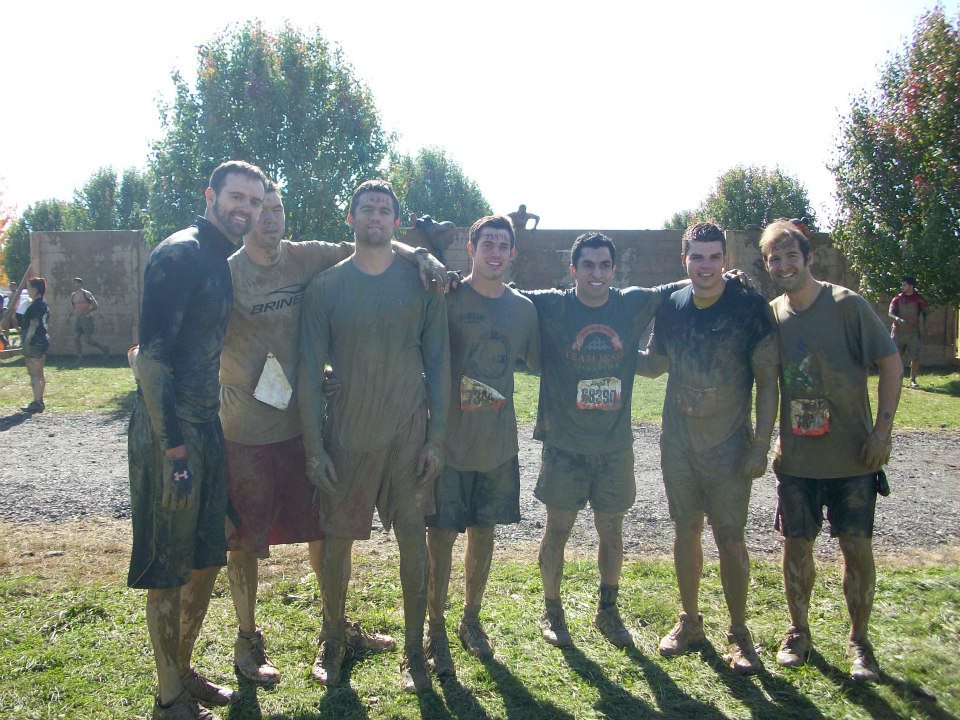
I am a Tough Mudder.

That’s right. This past Saturday I completed the 2012 Tri-State Tough Mudder event at Raceway Park in Englishtown, New Jersey.

For those not familiar with Tough Mudder, I’ll let them tell you what they’re about (from their website):

Tough Mudder events are hardcore 10-12 mile obstacle courses designed by British Special Forces to test your all around strength, stamina, mental grit, and camaraderie. As the leading company in the booming obstacle course industry, Tough Mudder has already challenged half a million inspiring participants worldwide and raised more than $3 million dollars for the Wounded Warrior Project. But Tough Mudder is more than an event, it’s a way of thinking. By running a Tough Mudder challenge, you’ll unlock a true sense of accomplishment, have a great time, and discover a camaraderie with your fellow participants that’s experienced all too rarely these days.

I got the idea to run the event from my friend Mike, who was looking for a new physical challenge beyond his normal gym routine. He recruited me and eight others, and we had our squad.

I’m running the New York City Marathon in two weeks, so my first priority was surviving the course without a major injury that might jeopardize my marathon hopes. I’m happy to report that I completed the course relatively unscathed apart from a few knee scrapes.

Tough Mudder prides itself on its badassness. Its branding is all about being a counter-culture event, more exciting and physically demanding than distance running. In fact, here are Tough Mudder’s thoughts on marathons:

Marathon running is boring. And the only thing more boring than doing a marathon is watching a marathon. Road-running may give you a healthy set of lungs, but will leave you with as much upper body strength as Keira Knightley. At Tough Mudder, we want to test your all-around mettle, not just your ability to run in a straight line, on your own, for hours on end, getting bored out of your mind. Our obstacle courses are designed by British Special Forces to test you in every way and are meant only for truly exceptional all-around people, not for people who have enough time and money to train their knees to run 26 miles.

Well, having completed my first Tough Mudder, I can say that any of my longer training runs (13+ miles) have been physically tougher. (I can neither confirm nor deny whether I have a stronger upper body than Keira Knightley.) Still, if it takes that sort of in your face rhetoric to drum up business, I can’t fault them for it–besides, it seems to be working.

Rather than taking you step-by-step through the event, here are some of my thoughts from the day:

Smells like team spirit. Tough Mudder is incredibly rah-rah, meaning it’s a lot of pump-me-up, Jock Jams kind of stuff–which I’m not a big fan of. Before we could begin the event, our emcee did a 20-minute spiel that included many a “hoo-rah.” I just wanted to start the race.

Once I got past all the hootin’ and hollerin’ and hit the course running, I realized that the spirit of the event is genuine. Anyone who needed a push, whether it was over a wall, through a tunnel, or up a muddy hill, got one. And there always seemed to be someone standing on the other side with an outstretched hand to pull you through. It was very cool to see that sort of teamwork from people who didn’t know each other.

During one of the mud hill climbs, a team of men wearing blue shirts with the Wounded Warrior logo formed a line and set up a pulley system with rope. It appeared that they were clearing space so that only they could use the rope. Several among us started to question them–it seemed against the spirit of the event that they brought a rope but were only allowing their own group to use it. However that notion quickly vanished when we realized that they were clearing space to haul a man in a wheelchair–an actual Wounded Warrior–up the hill. As we all started to realize what was happening and the crowd broke out into hearty applause.

One of many Tough Mudder walls that needed climbing. (Photo credit: Linda Germann)

Yeah, no…we get it…it’s very muddy. The majority of the obstacles involved athletics running through, being submerged in, or slipping in mud or muddy water. While I fully understand that the event is called Tough Mudder, the amount of mud on the course seemed borderline gimmicky. Nevertheless most of the obstacles were challenging. Here are my favorites:

  • Arctic Enema: The very first obstacle, it’s nothing more than a plunge into ice water. We got lucky with gorgeous weather so hypothermia wasn’t an issue, but this would have been much tougher on a cold day.
  • Funky Monkey: Monkey bars are set up over some muddy water. The bars are spaced far apart and slippery with mud. The first half of the bars inclined, and the second half declined. Despite my lack of height, I managed to get across.
  • Hangin’ Tough: Five hanging gymnastics rings are set up, you guessed it, over muddy water. I was happy to have completed this one without the entire contraption falling on me–as we waited in line for our group’s turn, we noticed repairmen fixing a few of the rings with duct tape.
  • Twinkle Toes: The goal here is to walk across a thin wooden beam, else you fall into muddy wa…you get the point. I nailed it, Gabby Douglas style.
  • Everest: The final hurdle before tasting sweet victory (and a free pint of Dos Equis), you must take a running start and run as far as you can up a half pipe, and either grab the top of the wall or catch a fellow Mudder’s outstretched hand to pull yourself over. My teammates were standing by and, with their help, I got up on the first try.

Who the hell would pay $100 to run in mud for four hours? Though most participants seemed reasonably fit, you need not be physically elite to complete the course. Tough Mudder hits you over the head about it being a teamwork event, not a race to the finish. Conquering all the course’s obstacles isn’t mandatory, but I didn’t see too many people who didn’t at least attempt an obstacle before deciding to skip it.

It was great to see so many women participating–I’d guess it was about 20% female–and all the ones I saw handled the course as well or better than their male counterparts. There was no, “Let me help you with that, sweetie” stuff either. On the Tough Mudder course, everyone is treated as an equal. (According to Tough Mudder’s site, 25% of registrants are female.)

Many people wore costumes while running the event. I don’t know if it had to do with Halloween or just because. I saw a couple of princesses, a guy in an ape mask, and four dudes wearing nothing but leopard print thongs. In hindsight, as I’m still figuring out how to de-muddify my own clothes from that day, the thong guys might have had the smartest outfit of all.

Did I mention it was muddy? (Photo credit: Linda Germann)

A few gripes. I’d be remiss if I didn’t point out the few negatives of what was largely a really positive experience:

  • Wait times for baggage were very long and didn’t seem particularly organized.
  • The “showers” were literally garden hoses with no hot water and no water pressure. (In fairness, I didn’t think they’d even have showers, so I can’t complain that they at least had something to wash off the caked mud and allow me to be semi-comfortable on my way home.)
  • The parking lots were 40 minutes from the site of the event by shuttle bus, which is a long way after a four-hour race.
  • They nickel-and-dimed participants, charging $10 for parking if your car didn’t contain at least four people; and spectators were charged $20 to watch the event (or $40 if they hadn’t bought their tickets in advance).

I’ve participated in a lot of running events, many in Central Park through New York Road Runners, and save for the above points, I thought that overall, Tough Mudder, was pretty well run. Tip: If you decide to do the event, sign up as early as possible–it’s $95 for early entry and the price increases as you get closer to the event. I can’t say for sure whether I’ll do the event again, but I feel like I got my money’s worth.

Read Full Post »

This past Saturday night, New York City let me down. I’ll explain.

My fiancée and I scored great tickets–Row A of the Loge section–for my favorite band, Death Cab For Cutie, at the Beacon Theatre on Manhattan’s Upper West Side. We’ve seen Death Cab once before, last summer at the Williamsburg Waterfront in Brooklyn. It was one of the best concerts either of us had ever been to. At that show, an outdoor concert, there were no seats; everyone stood and faced the stage, free to move about the giant lawn to dance, sway, or buy another beer, as the Manhattan skyline loomed at our backs. No one was fighting or jockeying for position; when people bumped  into you, they apologized.

Fast forward to Saturday night at the Beacon. The venue is beautiful inside–it reminded me of an opera house–and seemed fitting for Death Cab’s three performances over the weekend, which included an eight-piece orchestra accompanying their four usual band members.

The crowd seemed a little subdued. From our seats in Loge, one level above the Orchestra section, we could see a few heads bobbing but no one was standing up or dancing in their seats. But by the middle of the set, a few brave souls decided to stand, swaying and singing along. And by the time the set was over, everyone in the Orchestra was on their feet. (There had been tickets available in Orchestra, but I thought the first row of Loge would be a better value than the back of the Orchestra. I was incorrect.)

Meanwhile in our section no one was standing, save for a couple of energetic people next to us. When Death Cab came out for their encore, which is usually five or six more songs, my fiancée and I decided to stand up in our seats as the Orchestra fans were doing below us. That’s when we heard the people behind us. “Sit down please. Sit down please!”

We turned to address the angry couple behind us. “Are you kidding me?” I said. “This is a concert. It’s the encore! You could stand, too.” The male half of the couple said, “If we stand then the people behind us are going to hassle us.” Still incredulous, I implored them. “But it’s a concert!”

Then I got a response from the guy’s girlfriend that floored me: “This is the Beacon. If you want to stand, go to Brooklyn.”

Furious and frustrated (and a little confused by what the hell that even meant), we took to the aisle to stand, staying out of everyone’s way and hoping to enjoy the rest of the show. Within seconds, security ushered us right back to our seats, which meant we had two options: 1) stand and deal with the lames behind us for five more songs, or 2) give in and sit, and try to enjoy the rest of the concert on our butts. We opted for #2; as much as I enjoy arguing with strangers, I paid good money for Death Cab and they were my priority.

When Death Cab left the stage, my fiancée immediately turned back to our buddies behind us for a parting shot–but they were gone. While we were staying seated for their benefit (and to avoid the headache they were giving us) they had snuck out before the last note in an effort to avoid a confrontation. We couldn’t help feel a little disappointed–we were  hoping to get further explanation on the Brooklyn comment…

As I write this now, a day later, I’m still stunned. I don’t even know where to begin. Much has been made the last few days about fan etiquette after an incident at a Rangers-Yankees baseball game. And I’ve written before about fan behavior and  etiquette at the U.S Open. Part of going out to live sports or music event means dealing with people, many of whom have different opinions and habits than your own. But I’ve been to enough concerts to know that unless you’re at the opera (or possibly seeing the Beach Boys at Jones Beach), people are going to stand up to engage with the performance on stage. To look behind me and see 20 rows of people not standing–and yelling at us when we did–was and still is mind-boggling.

I don’t often ask for reader feedback on this blog, but I’m dying to know what you think. To sit or stand, that is the question!

UPDATE (11/7/12): I posed the question–sit or stand?–to the New York Times’ new The Ethicist columnist Chuck Klosterman. He settled the debate, kind of.

Read Full Post »

This morning I found myself in the unenviable position of buying a Metrocard (NYC’s public transportation currency) during the morning rush hour. But to my delight I found one short line of about four or five people waiting for the next available of the three (working) machines at the 77th st. 6-train station. (This, rather than the typical three lines, where one is very fast, one is very slow, and I’m forced to play Metrocard machine Russian Roulette, which I usually lose.)

But as I got to the second position on the line, a woman approached the front and said, “Why aren’t there three lines? This makes NO SENSE,” clearly laying the groundwork for an attempt to cut those of us ahead of her in line by starting another one behind the left or right machines.

I decided I had to defend the one-line system and so I spoke up. “Actually, it DOES make sense because whoever’s here first gets the next open machine.” She huffed and walked to the back of the line.

While misguided, this woman at least recognized the opportunity to expose what she perceived to be an inefficiency in the system to anyone within earshot. But for many of the complainers among us, this is as far as we’ll go when it comes to making our voices heard.

Also this morning, I came across this USA Today article, which suggests that not everyone feels that they necessarily want a say in how their public transportation provider or favorite restaurant or mechanic treats its customers. From the article:

Surely, it’s nice to be courted for input, at least sometimes. But some consumers say they’re fed up with giving time-consuming feedback for free, don’t like being drawn into a data web used to evaluate employees or feel companies don’t act on the advice they get. Others say they simply don’t have anything revelatory to impart about, say, ordering a shirt or buying a package of pens.

Anyone who’s read my blog before knows I’m incredibly sensitive to how I’m treated as a customer, both positively and negatively, and so I was surprised to learn that some people would rather forfeit their chance to share their opinion in exchange for just being left alone.

Sure, there are plenty of reasons why we might choose to take or not take a survey. For example, it’s more likely that you’ll fill out a survey or write a review if you’ve had a bad experience versus a good one. You’re also more likely to do it if you’re incentivized with a few bucks, a chance to win a sweepstakes, or some other prize or coupon. (Buffalo Wild Wings offers up free wings for completing a customer service survey.)

I flew Delta over the weekend and was delayed two hours on the way out and another hour on the way back when our arrival gate wasn’t ready and we were forced to deplane in some sort of temporary airplane parking space and take a “people mover” (i.e. a bus), then wait 20 minutes for our luggage.

Having dealt with airlines for many years and understanding how poor that industry is when it comes to customer service (I dare you to debate me on that) I knew my complaints would likely fall on deaf ears and I’d be cast as yet another cranky, disgruntled customer looking for a handout. So I put it behind me, chalking the experience up to a built-in hassle that comes with air travel.

But when I returned from my trip, I had an email from Delta waiting for me, asking me to rate my experience as it related to my delayed flight. They were reaching out to ask for my opinion, and about a negative issue no less.

Though the questions in the survey were mostly meaningless to me and not necessarily actionable for Delta (“Did airline staff alert you in a timely fashion about your delayed flight?”), they did include a comment box so I could elaborate on my issue, which I did.

I still have very little confidence that my complaints to Delta will do anything to reduce future delays in and out of JFK Airport, but at least I feel like they’re trying and I don’t take that for granted.

In the meantime, I’ll hold my breath and wait for the MTA to contact me about whether I prefer a one- or three-line system at the Metrocard machines.

Read Full Post »

I read a story in Harvard Business Review this week about Patagonia’s “Buy Less” campaign, in which the outdoor apparel brand is actually encouraging customers to cut down on their purchasing of Patagonia products. HBR explains:

To put its buy-less idea into action, Patagonia recently partnered with eBay to enable consumers to resell their used Patagonia apparel via the Common Threads Initiative within eBay. In addition, consumers will now be able to resell their used Patagonia apparel on a new Used Clothing & Gear section on Patagonia’s website. The company wants to influence consumer buying behavior as part of its corporate mission. Patagonia (and other sustainability pundits) views individuals’ consumption as a considerable drain on natural resources. And with the global population forecast to swell to over 9 billion by 2050, left unchecked, this drain will become significant.

HBR’s story tries to determine whether this initiative, which it calls “genuine and borderline heroic,” will ultimately increase Patagonia’s revenue. But I’m more interested in how an idea like this affects the customer. When I read about the “Buy Less” campaign, I thought of an old Chris Rock bit:

“The government curing AIDS? That’s like Cadillac making a car that last for fifty years… and you know they can do it! But they ain’t gonna do something that fucking dumb! Shit! They got metal on the space shuttle that can go around the moon and withstand temperatures up to 20,000 degrees. You mean to tell me you don’t think they can make an El Dorado where the fucking bumper don’t fall off?”

If a company makes a product that lasts too long, it’ll be a while before they’ll see any repeat business.

In 2009 I was in the market for a new PC. My Dell Dimension, which I’d received as a Christmas present in 2000, was on its last leg. I consulted my tech-savvy friend Gil about which brands other than Dell I should consider. I was really down on Dell after some poor customer service experiences and was ready for a change. But then Gil made a good point. “You know,” he said, “your last Dell computer lasted you nine years.”

And he was absolutely right. Sure, it took some of Gil’s magic to extend its life—cleaning out viruses more than once, adding new virus protection, and installing new memory—but a nine-year shelf life for a PC is unheard of. Not long after that conversation, I bought another Dell. (FYI I still think the customer service stinks, but the computer works fine.)

But if I called the CEO of Dell and told him that story, he might not be thrilled. After all, between 2001 and 2008, I didn’t buy a single Dell product.

Now imagine if Dell called me up in 2002 and said, “Mr. Calise, our records show your Dell Dimension is two years old. We’d like to buy it back from you. Oh and by the way, Dell now has several new PC models you may be interested in if you’re looking to upgrade.” Well, that seems to be the direction Patagonia (with the help of eBay) is headed in:

It sounds strange to say that encouraging customers to buy less new apparel could actually lead to increased sales volume for Patagonia. Yet this scenario is possible. Two types of customers could be more inclined to buy new Patagonia apparel as a result of Patagonia’s efforts: customers who make decisions based on sustainability considerations and customers who can now sell their used Patagonia apparel for cash to buy new apparel. Indeed, John Donahue, the CEO of Patagonia’s new business partner, eBay, suggested this might be possible: “Patagonia is extending its customer base and increasing it. People who are selling it are likely to turn around, take the money they got, and buy the new Patagonia products.”

For the record, I’ve never bought or owned a Patagonia product. But by encouraging me to Buy Less, Patagonia might actually persuade me to Buy More.

Read Full Post »

A few weeks ago on this blog I said farewell to Entourage, a show that while in its prime, reached a generation of 20- and 30-something guys who could escape their real life problems for 23 minutes at a time to live vicariously through the boys from Queens.

Meanwhile, I belatedly discovered (courtesy of HBO on Demand) a very Entourage-like show, How to Make It in America, which premiered in February 2010 and made its season 2 debut last night.

In season 1, Ben and Cam, two late 20s underachieving wannabe entrepreneurs, haven’t yet found the financial success they crave. Either for lack of ambition, know-how, or follow through, they seem to stall at every turn. The polar opposite of Vinny Chase and his pals, for whom everything seemed to go right, nothing works out for Ben and Cam.

When Entourage debuted in 2004, the pilot opened with Vince at a premiere for his first starring role in a fictitious feature film, Head On, co-starring Jessica Alba. So when we meet Vince for the first time, he is already a star. The rest of the episode focused on choosing his next multi-million dollar script and whether he should attend his 10-year high school reunion.

But when we meet Ben and Cam, they’re still smarting from a skateboard business venture gone bad which has resulted in some money trouble. Rather than getting the “how to” manual implicit in the show’s title, we’re not really sure if things will work out for Ben and Cam. We have to keep watching.

Eventually, if Ben and Cam do Make It in America, loyal viewers like myself will probably complain that they’ve become too successful and that the show was more entertaining when they were struggling.

But for now, I’m rooting for them.

Read Full Post »

As I stay in on a Friday night watching Yankees-Tigers Game 1 Karate Kid Part II to get mentally prepared for my half marathon tomorrow morning, I have a built in excuse to blog for the first time in almost two weeks. Here goes.

When I studied abroad in England in the fall of 2002, I expected to make tons of friends and future pen pals with some native Brits. Instead, though, our group of friends–American students from New York, Florida, Connecticut, and Massachusetts–spent every day and night hanging out together and seldom interacting with the English. Granted, we had a great time, but I no longer speak to any of them and I regret it a little that I didn’t do a better job immersing myself in European culture. And speaking of European culture…

Jersey Shore
When I first heard Jersey Shore was doing a season in Italy, I thought, “Wow, that Sallyann Salsano has done it again!” The gang brings their shenanigans to Italy and mix it up with the locals? Awesome, right?

Turns out, not that awesome.

Apart from Deena’s mini hook-up with a waiter named Ellis (and seriously, an Italian-born Italian named Ellis?), the roommates have pretty much kept to themselves. Even Situation’s situation finds him caught up with an American blonde stalker named Brittany.

The failure to assimilate themselves into Italian culture came to a head last night when Snooki declared it a Karma night in the house, where everyone would dress up, drink and dance like they were back in Jersey, with Pauly D supplying the music because he brought his DJ equipment (i.e his laptop). I guess I set my expectations for this season a little high. I’ll need to re-calibrate them for the home stretch.

Undercover Boss
I caught my first episode of Undercover Boss last night (I was still reeling from Jersey Shore, but UB broke my fall). I am way late on this one, since it apparently premiered in February 2010. But I’m hooked.

Is UB a little gimmicky? Sure. Is it basically free advertising and completely self-serving for the companies whose bosses go undercover? Sure. But it’s actually pretty watchable. (This is a massive understatement. I said, “I love this show!” to my girlfriend at least five times during the hour-long episode. Eyes were rolled.)

In this particular episode, the CEO of 7-Eleven goes undercover for a week: he works clerk shifts at three store locations across the country; he helps make donuts in a factory; and he rides shotgun with a delivery truck driver. He sees lots of good stuff (friendly, generous, and dedicated employees) and some bad (employees throwing out tons of unsold food that’s supposed to be earmarked for food banks), and takes his learnings back to HQ in Dallas, summoning his “bosses” from the previous week to Texas for the big reveal: the man they knew as a curious new employee was actually their boss!!! OH SNAP.

At this point, it got a little Wizard of Oz-ish. So enriched by his experiences, the CEO rewards his employees based on their needs: the older female store manager on dialysis gets an organ donation awareness program set up in her name; the young Pakistani store manager/criminal justice student is offered a call-me-any-time offer for mentorship from the CEO; the happy truck driver gets a resort vacation with his wife who he never spends time with because of his graveyard shifts; and the donut-maker (who’s also an amateur artist) gets hooked up with 7-Eleven’s marketing department to do some freelance artwork.

Bottom line: When I’m a boss some day, you can bet I will find some way to go undercover. Hopefully the show is still on the air at that point.

The Kindle Might Be Worth It After All
A while back I wrote that I didn’t think the Kindle was worth its price tag, and a big part of my reasoning was that ebooks at my public library weren’t compatible with the Kindle. Well, now they are.

Today I successfully and easily downloaded my first library ebook from the New York Public Library, The Thank You Economy by Gary Vaynerchuk. I’m very excited to read it.

As demand for ebooks starts to outpace libraries’ supply, we’ll likely see the same backlog many now have for print books. But I trust the 14 to 23 people who read my blog will keep this our little secret, at least for the time being.

Zappos Pays Employees 3 Grand–to Quit
Apparently this policy has been in place for a few years, but I just became aware of it this week after listening to a Freakonomics podcast. In an effort to weed out employees who are “only in it for the paycheck,” Zappos offers its new hires increasing monetary incentives to walk away from the company.

There are plenty of reasons why this won’t work at many (or most) companies, but Zappos’ approach is progressive, and it reminds me of a scene from one of my all-time favorite movies, A Bronx Tale.

Teenager Cologero is chasing a guy who owes him $20. Sonny, his role model and neighborhood mafia boss, stops him and explains:

“You don’t even like him. There’s your answer right there. Look at it this way, it cost you twenty dollars to get rid of him. Right? He’s never gonna bother you again. He’s never gonna ask you for money again. He’s out of your life for 20 dollars. You got off cheap. Fughgeddaboutit.”

Zappos isn’t getting off quite as cheap as Cologero did, but for a relatively small sum (to them), they can say fughgeddaboutit to any jerk who’s just working there for a paycheck–I mean, the nerve!

Read Full Post »

Recently, I’d been itching to get down to Atlantic City. I hadn’t been there in a while, plus I’ve been watching a lot of Boardwalk Empire lately. It was time to visit my old friend again.

So, using an amNY daily deal, three coworkers and I took the Hampton Luxury Liner bus down to Atlantic City for the day this past Saturday.

For $7, the deal included a round trip ride to Atlantic City–normally $25 on Hampton Luxury Liner–and $10 food and $5 slots vouchers for the Resorts casino. (I ambitiously bought three thinking I’d make multiple trips, and since the remaining two will expire at the end of the month, I’ll have paid $21 for this $7 deal.)

Cheap round trip bus rides are nothing new for Atlantic City casinos. Long before Groupon or LivingSocial, casinos figured out that if they subsidized the cost of a customer’s bus ticket to AC, they’d easily make it back on the tables.

One of the challenges of gambling in AC on the weekends is the higher table minimums. Blackjack generally has the best odds of any table game, but if you only have $100 to spend and you’re playing at a $10 minimum bet table, you don’t have much margin for error. If you are lucky enough to find a $5 table and sit down with that same $100, you might have enough money to stick around and survive a few losing hands until you find yourself on a “heater.”

So when I spotted two $1 minimum blackjack tables at the Trump Taj Mahal, I sat down immediately. I had never seen a blackjack table with such low limits outside of Las Vegas, and I figured there must be a catch. And there was.

The $1 blackjack tables were charging a “hand fee” of 25 cents per hand for any bet under $10. Meaning, if I played 50 hands an hour (and didn’t bet at least $10 on any of them), the casino would get $12.50 even if I broke even. Despite a few bad beats and many questionable decisions from the really nice but inexperienced gamblers playing beside me,  I walked away with $110–a net profit of just $10 after hand fees and tips for the waitresses and dealers. The casino’s profit (even though I won) was $2.50.

Experienced gamblers will warn you about all the “sucker bets” the casinos build into their games to win even when they lose. This includes the “Insurance” bet at the blackjack table, where you’re given the option of insuring your bet against the dealer’s possible blackjack, or accepting a smaller payout for blackjacks at a “Single Deck” table (they pay 6-to-5 instead of the usual 3-to-2). In my excitement over finding a low stakes table on a weekend, I failed to identify the 25-cent hand fee as yet another obvious sucker bet.

Clearly, the $1 blackjack tables were designed to attract the low stakes gamblers who didn’t really know how to play the game to their best advantage. Even as I, a more experienced blackjack player, used by-the-book basic strategy, I barely managed to turn a profit. The other guys at the table, a bachelor party from Virginia, walked away one by one having lost all the money they had started with. (Mind you, none of them lost no more than $30, which was basically their “casino fee” for being able to sit around with their friends and ironically drink White Russians.)

As for me, by the time we returned home to New York my wallet was only $60 lighter than it had been when I stepped onto the bus that morning, and I’d been able to gamble, eat, and drink all day. Considering my history with AC, I’d call that a win.

Read Full Post »

« Newer Posts - Older Posts »